Planning commission reviews broad package to streamline single‑family design review
December 04, 2025 | Santa Barbara City, Santa Barbara County, California
This article was created by AI summarizing key points discussed. AI makes mistakes, so for full details and context, please refer to the video of the full meeting. Please report any errors so we can fix them. Report an error »
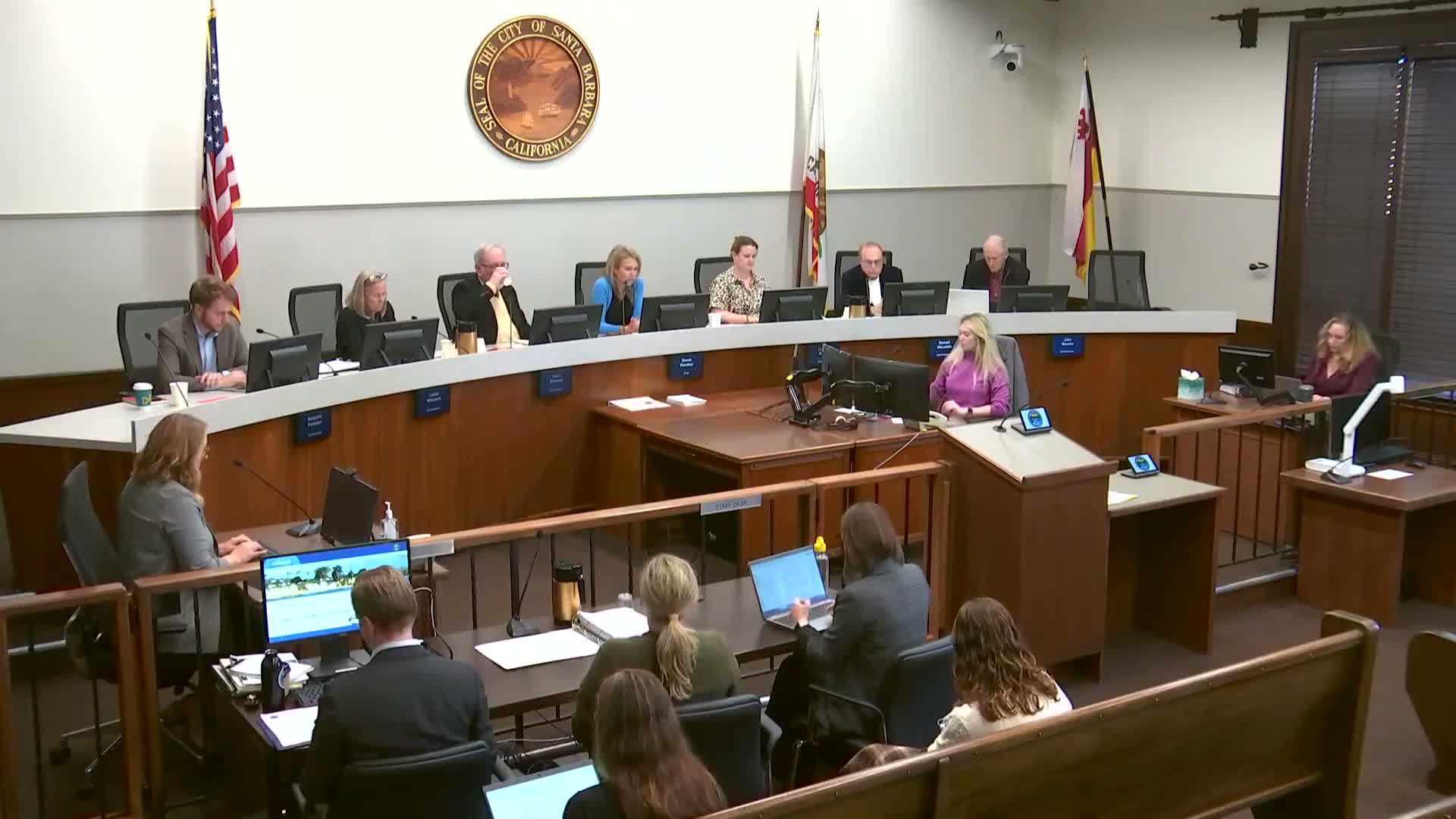
City planning staff, led by city planner Ellen Kokinda and acting design review supervisor Ted Hamilton Rolle, framed the package as a response to community feedback and a 2020 Novak Consulting Group report that recommended simplifying the permit process. Rolle said the proposals are intended to preserve aesthetic oversight while removing redundant review steps for projects that do not change a home’s massing or floor area.
The draft changes would exempt exterior alterations that add no new floor area and that either visually match existing development or produce a cohesive design. Staff estimated—conservatively—that the amendments would reduce the number of SFDB projects by at least 21% based on a three‑year review of 440 projects; staff said the actual reduction could be higher.
Key changes in the draft include raising several administrative approval thresholds and aligning mailed‑notice triggers so more projects can be approved by staff rather than at hearings. Examples staff identified: administrative approval for first‑story accessory buildings and additions would increase from 500 to 800 square feet, second‑story administrative approvals would increase from 150 to 250 square feet, and notice thresholds for mailed public notice would be adjusted to match those administrative limits. Deck standards would allow one exempt deck per façade up to 16 by 10 feet; larger decks could be eligible for administrative approval under defined criteria.
The package would also: remove the requirement that parking spaces be covered, allow guest houses (limited accessory buildings for nonpaying guests or employees) up to the code‑specified size, simplify open‑yard requirements for smaller lots (reducing the open‑yard minimum to 800 square feet for lots 6,000 square feet and under and changing minimum dimensions from 20x20 to 20x15 feet), and add upper‑story window privacy standards (minimum sill height or orientation) to limit direct views into neighboring yards.
Rolle described a procedural change that would consolidate the SFDB’s two hearings—project design approval and final approval—into one project design approval. Final conformity checks would move to the building‑permit phase where staff could administratively confirm substantial conformance or refer a plan back to SFDB. Under the proposal, staff said final approvals would be appealable only by the project applicant; project design approval would remain appealable by any interested party. Rolle said the change is intended to reduce redundant appeal points and to comply with the state Housing Crisis Act’s limit on review stages for housing projects.
To limit post‑approval drift, the draft introduces seven objective "substantial conformance" criteria that staff said would trigger referral back to the board for a revised project design approval when plans diverge materially from what was approved.
Public comment was split. Local resident Derek Booth urged the commission to preserve the SFDB’s original purpose of protecting neighborhood character and warned that treating applicants as clients could weaken neighborhood protections. "If you do nothing else…please encourage the council to remind the single family design board of their original purpose…to stiffen their spine and just to say no in the face of clear transgressions to our city's design guidelines," Booth said. Representatives of the American Institute of Architects and an architect who testified remotely said they support the direction of the reforms while asking staff to tighten ambiguous language on required application submittals and to commit to ongoing review after implementation.
Commissioners questioned staff at length about details including whether the city employs an on‑staff architect for design review (staff said a city architect exists in Public Works for capital projects but not within Community Development), the rationale for numerical thresholds (staff said thresholds reflect past administrative approvals and state ADU limits), how FAR (floor‑area ratio) and the "20 closest lots" study are used as tools in size and scale evaluations, and the expected staff time and fee implications. Staff said two planning staff currently support SFDB agendas full time and that a fee study is scheduled for 2026 to better quantify processing costs.
Staff emphasized implementation safeguards: objective substantial‑conformance criteria, the ability to refer nonconforming building‑permit plans back to SFDB, and training for SFDB members and staff. Rolle said staff anticipates returning to the planning commission in early January for a formal recommendation to city council, followed by ordinance committee and city council hearings in the spring; ordinance changes would require a 20‑day public notice period before adoption.
Because the item was agendized as discussion only, the commission did not take action on the ordinance text at the Dec. 4 meeting. Commissioners generally praised the work and offered targeted edits—requesting clearer language where staff used "may" or "may be requested," a definition of "public views," a codified minimum period to post story poles for visibility studies, and an annual or periodic implementation review to assess whether the streamlining yields the intended permit efficiencies without undermining neighborhood protections.
Following the commission’s feedback, staff said they will update the draft guidelines and code sections and return for formal action in early January.
Don't Miss a Word: See the Full Meeting!
Go beyond summaries. Unlock every video, transcript, and key insight with a Founder Membership.
30-day money-back guarantee
Sponsors
Proudly supported by sponsors who keep California articles free in 2025

