Needham proposes emergency culvert replacement to reduce repeated flooding; neighbors raise concerns about construction impacts
December 04, 2025 | Town of Needham, Norfolk County, Massachusetts
This article was created by AI summarizing key points discussed. AI makes mistakes, so for full details and context, please refer to the video of the full meeting. Please report any errors so we can fix them. Report an error »
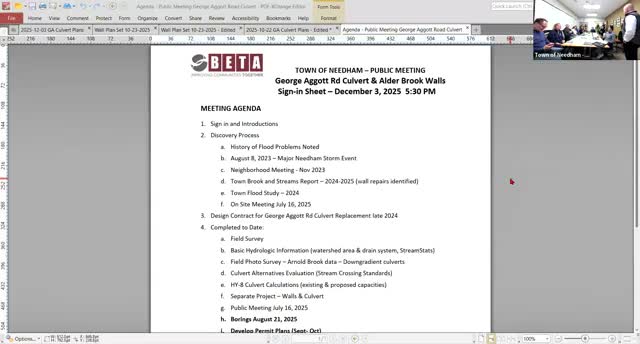
The proposal calls for a precast concrete box culvert roughly 6 feet wide inside and about 7 feet tall, with 2 feet of bedding material to mimic a stream bed. "We're proposing a culvert that has 3 times the capacity of this current proposal," Paradis said, adding that the new structure is intended to prevent frequent road overtopping at this location. Engineers said the work will include widening and rebuilding headwalls and replacing existing unstable stone walls with gravity walls built on wider bases.
The project will require heavy excavation and equipment. Engineers described excavation of roughly 11–12 feet and a work zone about 10 feet wide through the immediate area, the use of cranes and large trucks, and the likely need to remove several large trees. Utilities in the road will be protected or relaid where necessary: the sewer will be sleeved and encased in concrete, and a water line that currently crosses the site will be routed underneath the new structure and protected. Staff said the town will require contract specifications and restoration requirements and will include warranty plantings where feasible.
Residents questioned how construction would be staged and how nearby properties would be protected. "There's holes in it," Mike Retsky said of the existing metal pipes, warning that "when they do that, then everything becomes an emergency," underscoring town urgency to act. Attendees raised repeated concerns about vibration from driving sheet piling, dewatering and groundwater movement, driveway and garage access during construction, and the loss of large trees and mature shrubs. Engineers said electronic seismic sensors and vibration monitoring would be installed for pre- and post-construction surveys at the four immediately adjacent houses; staff agreed to ask geotechnical consultants whether monitoring should be expanded to additional houses within the buffer zone.
On hydraulic questions, staff acknowledged this phase did not include a full watershed hydraulic model for the entire basin. They said the box culvert is designed to reduce turbulence and increase conveyance at the site, but that upstream and watershed-scale projects (roughly 38–40 projects identified in the town flood study) — including large subsurface infiltration or storage systems at places such as Fazio Field and work near Pollard School and Chestnut Street — will be modeled and phased later to address any broader flow shifts. Town staff said those upstream measures and state/regulatory phosphorus treatment requirements are being coordinated as part of a longer program to reduce both quantity and pollution.
Staff described the permit and procurement sequence: the engineering team will file a Notice of Intent (NOI) with the Conservation Commission (abutters within 300 feet will be notified) and the commission will hold a public hearing, possibly more than one, before issuing an order of conditions. After an order of conditions is issued the town will finalize bid documents and solicit contractors; staff stated funding must be authorized through town appropriation processes (Town Meeting) and that work would not commence until funding and approvals are in place — likely with a contractor selected in the spring and construction starting no earlier than July, depending on funding, material lead times, and contractor means-and-methods.
Engineers said the contract will include requirements for restoration and warranty plantings if transplanted vegetation fails; Scott Ritter, the landscape architect on the call, said moving very large rhododendrons is difficult and that planting container-grown large specimens may be the more reliable restoration approach. Staff said temporary parking and staging arrangements would be coordinated with affected homeowners and that water bypasses (temporary service interruptions) would be scheduled with advance notice (the team cites roughly a 72-hour notice window as typical).
Cost and schedule figures discussed at the meeting included an approximate construction cost presented at about $2.02 million for this site, and staff estimated upstream storage and treatment projects could come in a multi-year sequence (staff mentioned a roughly three-year window for some upstream holding-tank projects). There were no formal votes at the meeting; staff emphasized the project is proceeding through permitting and public hearings and that the town will hold additional site meetings with a selected contractor to clarify schedule and means-and-methods before major work begins.
Next steps: staff will file the NOI with the Conservation Commission, post plans and supporting documents online when the review is complete, and schedule follow-up public/reconstruction meetings with the contractor and abutters to finalize staging, monitoring and mitigation details. Residents were advised to contact the assigned project engineer for updates and to follow the Conservation Commission hearing schedule for opportunities to comment.
View the Full Meeting & All Its Details
This article offers just a summary. Unlock complete video, transcripts, and insights as a Founder Member.
30-day money-back guarantee
Sponsors
Proudly supported by sponsors who keep Massachusetts articles free in 2025

