Select Board keeps residential tax exemption at 25% and 1.7 shift after public hearing
December 04, 2025 | Nantucket County, Massachusetts
This article was created by AI summarizing key points discussed. AI makes mistakes, so for full details and context, please refer to the video of the full meeting. Please report any errors so we can fix them. Report an error »
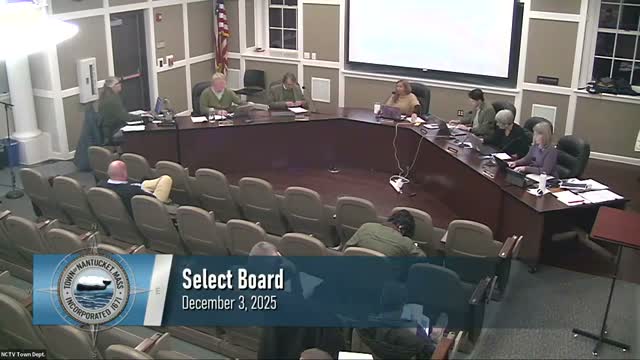
Rob Ranney, the town assessor, explained how the residential exemption works under Massachusetts General Laws (Chapter 59, Section 5C) and showed examples of a 25% to 50% exemption'scale. "The residential class was paying 93% prior to the shift," Ranney said while explaining historical percentages and the mechanics of the exemption. He also presented sample impacts at 25%, 30%, 35% and 50% and showed that larger exemptions raise the net tax rate because exempted value is removed from the base used to calculate the rate.
Public commenters and board members debated whether to inch the exemption up (several board members and residents suggested 27.5'30%), citing rising assessed values and housing-affordability concerns for year-round homeowners. Opponents emphasized the cumulative burden of large capital projects coming in the next five years — including potential new school and coastal-resiliency work — and warned the town should not reduce its fiscal capacity ahead of those votes.
After the discussion the board made a single motion to retain the prior scheme: a 25% exemption with a 1.7 commercial shift. The motion carried unanimously.
Board members scheduled a more detailed community forum in spring to examine exemption trade-offs, distributional effects, and how different exemption levels would interact with known capital projects.
The Select Board's action sets the residential exemption, which Ranney said would be worth roughly $899,000 under current values under a 25% exemption with a 1.7 shift, and keeps the commercial rate and levy splits at the distribution modeled in the assessor's presentation.
View the Full Meeting & All Its Details
This article offers just a summary. Unlock complete video, transcripts, and insights as a Founder Member.
30-day money-back guarantee
Sponsors
Proudly supported by sponsors who keep Massachusetts articles free in 2025

