Churchill County public administrator urges new fund, higher stipend and tighter paperwork for abandoned decedents
December 04, 2025 | Churchill County, Nevada
This article was created by AI summarizing key points discussed. AI makes mistakes, so for full details and context, please refer to the video of the full meeting. Please report any errors so we can fix them. Report an error »
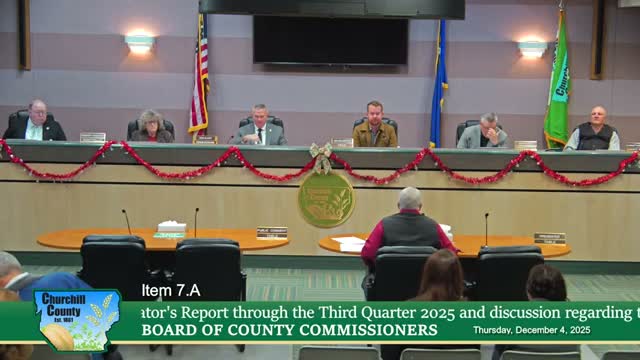
Bob Ghetto, Churchill County public administrator, told the Board of County Commissioners that his office is handling more complex and more numerous estates than when the county adopted its current funding approach and asked the board to consider three budget changes to address unrecovered expenses.
Ghetto, who said he has served in the office for about 10 years, described public administration as a constitutional, 24/7 function that steps in when a decedent has no will or no available family and where estates can range “from $0 to millions of dollars.” He said the county currently provides his office a $40,000 annual stipend, but after an internal audit of 23 cases the stipend is running short and sometimes estates yield little or no recoverable funds.
"Sometimes the public administrator might get $40. Sometimes they get $100. Sometimes they get $1,200," Ghetto said, describing the percentage-based compensation model used in Nevada. He told commissioners that paperwork, specialty software, postage for certified mail, towing, storage and vendor fees add up quickly and that pursuing small assets can cost more than the funds recovered.
Ghetto recommended three specific changes: increase the quarterly-paid stipend from $40,000 to $47,616 beginning July 1, 2026; raise the extraordinary-services hourly rate (charged to estates that can pay) from about $70 to roughly $90'92; and establish a separate account with an annual $10,000 allocation, starting Jan. 1, 2026, to pay cremation costs for abandoned decedents so those expenses do not draw on restricted social-services indigent funds.
Shannon Arndt, Churchill County Social Services, told the board that indigent-burial funds are restricted and come from social-services tax revenue under local and federal rules; she described a conflict between the way public-administrator expenses and indigent burial payments are prioritized under different Nevada Revised Statutes. "We are creating and paying from social services for those indigent bodies that he could not collect funds for," Arndt said, adding that Social Services needs the court's final accounting to determine whether cases are truly indigent and eligible for reimbursement.
Representatives of the local mortuary community also addressed the board. "We don't turn anybody down," Ted Williams, managing funeral director for the Gardens Funeral Home, said, describing routine operations to receive decedents, seek authorization for cremation and, if family cannot be located after roughly 30 days, transition a case to indigent status under state rules.
Public commenter Laurie Mokini, a retired county deputy assessor who has worked with Ghetto, praised his work on probates and real-estate matters and urged the board to support his recommendations.
The board approved Ghetto's quarterly report as submitted but explicitly excluded the three budgetary recommendations from that approval. Commissioners and county staff advised that the stipend increase and hourly-rate changes must be agendized as budget items and that the proposed $10,000 fund could be considered through the current-year budget process if the board chooses to act before July 2026.
Ghetto said he will work with staff to place the recommended items on the appropriate budget agenda and to coordinate with the district attorney for statutory interpretation and implementation details. The board did not approve new funds during the meeting.
Ghetto, who said he has served in the office for about 10 years, described public administration as a constitutional, 24/7 function that steps in when a decedent has no will or no available family and where estates can range “from $0 to millions of dollars.” He said the county currently provides his office a $40,000 annual stipend, but after an internal audit of 23 cases the stipend is running short and sometimes estates yield little or no recoverable funds.
"Sometimes the public administrator might get $40. Sometimes they get $100. Sometimes they get $1,200," Ghetto said, describing the percentage-based compensation model used in Nevada. He told commissioners that paperwork, specialty software, postage for certified mail, towing, storage and vendor fees add up quickly and that pursuing small assets can cost more than the funds recovered.
Ghetto recommended three specific changes: increase the quarterly-paid stipend from $40,000 to $47,616 beginning July 1, 2026; raise the extraordinary-services hourly rate (charged to estates that can pay) from about $70 to roughly $90'92; and establish a separate account with an annual $10,000 allocation, starting Jan. 1, 2026, to pay cremation costs for abandoned decedents so those expenses do not draw on restricted social-services indigent funds.
Shannon Arndt, Churchill County Social Services, told the board that indigent-burial funds are restricted and come from social-services tax revenue under local and federal rules; she described a conflict between the way public-administrator expenses and indigent burial payments are prioritized under different Nevada Revised Statutes. "We are creating and paying from social services for those indigent bodies that he could not collect funds for," Arndt said, adding that Social Services needs the court's final accounting to determine whether cases are truly indigent and eligible for reimbursement.
Representatives of the local mortuary community also addressed the board. "We don't turn anybody down," Ted Williams, managing funeral director for the Gardens Funeral Home, said, describing routine operations to receive decedents, seek authorization for cremation and, if family cannot be located after roughly 30 days, transition a case to indigent status under state rules.
Public commenter Laurie Mokini, a retired county deputy assessor who has worked with Ghetto, praised his work on probates and real-estate matters and urged the board to support his recommendations.
The board approved Ghetto's quarterly report as submitted but explicitly excluded the three budgetary recommendations from that approval. Commissioners and county staff advised that the stipend increase and hourly-rate changes must be agendized as budget items and that the proposed $10,000 fund could be considered through the current-year budget process if the board chooses to act before July 2026.
Ghetto said he will work with staff to place the recommended items on the appropriate budget agenda and to coordinate with the district attorney for statutory interpretation and implementation details. The board did not approve new funds during the meeting.
View the Full Meeting & All Its Details
This article offers just a summary. Unlock complete video, transcripts, and insights as a Founder Member.
✓
Watch full, unedited meeting videos
✓
Search every word spoken in unlimited transcripts
✓
AI summaries & real-time alerts (all government levels)
✓
Permanent access to expanding government content
30-day money-back guarantee
