Commissioners table hiring-delay, attrition policy after heated debate over elected officials' authority
December 04, 2025 | Churchill County, Nevada
This article was created by AI summarizing key points discussed. AI makes mistakes, so for full details and context, please refer to the video of the full meeting. Please report any errors so we can fix them. Report an error »
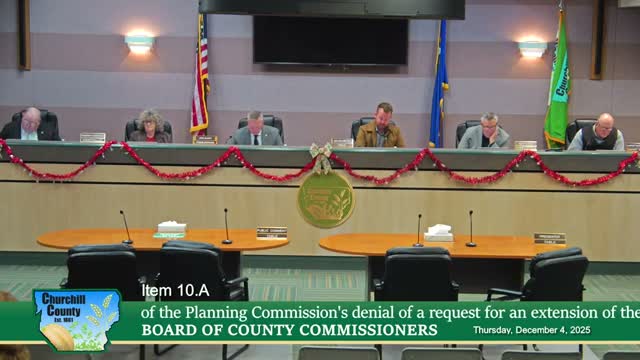
County staff presented proposed updates to Churchill County's hiring delay and attrition policy, originally adopted in 2013, that would require departments to wait (typically 90 days) before posting many vacant positions and would allow the county to pursue attrition savings when replacement alternatives could save the county at least 20%.
Assistant County Manager Joe Sanford said the policy aims to encourage departments to consider options such as job sharing, technological replacement or contracts before filling a vacancy. "The intention behind the policy is to create a method for every department and every elected official to make a consideration when one of the personnel in their department leaves, whether they really need that position or whether there's alternatives that could be a savings to the county," Sanford said.
Several elected officials objected. District Attorney Art Mallory said the policy creates an "intermediary" step where non-elected staff could prevent elected constitutional officers from performing their duties, calling it "offensive" to the system of government and urging commissioners to abolish the policy or limit it to non-elected department heads. Sheriff Richard Hickox said the policy had, in the past, delayed filling deputies and dispatchers, creating overtime burdens and potential public-safety issues.
"If we have to wait 90 days until we can even start to advertise, we're pushing that higher out potentially past the 6 month mark from the time that person leaves," Hickox said, adding that public-safety positions are difficult to recruit and require prompt action.
Other commissioners said county budgets and hiring freezes provide checks and balances and urged further discussion. One commissioner noted the policy had been used previously during economic stress and that other mechanisms (budget approvals, countywide hiring freezes) also exist.
After extended debate, the board voted to table the policy and directed staff to schedule workshops or a town-hall-style discussion with elected officials, department heads and relevant stakeholders (including the county's compensation-study meetings) before bringing a revised proposal back to the board.
Assistant County Manager Joe Sanford said the policy aims to encourage departments to consider options such as job sharing, technological replacement or contracts before filling a vacancy. "The intention behind the policy is to create a method for every department and every elected official to make a consideration when one of the personnel in their department leaves, whether they really need that position or whether there's alternatives that could be a savings to the county," Sanford said.
Several elected officials objected. District Attorney Art Mallory said the policy creates an "intermediary" step where non-elected staff could prevent elected constitutional officers from performing their duties, calling it "offensive" to the system of government and urging commissioners to abolish the policy or limit it to non-elected department heads. Sheriff Richard Hickox said the policy had, in the past, delayed filling deputies and dispatchers, creating overtime burdens and potential public-safety issues.
"If we have to wait 90 days until we can even start to advertise, we're pushing that higher out potentially past the 6 month mark from the time that person leaves," Hickox said, adding that public-safety positions are difficult to recruit and require prompt action.
Other commissioners said county budgets and hiring freezes provide checks and balances and urged further discussion. One commissioner noted the policy had been used previously during economic stress and that other mechanisms (budget approvals, countywide hiring freezes) also exist.
After extended debate, the board voted to table the policy and directed staff to schedule workshops or a town-hall-style discussion with elected officials, department heads and relevant stakeholders (including the county's compensation-study meetings) before bringing a revised proposal back to the board.
View the Full Meeting & All Its Details
This article offers just a summary. Unlock complete video, transcripts, and insights as a Founder Member.
✓
Watch full, unedited meeting videos
✓
Search every word spoken in unlimited transcripts
✓
AI summaries & real-time alerts (all government levels)
✓
Permanent access to expanding government content
30-day money-back guarantee
