Guam committee hears bill to pay $8.1 million GMH pharmaceutical shortfall; agencies dispute accounting
December 04, 2025 | General Government Operations and Appropriations , Legislative, Guam
This article was created by AI summarizing key points discussed. AI makes mistakes, so for full details and context, please refer to the video of the full meeting. Please report any errors so we can fix them. Report an error »
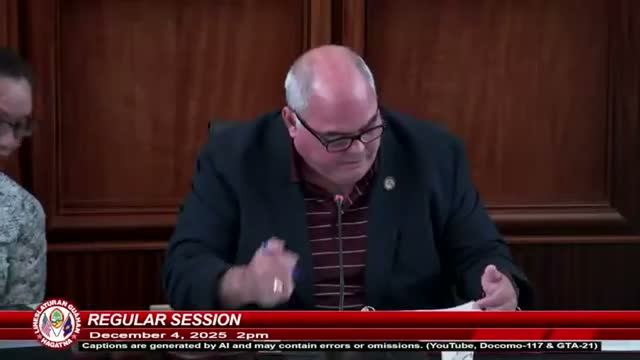
Senator Sabrina Salas Montanani introduced legislation seeking $8.1 million to "true up" amounts Guam Memorial Hospital Authority (GMH) says were legally due to its pharmaceutical fund but never delivered.
Montanani told the Committee of the Whole that audited financial statements and Office of Finance and Budget calculations show GMH was shorted across several fiscal years. "It is simply paying what is due," she said, urging colleagues to prioritize patients over process.
The bill would direct that previously collected business privilege tax (BPT) revenue—identified by GMH as the basis for a 6.19% statutory set-aside—be released to the hospital within 30 days to cover vendors and stabilize operations. GMH Chief Financial Officer Yuka Hichenova said the hospital's calculation, taken from audited figures, totals roughly $8.1 million for shortfalls in FY2019, FY2021, FY2022 and FY2023. "We're always short," Hichenova said, adding the hospital would use $3 million for an FY26 operating gap and $5 million to seed a supplies reserve.
Administration and budget officials disputed the straightforwardness of the claim. Edward Byrne, director of the Department of Administration (DOA), said the executive branch has followed budgetary appropriation processes and that transfers to agencies have historically been tied to the amounts appropriated in each year's budget act rather than a monthly remittance of 6.19% of collections. "Can we pay this money out today? The answer is no," Byrne told senators when asked whether unobligated funds currently exist to make the payment.
Lester Carlson, director of the Bureau of Budget and Management Research (BBMR), read a fiscal note prepared for the committee and confirmed the substitute bill now consistently lists $8.1 million after correcting two different figures in the introduced text. Carlson and other budget staff said BBMR concurs that the arithmetic underlying the $8.1 million aligns with Office of Finance and Budget (OFB) analyses, but they emphasized that audit figures (an accrual "earned" basis) differ from CRER/collections (the budgetary "cash" basis) and that the timing and source of any appropriation remain policy choices for the Legislature.
Public Auditor Benjamin Cruz said the statute requires that 6.19% of BPT collections be deposited into the pharmaceutical fund. Cruz and others cautioned that practice and implementation over past years did not always move funds into separate lock-box accounts, producing commingled balances that complicate retroactive reconciliation.
Several senators proposed quicker alternatives: a few members suggested amending a recently passed budget provision that earmarks $20 million in excess FY26 general fund revenues so a portion could be directed to GMH sooner. BBMR indicated that reconciling the CRER and updated excess-collections reporting might allow the Legislature to target FY26 excess revenue instead of relying solely on the contested $8.1 million calculation.
Committee members also pressed GMH on how prior emergency appropriations were spent. GMH said $30 million of a separate $40 million appropriation (Public Law 38-59) was used to reduce vendor payables and that about $10 million remains reserved for IT and electrical work. GMH described capital needs (roof/envelope, generator replacements, motor control and automatic transfer switches) and said the hospital has requisitions of about $2.4 million for motor-control work and estimated generator units at roughly $740,000 each. GMH said vendor payables now total about $5.5 million.
GMH officials outlined internal reforms to restrain recurring needs, including a planned $10 million cost-savings or revenue-generation program and a pending solicitation to outsource revenue cycle management, which GMH estimated would cost about $2 million per year but could improve billing and collections.
The committee considered and rejected procedural attempts to return the bill to committee for additional reconciliation; a motion to refer the bill back failed. An amendment requiring quarterly reporting on allocations and balances was ruled non-germane by the chair, and an attempt to overrule that ruling failed on a vote. The bill's author moved to send Bill 186-38 COR to the third-reading file and added a cosponsor; the motion to add a cosponsor was agreed to with no objections before the committee recessed.
What happens next: the committee advanced discussion but did not record a final appropriation vote during the hearing; senators suggested two principal paths forward: (1) pass Bill 186-38 COR to appropriate the $8.1 million as drafted, or (2) amend budget law language to accelerate and earmark FY26 excess revenue so GMH receives funds administratively once collections are confirmed.
Votes at a glance: a motion to overrule the chair on a non-germane ruling failed; a motion to refer the bill back to committee failed; a motion to add a cosponsor to the bill carried with no objection. No final appropriation vote on the bill is recorded in the transcript.
Reporting note: This article uses direct quotes and attributions only to speakers identified in the hearing transcript; accounting terms "earned" (audit/accrual basis) and "collected" (CRER/cash basis) are used as presented by witnesses and officers.
Montanani told the Committee of the Whole that audited financial statements and Office of Finance and Budget calculations show GMH was shorted across several fiscal years. "It is simply paying what is due," she said, urging colleagues to prioritize patients over process.
The bill would direct that previously collected business privilege tax (BPT) revenue—identified by GMH as the basis for a 6.19% statutory set-aside—be released to the hospital within 30 days to cover vendors and stabilize operations. GMH Chief Financial Officer Yuka Hichenova said the hospital's calculation, taken from audited figures, totals roughly $8.1 million for shortfalls in FY2019, FY2021, FY2022 and FY2023. "We're always short," Hichenova said, adding the hospital would use $3 million for an FY26 operating gap and $5 million to seed a supplies reserve.
Administration and budget officials disputed the straightforwardness of the claim. Edward Byrne, director of the Department of Administration (DOA), said the executive branch has followed budgetary appropriation processes and that transfers to agencies have historically been tied to the amounts appropriated in each year's budget act rather than a monthly remittance of 6.19% of collections. "Can we pay this money out today? The answer is no," Byrne told senators when asked whether unobligated funds currently exist to make the payment.
Lester Carlson, director of the Bureau of Budget and Management Research (BBMR), read a fiscal note prepared for the committee and confirmed the substitute bill now consistently lists $8.1 million after correcting two different figures in the introduced text. Carlson and other budget staff said BBMR concurs that the arithmetic underlying the $8.1 million aligns with Office of Finance and Budget (OFB) analyses, but they emphasized that audit figures (an accrual "earned" basis) differ from CRER/collections (the budgetary "cash" basis) and that the timing and source of any appropriation remain policy choices for the Legislature.
Public Auditor Benjamin Cruz said the statute requires that 6.19% of BPT collections be deposited into the pharmaceutical fund. Cruz and others cautioned that practice and implementation over past years did not always move funds into separate lock-box accounts, producing commingled balances that complicate retroactive reconciliation.
Several senators proposed quicker alternatives: a few members suggested amending a recently passed budget provision that earmarks $20 million in excess FY26 general fund revenues so a portion could be directed to GMH sooner. BBMR indicated that reconciling the CRER and updated excess-collections reporting might allow the Legislature to target FY26 excess revenue instead of relying solely on the contested $8.1 million calculation.
Committee members also pressed GMH on how prior emergency appropriations were spent. GMH said $30 million of a separate $40 million appropriation (Public Law 38-59) was used to reduce vendor payables and that about $10 million remains reserved for IT and electrical work. GMH described capital needs (roof/envelope, generator replacements, motor control and automatic transfer switches) and said the hospital has requisitions of about $2.4 million for motor-control work and estimated generator units at roughly $740,000 each. GMH said vendor payables now total about $5.5 million.
GMH officials outlined internal reforms to restrain recurring needs, including a planned $10 million cost-savings or revenue-generation program and a pending solicitation to outsource revenue cycle management, which GMH estimated would cost about $2 million per year but could improve billing and collections.
The committee considered and rejected procedural attempts to return the bill to committee for additional reconciliation; a motion to refer the bill back failed. An amendment requiring quarterly reporting on allocations and balances was ruled non-germane by the chair, and an attempt to overrule that ruling failed on a vote. The bill's author moved to send Bill 186-38 COR to the third-reading file and added a cosponsor; the motion to add a cosponsor was agreed to with no objections before the committee recessed.
What happens next: the committee advanced discussion but did not record a final appropriation vote during the hearing; senators suggested two principal paths forward: (1) pass Bill 186-38 COR to appropriate the $8.1 million as drafted, or (2) amend budget law language to accelerate and earmark FY26 excess revenue so GMH receives funds administratively once collections are confirmed.
Votes at a glance: a motion to overrule the chair on a non-germane ruling failed; a motion to refer the bill back to committee failed; a motion to add a cosponsor to the bill carried with no objection. No final appropriation vote on the bill is recorded in the transcript.
Reporting note: This article uses direct quotes and attributions only to speakers identified in the hearing transcript; accounting terms "earned" (audit/accrual basis) and "collected" (CRER/cash basis) are used as presented by witnesses and officers.
Don't Miss a Word: See the Full Meeting!
Go beyond summaries. Unlock every video, transcript, and key insight with a Founder Membership.
✓
Get instant access to full meeting videos
✓
Search and clip any phrase from complete transcripts
✓
Receive AI-powered summaries & custom alerts
✓
Enjoy lifetime, unrestricted access to government data
30-day money-back guarantee
