Board hears special-session update: AB 6 school-zone changes and SB 7 pose safety and budget concerns
December 04, 2025 | CLARK COUNTY SCHOOL DISTRICT, School Districts, Nevada
This article was created by AI summarizing key points discussed. AI makes mistakes, so for full details and context, please refer to the video of the full meeting. Please report any errors so we can fix them. Report an error »
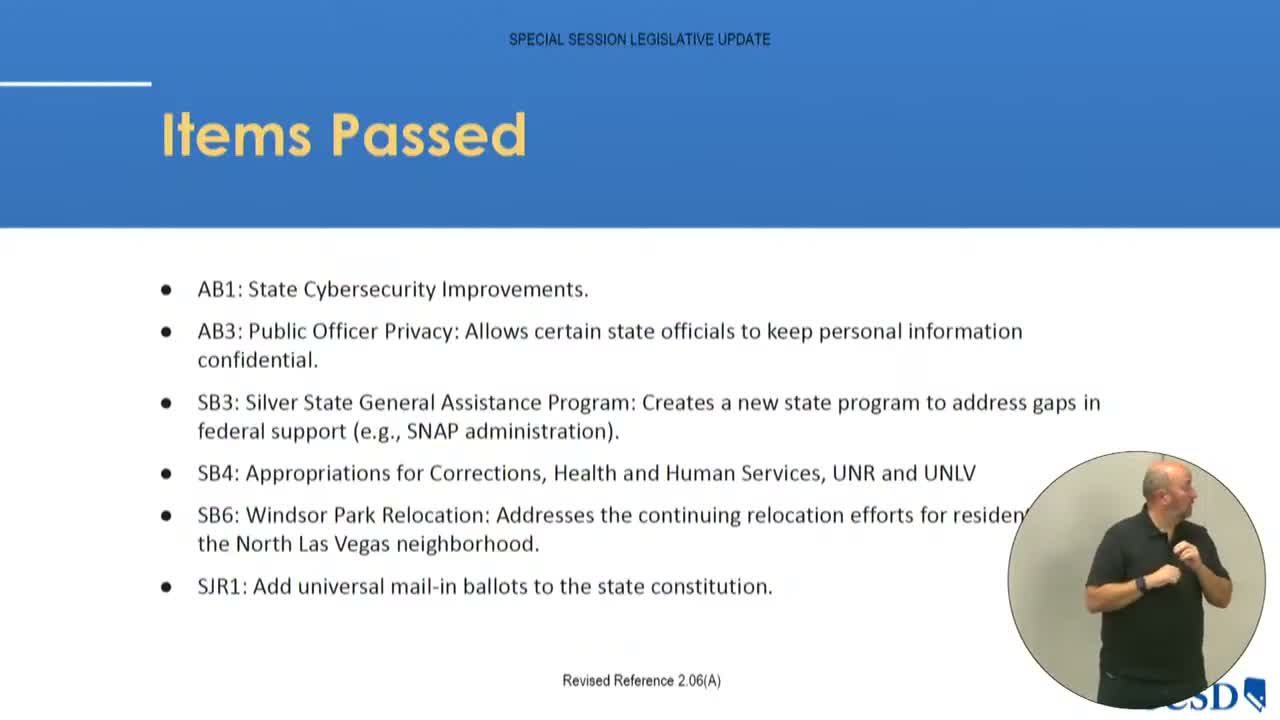
District staff briefed trustees on outcomes from the governor's November special session and highlighted several bills with direct implications for CCSD operations.
Assembly Bill 6 (school zone safety improvements) passed and gives local authorities broader discretion to set prohibitions on speeding, U-turns and passing in school zones, requires new standards for signage, doubles penalties and demerit points for violations in active school zones and includes two senate amendments that limit directory information and restrict disclosure of parent/student phone numbers and addresses to third parties except as required by law or necessary for instructional or wraparound services. Staff reported they are coordinating with the Nevada Department of Education to draft regulations clarifying definitions for "instructional" and "wraparound" uses to avoid unintended impacts.
Senate Bill 7 expands presumptions that certain lung diseases are work-related for eligible first responders. Justin Dayhoff, CCSD chief financial officer, said the law could substantially increase workers' compensation costs for CCSD (which employs roughly 188 police service officers) and provided a conservative estimate of a $21 million to $26 million annual increase in claims costs. Dayhoff said the change effectively removes the district's ability to deny certain lung-related claims and will likely require higher risk premiums that are borne at the school level, reducing funds available for instructional priorities. Staff noted ongoing conversations with local government partners and with the governor's office about potential legislative changes in the 2027 session.
Staff also noted other special-session measures of interest (AB 4 public-safety omnibus; a failed AB 5 film tax credit expansion that would have funded pre-K via a tax district) and announced a ceremonial signing for AB 6 on Dec. 11 at Roe Elementary School with the governor and local leaders.
Trustees asked for additional fiscal modeling of SB 7 impacts over multiple years and were told staff will provide follow-up analysis and proposed strategies for the 2027 session.
Assembly Bill 6 (school zone safety improvements) passed and gives local authorities broader discretion to set prohibitions on speeding, U-turns and passing in school zones, requires new standards for signage, doubles penalties and demerit points for violations in active school zones and includes two senate amendments that limit directory information and restrict disclosure of parent/student phone numbers and addresses to third parties except as required by law or necessary for instructional or wraparound services. Staff reported they are coordinating with the Nevada Department of Education to draft regulations clarifying definitions for "instructional" and "wraparound" uses to avoid unintended impacts.
Senate Bill 7 expands presumptions that certain lung diseases are work-related for eligible first responders. Justin Dayhoff, CCSD chief financial officer, said the law could substantially increase workers' compensation costs for CCSD (which employs roughly 188 police service officers) and provided a conservative estimate of a $21 million to $26 million annual increase in claims costs. Dayhoff said the change effectively removes the district's ability to deny certain lung-related claims and will likely require higher risk premiums that are borne at the school level, reducing funds available for instructional priorities. Staff noted ongoing conversations with local government partners and with the governor's office about potential legislative changes in the 2027 session.
Staff also noted other special-session measures of interest (AB 4 public-safety omnibus; a failed AB 5 film tax credit expansion that would have funded pre-K via a tax district) and announced a ceremonial signing for AB 6 on Dec. 11 at Roe Elementary School with the governor and local leaders.
Trustees asked for additional fiscal modeling of SB 7 impacts over multiple years and were told staff will provide follow-up analysis and proposed strategies for the 2027 session.
View the Full Meeting & All Its Details
This article offers just a summary. Unlock complete video, transcripts, and insights as a Founder Member.
✓
Watch full, unedited meeting videos
✓
Search every word spoken in unlimited transcripts
✓
AI summaries & real-time alerts (all government levels)
✓
Permanent access to expanding government content
30-day money-back guarantee
