Cathedral City planning commission begins phased review of 34 specific plans, may fold standards into updated code
December 04, 2025 | Cathedral City, Riverside County, California
This article was created by AI summarizing key points discussed. AI makes mistakes, so for full details and context, please refer to the video of the full meeting. Please report any errors so we can fix them. Report an error »
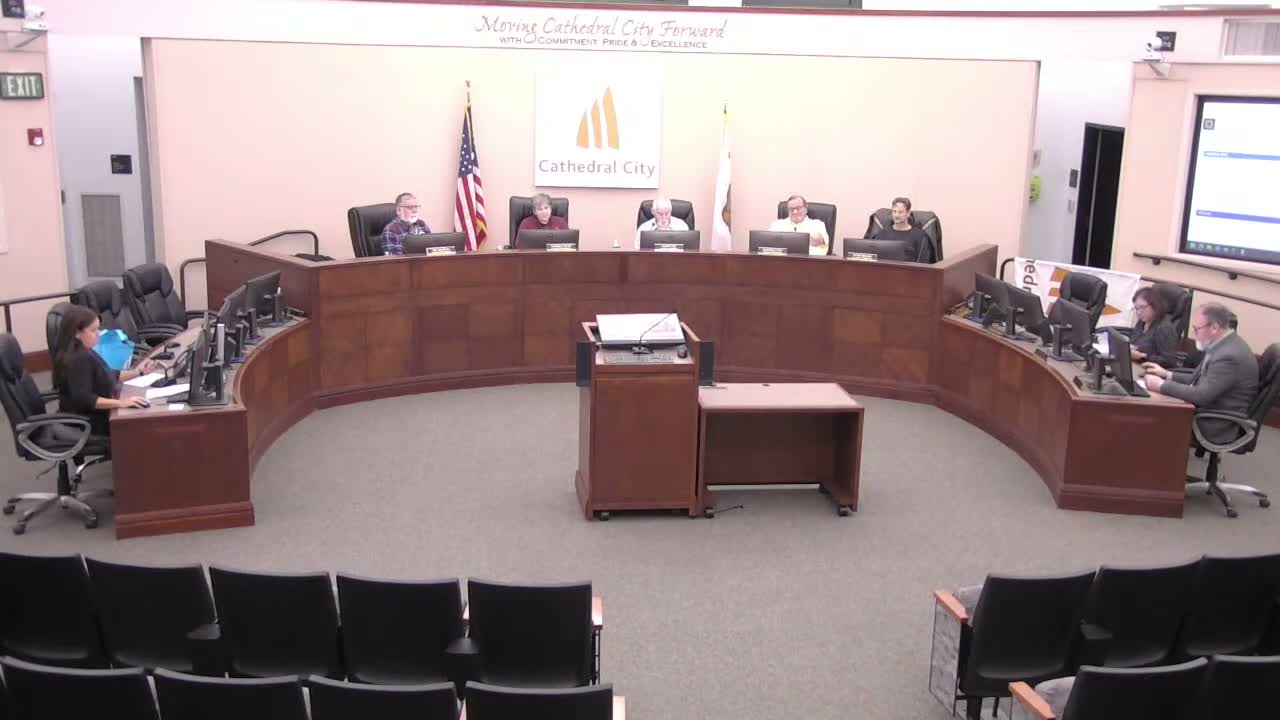
Planning staff outlined a four‑category approach: plans to retain, plans to consider rescinding because their stated objectives are no longer being met, plans whose standards could be carried into a new citywide development code, and plans that require broader discussion and possible amendment. "Rescission of a specific plan or rescinding a specific plan is done in the same manner as adopting it," a staff member said, describing the ordinance or resolution and public‑hearing steps required.
Commissioners pressed for context and examples. Commissioner MacPhail noted that attachments listed roughly 37 plans and that many were adopted in the 1980s and 1990s, asking why the city relied on specific plans historically and why that practice declined in the 21st century. Staff said plans can be either city‑led or developer‑led, and pointed to the North City plan as a city‑initiated document intended to coordinate infrastructure (roads, sewer, water) at buildout. "It could be either way," staff said when asked who initiates specific plans.
Several commissioners suggested that minor or narrowly technical plan provisions—landscape setbacks, building setbacks, screen walls, and restrictions on driveway access along streets such as Aliso Road and Ramon—would be better handled through a consolidated development code rather than dozens of separate plans. One commissioner asked why features of older specific plans, such as the 1987 plan referenced as 8726C, had not been implemented; staff said they would investigate that apparent discrepancy.
A subset of plans, including a west‑side Date Palm plan that allows mixed use and references PCC or R‑2 fallback standards, was flagged for further discussion. Commission and staff members described an ongoing project with Cal Poly San Luis Obispo’s design studio to study the Date Palm corridor and identify possible bold design ideas to complement the code update. "We are working with Cal Poly, San Luis Obispo, and the design studio," staff said, asking whether that effort should be coordinated with the zoning code changes.
Commissioners also asked staff to make the specific‑plan documents more publicly accessible, suggesting a web page or GIS layer where residents can view plan boundaries and standards. Staff responded that posting the plans online would be straightforward.
Staff said the review will be incremental and that recommendations, including any ordinance or resolution to repeal a plan, would return to the commission for public hearings and a future city council action. Staff listed upcoming meeting dates and closed the item; no formal motions or votes were taken on specific plan actions during the Dec. 3 meeting.
Next steps: staff will complete the categorization work, confirm plan mappings cited during the discussion, investigate apparent non‑implementation issues, and bring suggested amendments or rescissions back to the commission and ultimately to city council for public hearings.
View the Full Meeting & All Its Details
This article offers just a summary. Unlock complete video, transcripts, and insights as a Founder Member.
30-day money-back guarantee
Sponsors
Proudly supported by sponsors who keep California articles free in 2025

