Martin County LPA unanimously approves ADU text changes, creates new 'employee dwelling unit' category
December 05, 2025 | Martin County, Florida
This article was created by AI summarizing key points discussed. AI makes mistakes, so for full details and context, please refer to the video of the full meeting. Please report any errors so we can fix them. Report an error »
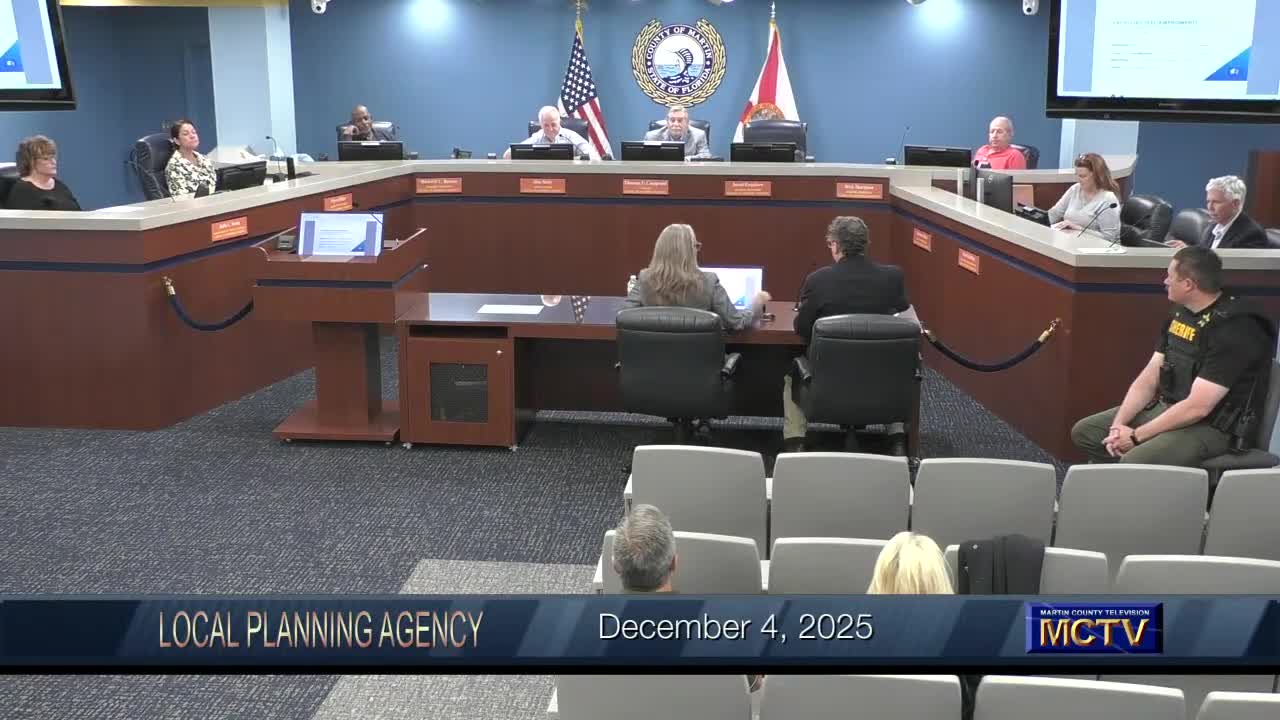
Amy Offenbach, planner with the Martin County Growth Management Department, told the agency the comprehensive plan amendment (CPA 25-04) updates definitions to treat accessory dwelling units (ADUs) as living quarters associated with single-family lots and adds a new term, employee dwelling units (EDUs), for living quarters on nonresidential properties. She said CPA 25-04 would add ADU criteria under Goal 4.9 and permit ADUs in future land use categories that allow single-family dwellings—excluding mobile-home designations. Offenbach said the amendment is legislative and requires three public hearings: the LPA hearing Dec. 4, a Board of County Commissioners (BCC) transmittal hearing scheduled Dec. 9, and a final BCC hearing expected in January 2026.
Staff also presented LDR 25-03, a package of text changes to the Land Development Regulations that would replace the term "guest house" with "accessory dwelling unit," add "employee dwelling units" to nonresidential use tables, allow ADUs to be rented, and consolidate conflicting definitions of "family" by adopting a consistent limit of five unrelated persons where the code previously referenced both four and five unrelated persons. Offenbach said the Affordable Housing Advisory Committee supports the staff recommendation.
Board members and staff discussed utility and capacity questions. One member asked whether sewer and septic capacity and the county’s residential housing capacity analyses account for ADUs. Offenbach said septic permits are reviewed by the Martin County Health Department and that the comprehensive plan includes a text limit of 2,000 gallons per day for a single property; permitting and building-department review would enforce septic capacity at the site level. A county utilities representative said engineering resource credits (ERCs) are used when sizing systems and that the utilities department builds cushion into capacity planning; staff stated ADUs would generally not be counted as additional units in the county’s residential capacity analysis because they are accessory to single-family dwellings.
Paul Shilling, Growth Management Director, gave examples of existing nonresidential uses that include living quarters—such as a self-storage facility with a full residence above part of the building—to explain the rationale for creating the EDU category. Staff explained EDUs are intended for limited nonresidential contexts (for example, night watchman quarters at certain waterfront or industrial sites) and that lot size and development standards would limit how many EDUs a particular nonresidential parcel could host.
Public comment included support from Rob Ranieri, CEO of House of Hope, who praised the amendments as a valuable tool to add lower-cost housing inventory. Resident Nick Berkeley told the agency he supports ADU allowances and asked whether size standards could be adjusted in the future to accommodate tiny homes; staff offered to meet with him to follow up.
The LPA approved both items on motions recorded by the chair. For CPA 25-04 the chair announced the motion as made by "Mister Morris" with a second by "Mister Brown," and the chair recorded the motion as passing 4–0. For LDR 25-03 the chair announced the motion as by "Mister Moore" with a second by "Mister Brown" and recorded the passage as unanimous. The transcript does not include a full roll-call or individual recorded yes/no votes beyond the chair’s tally.
Next steps: CPA 25-04 and LDR 25-03 will proceed to the Board of County Commissioners for the transmittal hearing on Dec. 9, 2025, and for final consideration at a January 2026 BCC meeting. Staff recommended approval on the basis that the proposals are consistent with the comprehensive plan and Florida statutes, and that more restrictive local requirements would not be imposed before Oct. 1, 2027.
(Quotations used in this article are taken verbatim from the meeting transcript.)
Don't Miss a Word: See the Full Meeting!
Go beyond summaries. Unlock every video, transcript, and key insight with a Founder Membership.
30-day money-back guarantee
Sponsors
Proudly supported by sponsors who keep Florida articles free in 2025

