Land bank adopts disposition policy and 5/50 tax-waiver policy after extended debate on guardrails
December 04, 2025 | Grand Rapids City, Kent County, Michigan
This article was created by AI summarizing key points discussed. AI makes mistakes, so for full details and context, please refer to the video of the full meeting. Please report any errors so we can fix them. Report an error »
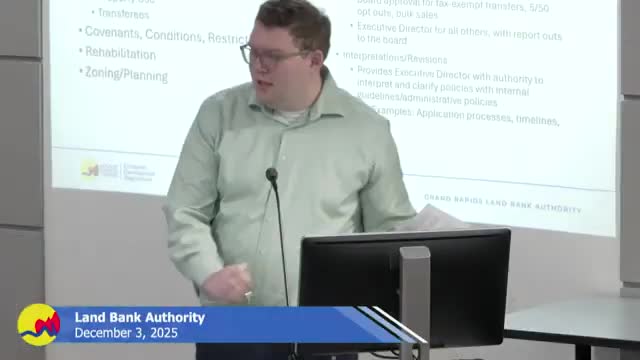
Staff described the 5/50 policy as "the 5 50 tax waiver," explaining that when the land bank sells a parcel the land bank typically receives 50% of property taxes for the first five years and that the proposed policy would permit waiving that capture in narrowly defined cases to improve project feasibility. "It is the primary revenue mechanism for land banks throughout Michigan," staff said while reviewing the statutory background. Board members pushed for explicit 'but-for' analysis and measurable community outcomes before waiving capture; one member suggested formal criteria linking waivers to job creation, new investment and demonstrable affordable-housing outcomes.
The board approved the formal 5/50 waiver policy, with members directing staff to return with more precise parameters and guidance for consistent decisions. The land-banking policy the board adopted expands the land bank's toolkit — quiet-title services, option agreements, deed restrictions and prioritized applicant scoring — and embeds equity priorities such as giving preference to affordable-housing uses and legacy returning residents while making clear the priorities are inclusionary, not exclusionary. Staff emphasized that planning review and site feasibility checks will be required at intake to avoid futile applications.
Board members and planning staff reviewed the land bank portfolio transferred from the State Land Bank in January 2025. Planning supervisor Rowan Brady said the inventory contains roughly 55 parcels (56% of the portfolio) categorized as buildable by right (single-family or two-family with accessory dwelling unit potential), five parcels (5%) that could be made buildable with variances, and 38 parcels (39%) that are not buildable due to physical constraints such as wetlands, lack of access or steep slopes. Examples cited included 1135 Cromwell (regular buildable lot), 1373 Lancaster (irregular triangular lot requiring variances), and 1055 Ida (26-foot grade change and steep-slope restrictions).
The board approved the land-banking/disposition policy and the 5/50 waiver policy by voice votes. Members asked staff to prioritize strategies that remove barriers — permit-ready plans, pre-variance work, and targeted outreach to emerging developers — while protecting the land bank's revenue stream and ensuring measurable public benefit when waivers are used.
Next steps: staff will incorporate the board's direction into administrative guidance, return with clarified waiver criteria and work with planning to develop permit-ready and marketing materials for buildable parcels.
Don't Miss a Word: See the Full Meeting!
Go beyond summaries. Unlock every video, transcript, and key insight with a Founder Membership.
30-day money-back guarantee
Sponsors
Proudly supported by sponsors who keep Michigan articles free in 2025

