Thurston County hears appeal of Johnson Creek Quarry permit amid dispute over 42-acre operations area and 228-acre permit boundary
December 04, 2025 | Thurston County, Washington
This article was created by AI summarizing key points discussed. AI makes mistakes, so for full details and context, please refer to the video of the full meeting. Please report any errors so we can fix them. Report an error »
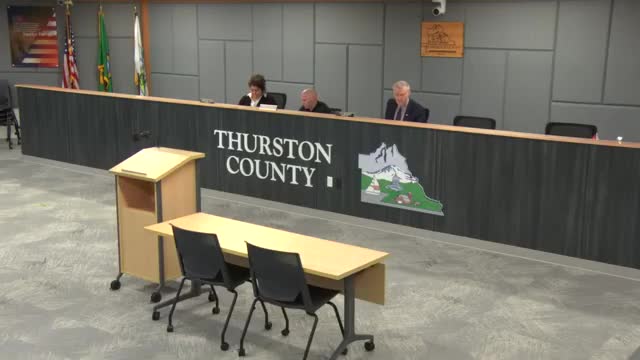
Appellant counsel Brian Tellegen told the board that the permit approved two different things: an expansion of the active mining area from 10.4 acres to 42 acres and an expansion of the mine/site boundary to 228 acres. "If the mine boundary is approved for the whole 228 acres, then it is very possible that the county could lose its authority under this provision to curtail future or further mine expansions into that area," Tellegen said, arguing the examiner declined staff's requested condition that would expressly confine operations to the 42-acre footprint.
Why it matters: Tellegen said the larger boundary, combined with the code provision the examiner cited (Thurston County Code 20.54.030), could be read to make the permitted use 'deemed' on the lot and limit the county's ability to deny or curtail later expansions. He asked the board to reverse the examiner or, at minimum, remand with instructions requiring the applicant to file and process a forest land conversion permit concurrently with the SUP so the county could determine the exact scope of conversion and whether the proposal complies with all Long Term Forestry (LTF) zone purposes.
The applicant's attorney, Nancy Rogers, urged the board to uphold the hearing examiner. Rogers said the record and the examiner's findings clearly document the 42-acre operations area and that condition 26 (as applied in the decision) and other code language require a new SUP for any enlargement or increase in intensity of the mining operation. "A new special use permit absolutely will be required for any expansion beyond those 42 acres of operation area," Rogers said.
Conversion-permit dispute: Tellegen emphasized the county code requirement that a Class 4 forest practices conversion application be submitted with development applications (citing Thurston County Code language and a code section referenced in the record). He said without a conversion permit the county lacks the site-specific information (harvest boundaries, roads, stumping, grading) necessary to judge whether mining in the LTF zone would conserve forest lands and discourage incompatible uses. Rogers responded that condition 34 requires the conversion permit be applied for and processed prior to mining on the 42-acre operations area and noted the hearing examiner found the 42-acre area had already been clear-cut.
Hydrogeology and staff review: Commissioners pressed both sides about groundwater and surface-water modeling. Tellegen said county planning staff raised concerns that the applicant's modeling did not adequately demonstrate compliance with code protections for groundwater and aquifer capacity. Rogers said hydrogeology was the subject of extensive briefing and hearing time, that the examiner addressed the required hydrogeologic data in detail, and that one county reviewer had concluded the submittals were flawed and stopped a detailed review. Rogers said the hearing examiner's findings addressed the contested points and supported approval.
Boundary, monitoring and operational controls: Rogers explained that the 228-acre permit boundary shown in exhibit 14.2 includes the 42-acre operations area, designated soil-stockpile areas, groundwater monitoring wells and adjacent sensitive features; she said including the larger boundary helps with monitoring, record-keeping and long-term site management even though any expansion of active mining beyond the 42-acre operations area would require a new SUP application and the site is subject to periodic (five-year) review under county code.
What the board can do: Commissioners asked whether a narrow remand (for example, clarifying that only the 42 acres are authorized for active mining and adding a sentence to condition 26 that any expansion requires a new SUP) would resolve appellant concerns. Tellegen said a remand might be appropriate in some respects but argued reversal and remand to county staff might be needed to ensure an actual conversion permit application is filed and processed. Rogers said the board could add a clarifying sentence to condition 26 if commissioners remain uneasy; she repeatedly urged that reversal was unnecessary.
Next steps: The board closed oral argument, set a deadline to issue a written decision by Dec. 9, 2025, and convened a closed session to consult with counsel regarding the quasi-judicial appeal.
Reporting details: The matter centers on the hearing examiner's Sept. 26, 2025 decision approving Mountain Stone Aggregate's SUP with conditions. Appellants include Asia Alexander and several households named in the record; the applicant and affected landowner include Mountain Stone Aggregate and Weyerhaeuser timberlands. Commissioners disclosed no ex parte communications since the appeal was filed on Oct. 10, 2025.
The board did not vote or take a final public action during the Dec. 3 oral argument; it will issue a written decision by Dec. 9, 2025.
Don't Miss a Word: See the Full Meeting!
Go beyond summaries. Unlock every video, transcript, and key insight with a Founder Membership.
30-day money-back guarantee
Sponsors
Proudly supported by sponsors who keep Washington articles free in 2025

