Lane County reviews three funding paths to shore up sheriff staffing as county discusses polling and public outreach
December 04, 2025 | Lane County, Oregon
This article was created by AI summarizing key points discussed. AI makes mistakes, so for full details and context, please refer to the video of the full meeting. Please report any errors so we can fix them. Report an error »
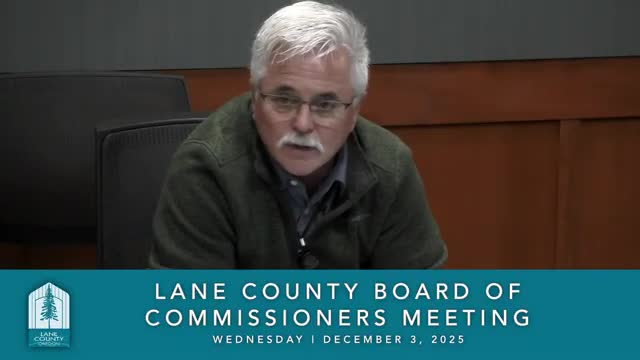
The sheriff told commissioners the county faces an “artificially low” property tax base after long-standing timber and federal revenues declined, leaving Lane’s sheriff’s office with minimal patrol coverage and many statutorily required duties that cities do not perform. "Our minimum staffing ... is three deputies and a sergeant," the sheriff said, saying the county’s size and rural geography make response times and follow-up investigations difficult.
The sheriff’s chief deputy, Tom Spellbridge, said Lane County staffs about 0.22 deputies per 1,000 residents, less than half the comparator-county average (0.43 per 1,000). He said the county’s combination of low staffing and the largest geography among peers produces delayed responses, limited ability to follow up on property-only crimes, and officer-safety risks. "It causes delayed response to calls," Spellbridge said. "It diminishes our capacity for good investigations."
The task-force options presented to the board included three escalations of investment: a patrol-focused enhancement to reach comparable staffing (roughly 64 deputies plus supervisors/support, estimated at about $22,000,000 per year); a combined funding approach to cover patrol and the district attorney’s office (presented at about $55,000,000); and an “all in” public-safety system funded separately from the general fund (about $95,000,000). The sheriff emphasized that any increase in patrol staffing would also require more support staff (dispatchers, records, evidence technicians) to process the higher case volume.
Commissioners pressed staff on how those dollar figures would translate into tax rates and levy mechanics. Staff said the current jail levy brings in about $22,000,000 a year (the levy rate discussed in the session was about $0.50 per $1,000 assessed value) but noted that levy proceeds are currently dedicated to corrections and would not automatically fund patrol functions, so new or different mechanisms would be required. The county’s analysis and the task force flagged two principal revenue models to consider: a property-tax-funded public-safety district or a payroll tax, with hybrid approaches also on the table.
Commissioners and staff discussed trade-offs. A district funded by property taxes can be more structurally durable but is complex to design and to message; a payroll tax could fund services without forming a district but could be vulnerable to ballot initiatives that repeal it. Using Deschutes County as an example, staff described how one county formed both a countywide district and a separate unincorporated-area district to allocate different public-safety functions.
Board members and the sheriff also weighed community-level options: assigning deputies to regional or neighborhood districts (for example, West Lane or McKenzie Valley) that build relationships with residents and reduce crime through familiarity and targeted enforcement. Staff cited a McKenzie-Valley pilot in which dedicated deputies were credited with significantly reducing property-crime incidents and improving community reporting and partnership.
Several commissioners noted that traffic citations generate little local revenue under current state distribution rules and therefore are not a practical revenue strategy for funding patrol expansion. The sheriff added that improving traffic enforcement is a public-safety goal but said a traffic-safety team cannot be justified if it would reduce resources available for higher-priority emergency responses.
Staff told the board they are running phased public-engagement work: initial polling now, focus groups and additional outreach early next year, and broader community engagement in mid-2026, with a realistic expectation that any voter referral would be targeted for 2027. The county said it plans to hire a consultant in the first quarter to support community engagement and to return to the board with polling results and follow-up data.
The sheriff’s office offered to provide more district-level data on calls for service, restraining-order service volumes and other duties the sheriff’s office performs inside urban-transition areas to help the board craft clearer public messaging. The session closed with appreciation for staff and a plan to continue the discussion at future budget-work meetings and at a scheduled presentation from the district attorney’s office next week.
Next steps: staff will return with poll analysis and requested data points; commissioners and staff said they will use focus groups and community outreach to refine options before deciding whether to refer a measure to voters in 2027.
View the Full Meeting & All Its Details
This article offers just a summary. Unlock complete video, transcripts, and insights as a Founder Member.
30-day money-back guarantee
Sponsors
Proudly supported by sponsors who keep Oregon articles free in 2025

