University System of Georgia says maintenance formula lags costs as enrollment grows
November 08, 2025 | Appropriations, HOUSE OF REPRESENTATIVES, Committees, Legislative, Georgia
This article was created by AI summarizing key points discussed. AI makes mistakes, so for full details and context, please refer to the video of the full meeting. Please report any errors so we can fix them. Report an error »
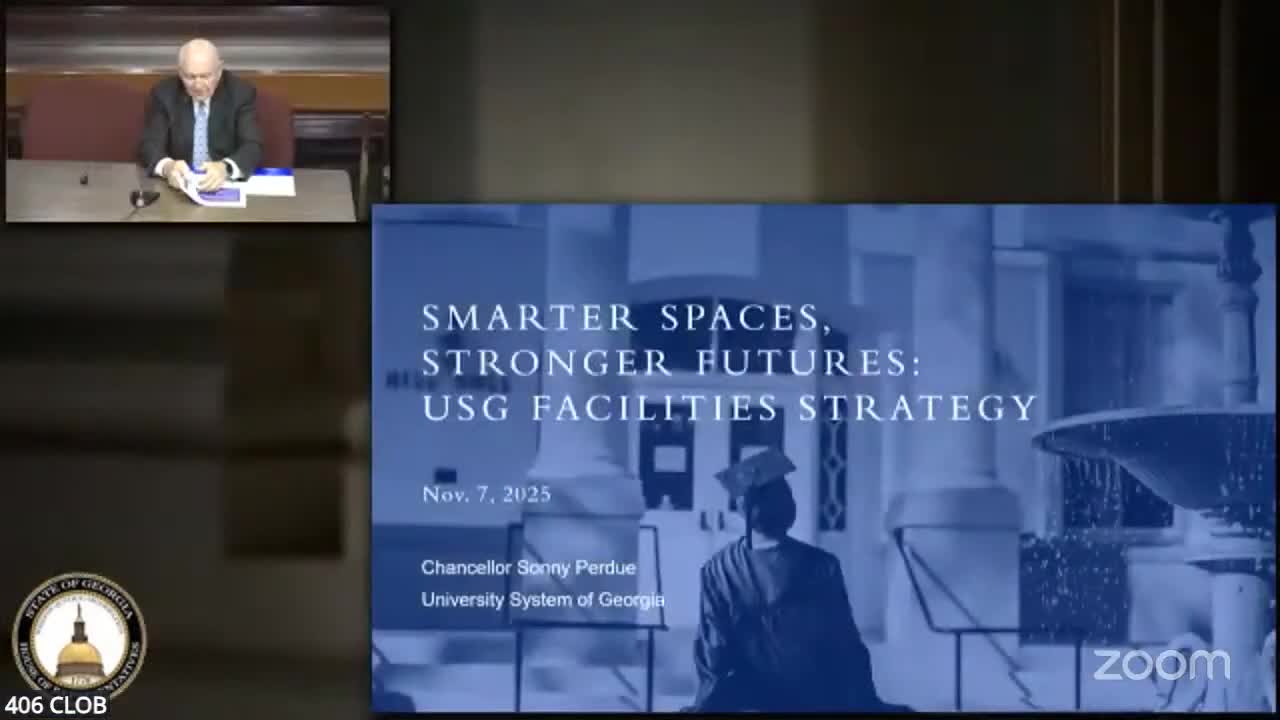
Perdue said system slides show a formula rate of $8.28 per square foot for M&O while recent institutional spending averages about $16.37 per square foot. "We're trying to keep take these older buildings and refurbish them," Perdue said, noting renovation and preventive maintenance are priorities while dorm capacity and campus living remain significant capital challenges.
Why it matters: the M&O allocation helps campuses pay for utilities, custodial services and routine upkeep. Perdue and members of the committee framed the mismatch as a statewide budgeting question: if formula amounts are static while energy and repair costs rise, institutions cover the shortfall by redirecting tuition, fees or one‑time funds, potentially reducing capacity for other priorities.
Perdue highlighted several related items: system enrollment projections, which his slides placed near 379,500 by 2029 though he said current counts already exceed that forecast; efforts to limit scope creep in capital projects through early vetting by the Board of Regents; and examples of aggressive value engineering that reduced the share of projects requiring later budget adjustments. "Only 5.1% of the 58 state-funded projects required budget adjustments," he said, attributing that outcome to tighter design and procurement controls.
Committee members pushed on two points. Chairman Martin called the funding formula the "third rail" of higher-education finance and said parts of the formula date to the early 1980s; Martin urged using modern data and predictive models to calibrate maintenance costs by building age and type. Perdue agreed that improved data analytics could allow a more nuanced approach than a static per-square-foot rate.
Members also asked about the effects of ongoing federal budget uncertainty. Perdue said Georgia institutions had so far seen limited effects from federal funding threats but warned that an extended federal shutdown could strain programs tied to federal grants after roughly 30 days.
Next steps and context: Perdue said USG provided a packet of answers to the committee and offered to supply additional detail on space utilization and administrative-versus-academic space ratios. The committee indicated it will follow up on formula reform and capital-prioritization questions in later oversight work.
Sources and attribution: quotes and figures in this article are drawn from Chancellor Lisonbee Perdue's presentation and committee exchanges before the Appropriations Subcommittee (transcript segments provided by the committee). The first reference uses the transcript’s name spelling and committee attributions.
View the Full Meeting & All Its Details
This article offers just a summary. Unlock complete video, transcripts, and insights as a Founder Member.
30-day money-back guarantee
Sponsors
Proudly supported by sponsors who keep Georgia articles free in 2025

