Lake Forest commission reviews conceptual plan to reshape Kavanaugh Park; berm removal, lighting and budget cited
December 04, 2025 | Lake Forest City, Orange County, California
This article was created by AI summarizing key points discussed. AI makes mistakes, so for full details and context, please refer to the video of the full meeting. Please report any errors so we can fix them. Report an error »
Brian Avalos, studio director for David Veil Design, said the concept grew from two rounds of community outreach and a 105‑person digital survey in which residents emphasized safety, shaded gathering areas, modern playground equipment and pathways. "We reduced that to 25% of the park, leaving 75% to be usable," Avalos said, describing changes that include a centralized playground with separate age zones, distributed fitness equipment along a loop path and a reinstated half basketball court.
Avalos said the existing berm is the largest contributor to nonfunctional turf at Kavanaugh Park and that removing the berm (including cut‑and‑export of soil and tree removal) was the single biggest construction line item. "We figured that approximately it'd be around 1000000 dollars for removal and export of such a big berm, just with cut and export of soil and and the tree removal," he said.
Deputy City Manager McGovern told commissioners the city's capital improvement program (CIP) currently includes about $1,000,000 for the park but that the conceptual plan would exceed that allocation. "After tonight, the next step is for this to go to the city council," McGovern said. "The city council, if they wanna move forward with this, they're gonna have to amend the CIP budget at some point and allocate more money towards it." He said final engineering and a photometric lighting study would follow in the design stage and that equipment choices would be made later in coordination with the city arborist and the public works engineering phase.
Commissioners asked a range of design questions: how play equipment would limit hiding spaces, which led Avalos to say selection would prioritize visibility; whether a "fraction ball" learning court developed with UCI could be adapted for a half‑court; and how many lights would be installed. The design team said a typical layout used about 75 lights as a starting point and that a precise photometric study would determine final spacing and fixtures.
The presentation also addressed interagency constraints along the park's southern edge. Chair Bruton pointed out a tall retaining wall adjacent to the freeway; McGovern clarified that Caltrans owns and maintains the large freeway wall, while the intermediate wall and berm inside the park shown in the concept would be removed as part of the work.
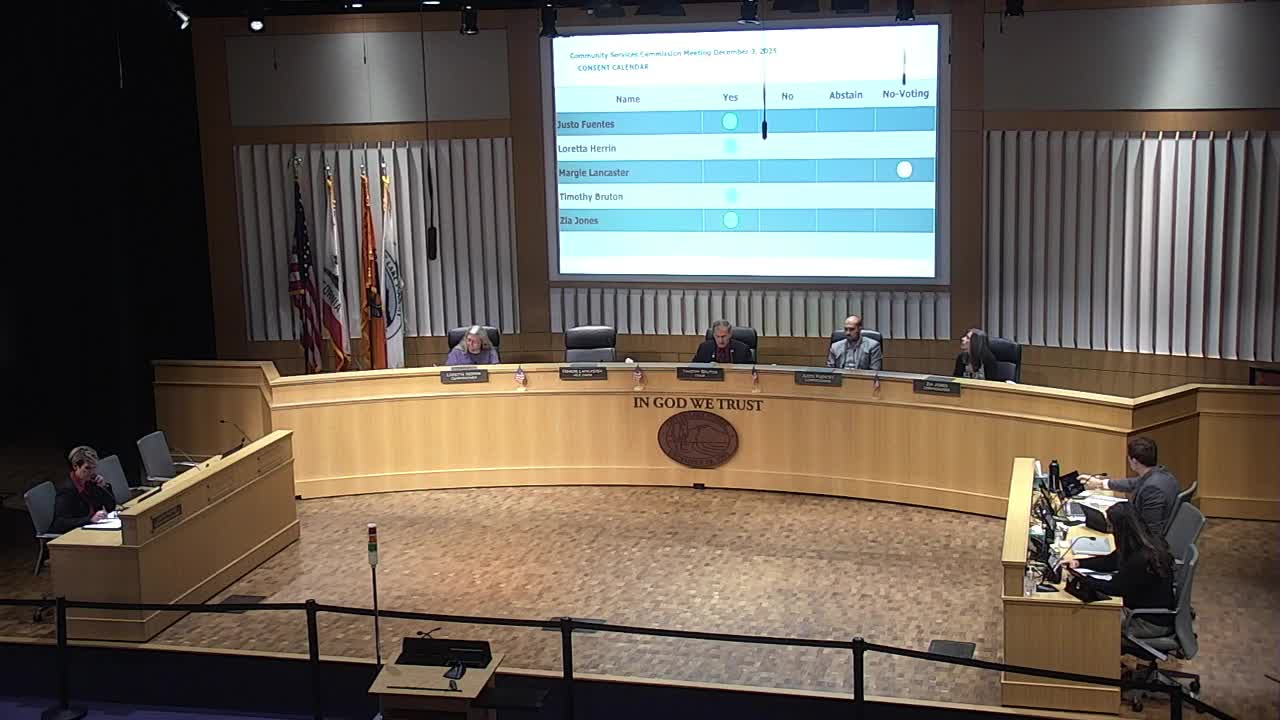
The commission did not take a formal vote on the concept. McGovern said staff will transmit the concept to the city council and return with updates; the project will move into engineering and design if the council amends the CIP. The CPTED (crime prevention through environmental design) consultant is expected to brief the commission in a future meeting, and staff is working on a security services procurement intended to increase physical patrols in city parks.
Next steps: concept goes to city council for CIP consideration; engineering and equipment selection will follow in the design phase (staff indicated design work will progress in 2026).
Don't Miss a Word: See the Full Meeting!
Go beyond summaries. Unlock every video, transcript, and key insight with a Founder Membership.
30-day money-back guarantee
Sponsors
Proudly supported by sponsors who keep California articles free in 2025

