Perris planning commission backs Perris Gateway entitlements, with conditions on drive‑throughs and a second fuel station
December 04, 2025 | Perris, Riverside County, California
This article was created by AI summarizing key points discussed. AI makes mistakes, so for full details and context, please refer to the video of the full meeting. Please report any errors so we can fix them. Report an error »
The commission’s action forwards Resolution 25‑24 — which would approve a specific plan amendment, tentative parcel maps, conditional use permits and development plan reviews for the Perris Gateway project — with edits that reduce the number of drive‑through pads in the eastern portion of the site, prohibit a secondary fuel station at a corner parcel (leaving the Maverick convenience store as the only approved station with an alcohol‑sales CUP), add landscape and trellis requirements, and require that any future hotel or medical office plans return to the commission for design review and a CEQA compliance determination.
Matthew Evans, the city’s project planner, told the commission the project as proposed includes a 157,928‑square‑foot self‑storage building, two commercial buildings totaling about 12,000 square feet, four drive‑through restaurants totaling roughly 18,400 square feet in phase 2, two convenience stores totaling about 10,039 square feet, two vehicle fuel stations and a 5,425‑square‑foot automated car wash. Evans said the city and applicant had worked with an ad hoc committee to remove two driveways from the site plan, add CC&Rs to enforce architectural standards, and set aside two interior pads to be marketed for higher‑paying uses such as medical or dental offices or a future hotel.
Traffic and Caltrans coordination were central to the discussion. The city engineer explained that street improvements between Nevada Avenue and Webster Avenue (sidewalks, landscaping, street lights and roadway widening to ultimate sections) must be physically built as part of the project. For the segment between the I‑215 ramp and Nevada Avenue — which lies in Caltrans right‑of‑way — the developer may construct the improvements or pay a $1,000,000 in‑lieu fee. The engineer cautioned that Caltrans review could take years and that an ultimate interchange reconstruction could be required.
Brad (city engineer) confirmed the traffic modeling in the EIR: “15,000 is new trips generated that are from home to get to this area,” and staff said that figure is included in the traffic analysis in the certified EIR. Applicant Michael Nagar said the WRCOG‑administered TRUMPF funding program has roughly $7.8 million available for interchange work and, with the proposed $1,000,000 in‑lieu fee, could create an initial funding pool for design and early construction work.
Public comment underscored local concern about congestion and infrastructure. Marwan Al Abbasi, a nearby resident, urged the commission to require construction rather than accept an in‑lieu payment and asked whether utilities (water, sewer, storm drain) were included among required improvements. Al Abbasi also said he had experience with Caltrans and urged the city to press for construction and temporary occupancy strategies to reduce delay.
Commissioners praised revisions to landscaping, architecture and pedestrian connections but several said they remained wary that the only near‑certain components were the Maverick convenience store and the self‑storage facility. Commissioners emphasized that the commission’s support depended on the staff‑recommended conditions that (1) reduce the number of drive‑throughs in the phase‑2 area (one pad to be converted to a sit‑down option or removed), (2) remove approval for a second corner fuel station, (3) require CC&Rs so future builders conform to the conceptual elevations and materials, (4) add a trellis cover and extend landscaping where driveways are removed, and (5) require Planning Commission development‑plan review (and, if needed, CEQA addendum or supplement) for any future hotel or medical‑office development on the reserved pads.
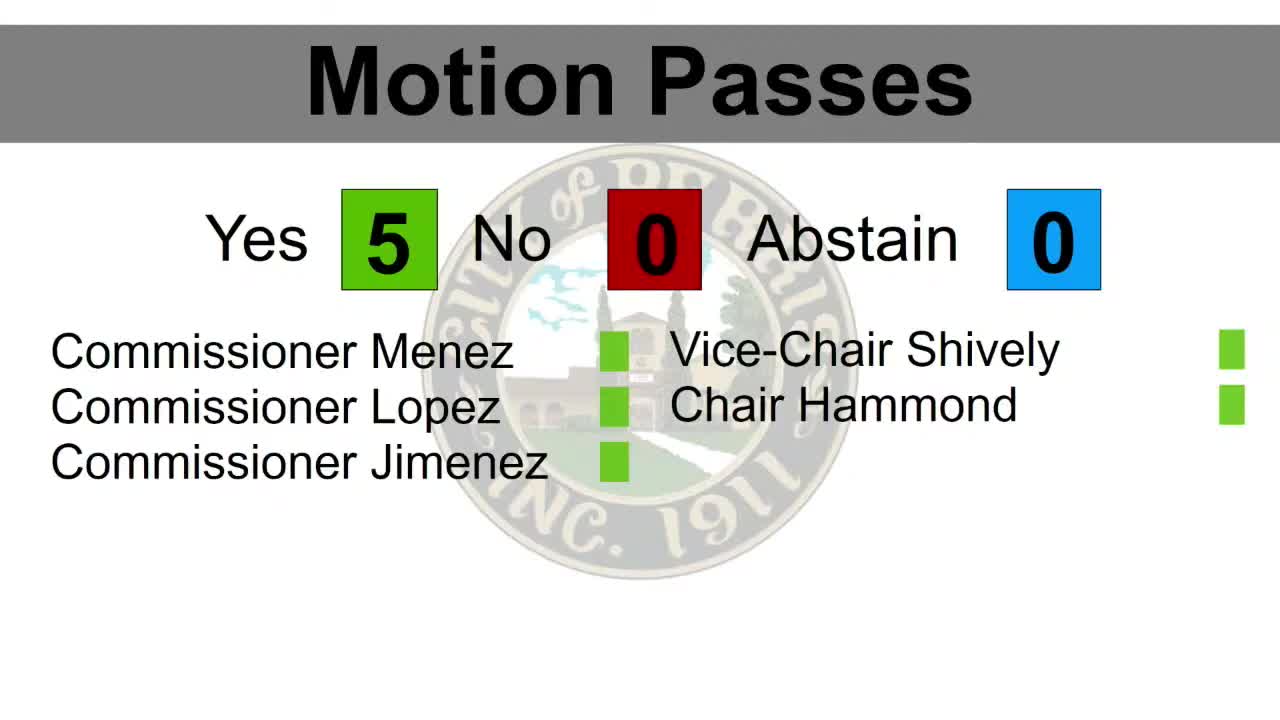
The motion to recommend the revised resolution to council passed on a 5‑0 roll call vote. Commissioner Lopez moved the motion; Vice Chair Shively seconded. The commission instructed staff to clean up the project description and conditions, then return the corrected resolution to the commission as a consent item before it goes to council.
If the City Council follows the commission’s recommendation, the certification of the EIR will include a statement of overriding considerations the commission noted is necessary because the EIR identifies significant and unavoidable impacts related to air quality and cumulative greenhouse‑gas emissions. Staff said three comment letters were received during the 45‑day public review period (from an environmental advocacy group, Riverside County Flood Control and Caltrans) and that mitigation and monitoring measures are part of the resolution’s findings and conditions.
Next steps: staff will prepare a cleaned‑up resolution reflecting the commission’s changes and clarifications and bring it back as a consent adoption item for the commission prior to transmittal to the City Council. Council will have the final decision on EIR certification and the entitlements.
View the Full Meeting & All Its Details
This article offers just a summary. Unlock complete video, transcripts, and insights as a Founder Member.
30-day money-back guarantee
Sponsors
Proudly supported by sponsors who keep California articles free in 2025

