State budget staff urge folding technology‑replacement requests into standard budget to cut 700 agency exceptions
December 04, 2025 | Appropriations, Joint & Standing, Committees, Legislative, Wyoming
This article was created by AI summarizing key points discussed. AI makes mistakes, so for full details and context, please refer to the video of the full meeting. Please report any errors so we can fix them. Report an error »
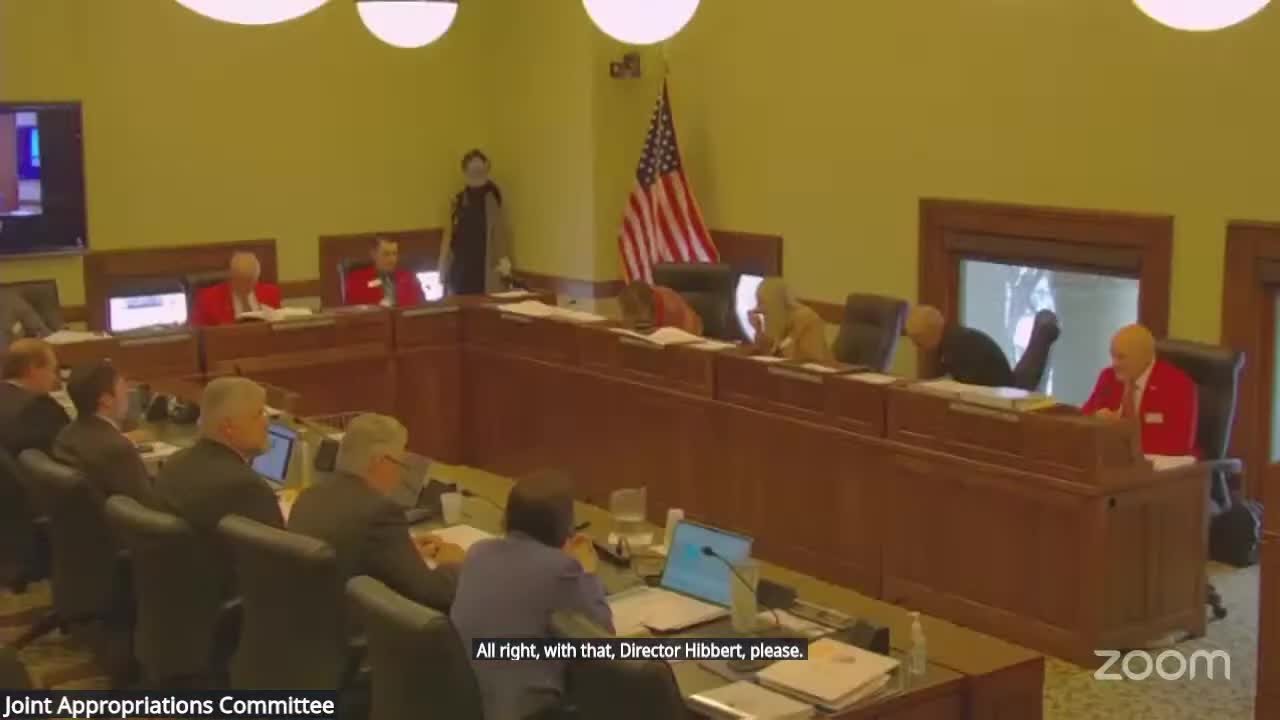
Director Kevin Hibbert told the Joint Appropriations Committee the TRP book was created after an interim discussion to give legislators a single, enterprise view of agency technology replacement requests. He said the rollup shows the TRP total is about $8,290,176 within an $11 billion overall budget request and that the book is designed so the committee "can make TRP discussions and not get distracted at each agency's budget hearing."
Hibbert emphasized that federal grant rules limit how the state can allocate technology purchases. "CFR 200 ... says that computers have to be a direct cost," he said, adding that the Federal Acquisition Regulation also imposes inventory, disposal and reporting requirements when federally funded assets exceed thresholds. For that reason, he said, the state cannot simply pool all agency TRP requests into a single statewide cost allocation without risking the loss of roughly $1.7 million in recoverable federal funds.
Because of those constraints, Hibbert proposed a narrow statutory change that would allow the TRP book — produced by ETS and the State Budget Department — to be referenced in chapter 17 of the budget statutes. "If you were to make that small change in the statute ... you would shrink the total number of requests in the budget by 700," he said, calling 700 an estimate but one he believes is "really close." He added the move would not prevent individual adjustments at the agency level during chapter 17 deliberations.
Committee members probed alternatives: treating TRP like capital construction, adopting a major‑maintenance formula, or making TRP a unit inside ETS. Staff responded that major differences in federal rules and the state’s 0‑based equipment budgeting approach limit those options. Director Hibbert said the key trade‑off is whether the state wants the purchasing and scheduling advantages of an enterprise process while protecting federal and special‑revenue recoveries.
On practicality, ETS and OCIO staff said the TRP book will improve transparency and speed future review cycles. Deputy director Erica Ligurski told the committee the OCIO review identifies standard pricing tied to NASPO agreements and that, where appropriate, ETS could replace scattered exception requests with a single, well‑documented TRP table for the committee to act on. "We could probably replace efficiently 200 to 250 computers a month," Ligurski said, describing the procurement and deployment advantages of consolidating purchases.
Next steps: staff suggested the committee consider drafting narrow language that would permit the TRP book to be included in chapter 17 while preserving agencies’ fund distributions and the committee’s ability to make reductions at the agency level.
Hibbert emphasized that federal grant rules limit how the state can allocate technology purchases. "CFR 200 ... says that computers have to be a direct cost," he said, adding that the Federal Acquisition Regulation also imposes inventory, disposal and reporting requirements when federally funded assets exceed thresholds. For that reason, he said, the state cannot simply pool all agency TRP requests into a single statewide cost allocation without risking the loss of roughly $1.7 million in recoverable federal funds.
Because of those constraints, Hibbert proposed a narrow statutory change that would allow the TRP book — produced by ETS and the State Budget Department — to be referenced in chapter 17 of the budget statutes. "If you were to make that small change in the statute ... you would shrink the total number of requests in the budget by 700," he said, calling 700 an estimate but one he believes is "really close." He added the move would not prevent individual adjustments at the agency level during chapter 17 deliberations.
Committee members probed alternatives: treating TRP like capital construction, adopting a major‑maintenance formula, or making TRP a unit inside ETS. Staff responded that major differences in federal rules and the state’s 0‑based equipment budgeting approach limit those options. Director Hibbert said the key trade‑off is whether the state wants the purchasing and scheduling advantages of an enterprise process while protecting federal and special‑revenue recoveries.
On practicality, ETS and OCIO staff said the TRP book will improve transparency and speed future review cycles. Deputy director Erica Ligurski told the committee the OCIO review identifies standard pricing tied to NASPO agreements and that, where appropriate, ETS could replace scattered exception requests with a single, well‑documented TRP table for the committee to act on. "We could probably replace efficiently 200 to 250 computers a month," Ligurski said, describing the procurement and deployment advantages of consolidating purchases.
Next steps: staff suggested the committee consider drafting narrow language that would permit the TRP book to be included in chapter 17 while preserving agencies’ fund distributions and the committee’s ability to make reductions at the agency level.
Don't Miss a Word: See the Full Meeting!
Go beyond summaries. Unlock every video, transcript, and key insight with a Founder Membership.
✓
Get instant access to full meeting videos
✓
Search and clip any phrase from complete transcripts
✓
Receive AI-powered summaries & custom alerts
✓
Enjoy lifetime, unrestricted access to government data
30-day money-back guarantee
