Trainer urges treating all confined spaces as permit-required after safety overview
December 01, 2025 | Utah Government Trust, Utah Government Divisions, Utah Legislative Branch, Utah
This article was created by AI summarizing key points discussed. AI makes mistakes, so for full details and context, please refer to the video of the full meeting. Please report any errors so we can fix them. Report an error »
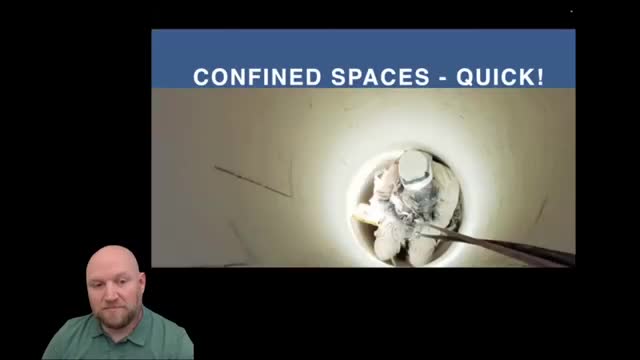
Stagg opened by warning that confined spaces "can get you dead real quick," and said rescuers account for "over 60 percent" of confined-space fatalities, a pattern he attributed to would-be rescuers entering impulsively without taking precautions. He also cited an investigation figure—"139 deaths"—in which no detectors or ventilation were used; he did not provide a formal source for that figure during the webinar.
Why it matters: Stagg argued that many spaces that appear safe can become hazardous after entry, so consistent procedures are essential. He reviewed OSHA's working definition of a confined space—large enough to enter, limited means of entry or egress, and not designed for continuous occupancy—and explained what makes a space "permit-required": potential hazardous atmospheres, engulfing materials, entrapment configurations, or other recognized serious hazards.
Key controls and procedures: Stagg described required elements of a permit-entry program: designation of a competent person, identification of the entry team (entrants, attendants, supervisors, rescue services), air testing, ventilation plans, and cancellation and recordkeeping. He said canceled permits should be retained for at least one year and reviewed at least once a year, with more frequent reviews recommended.
Gas monitoring and alarm limits: Stagg stressed carrying a three- or four-gas meter for each entrant and bump-testing it before use. He gave commonly used thresholds: oxygen should be between 19.5% and 23.5% (normal air is 20.9%); carbon monoxide below 25 parts per million; hydrogen sulfide below 10 parts per million (noting that H2S can deaden smell at high concentrations).
Ventilation and monitoring: Ventilation or air replacement is the first correction for an unsafe atmosphere; once started it must be continuous for the duration of the entry. Intake air must come from a safe location (not a vehicle tailpipe, for example).
Rescue planning and equipment: Stagg warned that local fire or rescue services should not be presumed to be trained or equipped for confined-space rescue and that rescue will likely require a multi-agency response. He recommended planning for self-rescue, using harnesses and retrieval lines anchored to fixed points, and, for entries deeper than 5 feet, provision of a mechanical device (tripod/davit and winch) capable of extrication.
What Stagg recommended attendees do: treat all confined spaces as permit-required, know and test spaces and meters every time, ensure attendants remain attentive, follow permit roles precisely, and prioritize self-rescue preparations so workers "go home safe every single day."
Authorities and sourcing: Stagg repeatedly referenced OSHA definitions and language (for example, using the term "shall" aligned with OSHA phrasing) but did not read or quote a specific OSHA standard number during the webinar; the numerical statistics he cited (e.g., "over 60 percent," "65 percent," and "139 deaths") were presented as factual in his remarks but without a documentary citation in the session.
Next steps: Stagg invited attendees to sign up for an OSHA 10 training for a deeper dive and offered to share sample permits and templates for organizations. The webinar closed with a final reminder to test, ventilate, and document each entry.
View the Full Meeting & All Its Details
This article offers just a summary. Unlock complete video, transcripts, and insights as a Founder Member.
30-day money-back guarantee
Sponsors
Proudly supported by sponsors who keep Utah articles free in 2025

Excel Chiropractic

