State board committee forwards PCAU materials after debate over third-grade content and delivery
November 26, 2025 | Financial Operations , Utah Board of Education, Offices, Departments, and Divisions, Organizations, Utah Executive Branch, Utah
This article was created by AI summarizing key points discussed. AI makes mistakes, so for full details and context, please refer to the video of the full meeting. Please report any errors so we can fix them. Report an error »
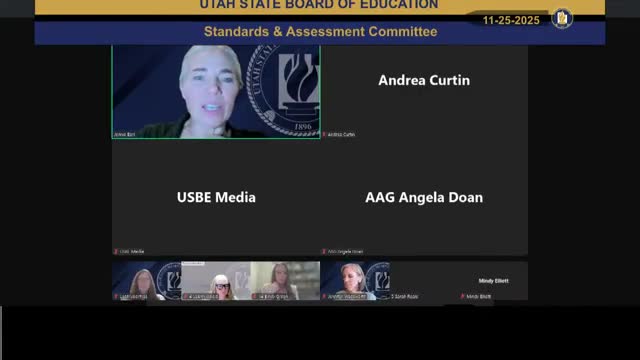
The meeting opened with three public commenters, including Deandra Brown, who identified herself as a survivor and PCAU collaborator. She told the committee that “words matter. Clarity gives children power, and vagueness takes that power away,” and urged the board not to replace explicit terms for abuse with vague labels such as “body safety.” Alex Peterson, another survivor and parent, said prevention lessons could be life-changing and added, “If my 4 kids have to miss 30 minutes of a math lesson or a social studies lesson … that’s a small price for our family to pay.”
Board member Emily Green described attending a third-grade session she said condensed two days of material into a single 35‑minute presentation and raised concerns about the pace and emotional load for 8‑ and 9‑year‑old students. “Having this all of this information given … in a 35 minute presentation is too much,” Green said, urging the committee to ask PCAU to add resilience-building elements and to confirm that wording is developmentally appropriate.
Other committee members raised process and timing concerns. Vice Chair Leanne Wood and Sarah Riel said vendors are under contract and that changing curriculum or delaying approval may disrupt district schedules and provider obligations. Staff and the prevention coordinator, Tanya, said organizations typically provide sample parent-notification forms for local education agencies (LEAs) to adapt and that state policy requires parents be given the option to opt out; the meeting referenced a statutory notice cited in the record as "53 g $9.02 $0.07." A staff member also noted that PCAU’s approval was set to expire in December, which framed options for extending approval while staff and PCAU address the committee’s feedback.
On motions, the committee moved several PCAU-related curriculum items (referred to in the meeting by vendor IDs) to the full board for final approval: item 24846, 24847, 24848 and 24849 (Boundary Town materials) were forwarded to the board for final action in January; item 24838 (an Asian Association of Utah submission) was forwarded for final approval in December. The committee recorded multiple 4–1 votes where one member registered a 'no' and one unanimous approval for the December item; the record does not attribute each 'aye' vote individually. Following discussion, the committee voted 4–1 to direct staff to reach out to PCAU to discuss the committee’s concerns — resilience emphasis and whether language is age-appropriate — and to bring the PCAU curricula (24846–24849) back to Standards and Assessment for consideration. The motion to extend PCAU’s currently used curriculum approval through January 2026 passed unanimously.
The committee framed its next steps as staff-led: staff will convey the committee’s feedback to PCAU, invite PCAU to respond or participate in a future committee meeting, and return revised or clarified materials for further committee consideration. Chair Jenny Earl said the intent was not to criticize providers but to ensure materials used statewide are both accurate and appropriate for the grade levels in which they are presented.
The committee adjourned after completing the motions. The full board will receive the forwarded items and any staff/PCAU responses at upcoming board meetings as scheduled.
View the Full Meeting & All Its Details
This article offers just a summary. Unlock complete video, transcripts, and insights as a Founder Member.
30-day money-back guarantee
Sponsors
Proudly supported by sponsors who keep Utah articles free in 2025

Excel Chiropractic

