Council approves next phase of Public Works site study; consultants recommend 18–20 acre site and larger garage
November 25, 2025 | Verona, Dane County, Wisconsin
This article was created by AI summarizing key points discussed. AI makes mistakes, so for full details and context, please refer to the video of the full meeting. Please report any errors so we can fix them. Report an error »
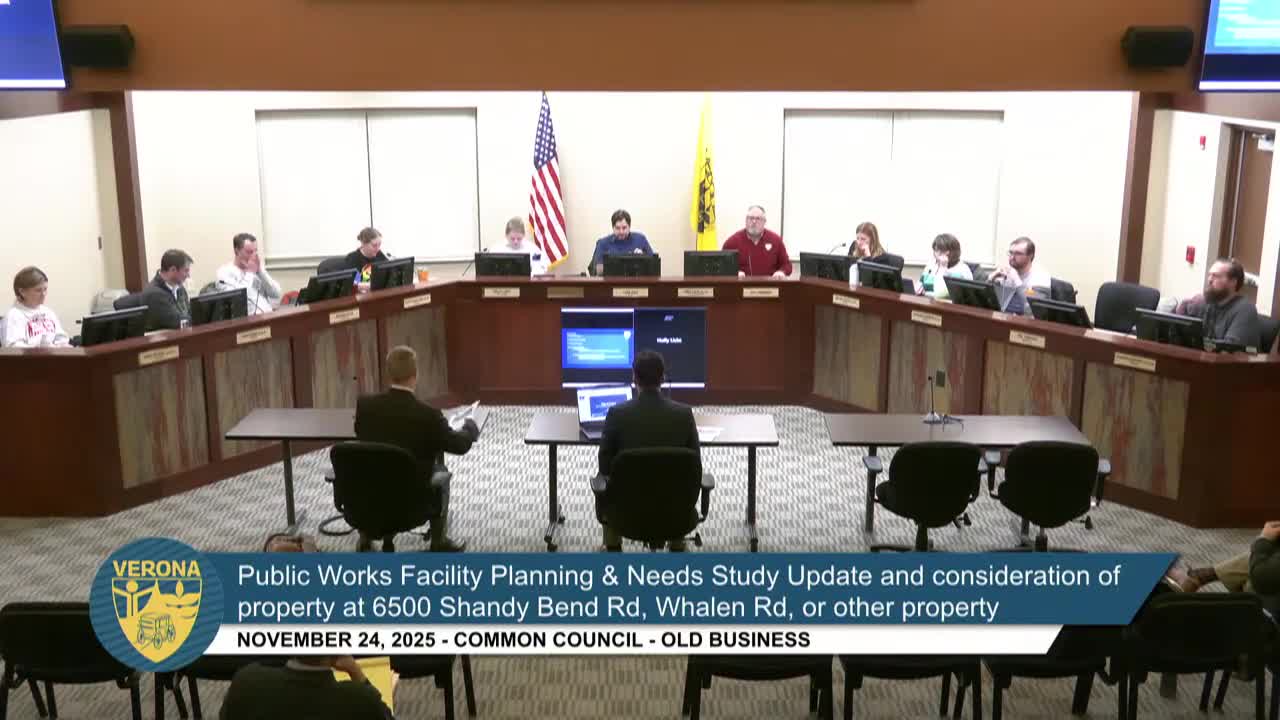
Josh Cook and Patrick Wesley of Barrientos summarized the recently completed task 1 program update and said the city’s service demands and fleet have grown since the firm’s 2017 study. Barrientos reported Verona’s population at about 16,800, current DPW staff of 19 and an existing fleet of roughly 69 vehicles; consultants estimated about 20 additional vehicles over the next 15 years. Based on operational needs and projected growth, Barrientos recommended an optimal facility program of roughly 80,000–85,000 square feet (about double the current 40,000 sq ft) and site acreage in the 18–20 acre range to accommodate buildings, circulation and yard functions (including 2½–4 acres for a civic yard-waste drop-off).
Councilors asked about leasing alternatives, long-term operating costs (including travel-related carbon and crew time), grading and utility extension costs and whether the consultants could provide comparative cost estimates for top candidate parcels. Barrientos said leasing was explored but typically is not a long-term solution for specialized yard and fleet needs, and that the proposed scope (tasks 2 and 3) would include evaluating approximately five parcels, applying a weighted scoring matrix, performing test fits on the top three and preparing conceptual floor plans and one high-level cost estimate for the preferred site; conceptual-design and site-exploration work would take about four months under the existing schedule.
Finance staff told the council capital funds are available for design work (current balance cited at $411,421) and the council approved proceeding with Barrientos for tasks 2 and 3 in an amount not to exceed $26,210. The motion to proceed was moved by Alder Tucker Long and seconded by Alder Swanson and passed without recorded opposition.
What happens next: Barrientos will evaluate candidate parcels, apply the agreed scoring criteria (with council input), narrow to three sites for test fits, then develop conceptual designs and a higher-level cost estimate for the single selected site. Staff and consultants said additional optional cost estimating for more than one top site can be scoped and priced as an add-on.
View the Full Meeting & All Its Details
This article offers just a summary. Unlock complete video, transcripts, and insights as a Founder Member.
30-day money-back guarantee
Sponsors
Proudly supported by sponsors who keep Wisconsin articles free in 2025

