Officials warn House Bill 4024 implementation needs clarifications, funding and new IT work
November 17, 2025 | Legislative, Oregon
This article was created by AI summarizing key points discussed. AI makes mistakes, so for full details and context, please refer to the video of the full meeting. Please report any errors so we can fix them. Report an error »
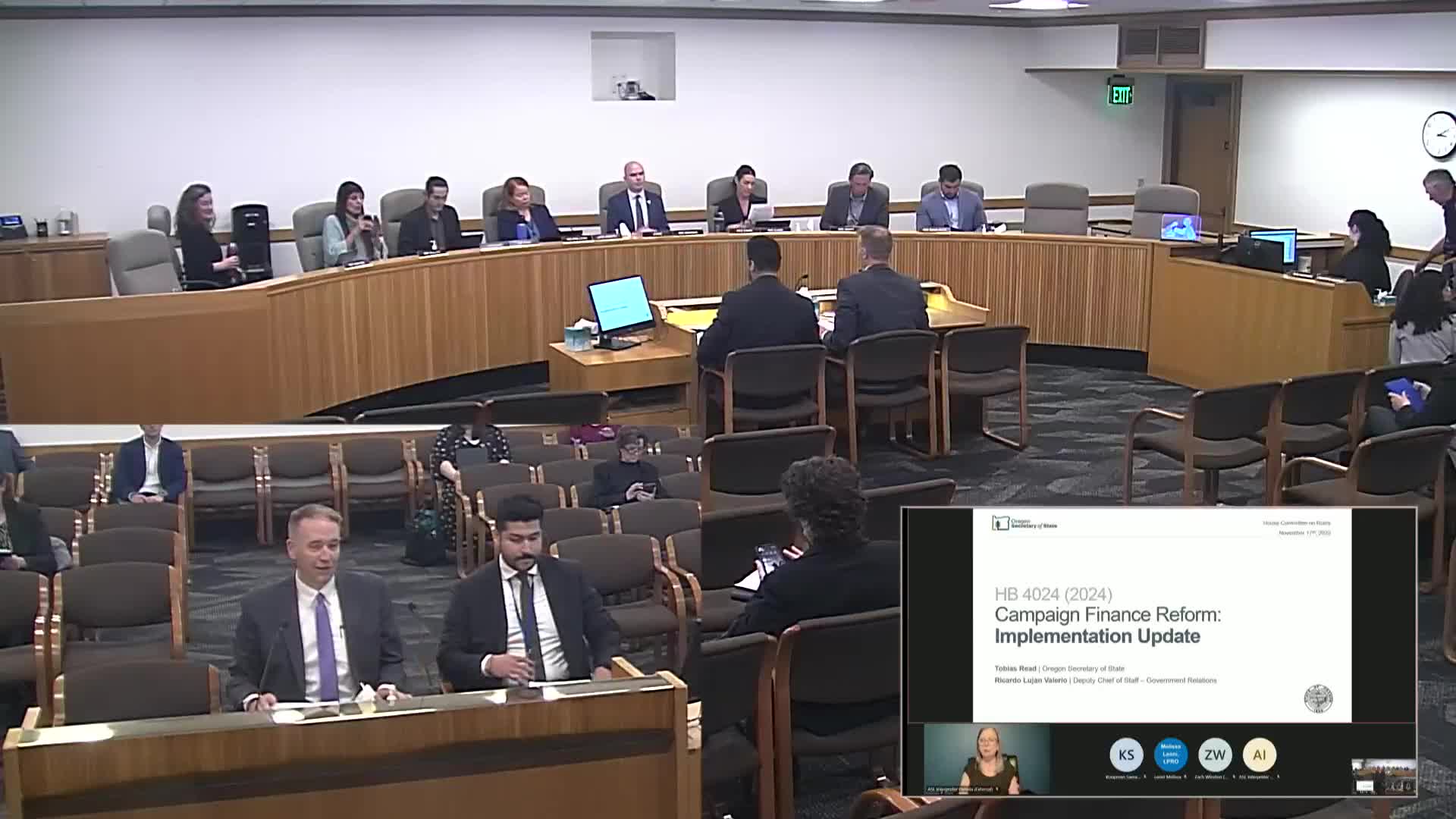
"We're going from 0 to 100 very fast," Secretary of State Tobias Reed said, describing HB 4024's shift to contribution limits, networked-entity rules (EFMC — established, financed, maintained, or control), and requirements to disclose an original source of funds. Reed warned that misinterpretation could expose participants to "big penalties" and that implementation hinges on difficult definitional choices.
Ricardo Lujan Valerio, deputy chief of staff at the Secretary of State’s office, walked the committee through technical and programmatic hurdles: inconsistent time frames for contribution limits (by election, cycle or calendar year), new committee classifications (for example, limiting statewide party committees), liability that extends to contributors, and a public transparency dashboard that will require sensitive personal and business data to link donors across committees.
"To build a public dashboard, we have to collect highly sensitive personal/business data," Lujan Valerio warned, noting that under current public-records law such data may become public and that privacy and security tradeoffs must be addressed by the Legislature. The office also said ORSTAR, the decades-old filing and reporting system, "was not built for this new era" and will likely require replacement to meet the law's requirements by Jan. 1, 2027.
Officials described a compressed timeline of rulemaking and procurement: draft rules were published May 1, 2025; revised proposed rules were issued Sept. 15; public comments accepted through Nov. 21; and the agency must build, test and deploy an updated system in 2026 if the 2027 effective dates are to be met. Lujan Valerio said the office exhausted its existing authority in rulemaking and that legislative clarity is still needed on several items, including the network definitions, original-source tracing, independent-expenditure treatment and recall/different-election dynamics.
Committee members raised concerns about compliance burden and costs for small or first-time candidates. Rep. Alex Carlatos asked whether the added compliance overhead could price ordinary citizens out of running for office; agency staff acknowledged the risk and said penalties under the statute vary by case and could be substantial. Officials repeated that implementing the law will require additional staff (investigators, compliance officers, data analysts), vendor work for a new IT system and likely a larger budget than the initial $5.4 million request from a predecessor administration.
Reed urged the Legislature to clarify statutory questions and to fund the agency: "Strong policy ideas fail without the resources to make them work," he said, and added that the agency will not "declare victory simply by flipping a switch on 01/01/2027 if the system isn't actually working for people." The office committed to continuing public engagement and to returning with budget requests and technical proposals as work proceeds.
Don't Miss a Word: See the Full Meeting!
Go beyond summaries. Unlock every video, transcript, and key insight with a Founder Membership.
30-day money-back guarantee
Sponsors
Proudly supported by sponsors who keep Oregon articles free in 2025

