Parole board hears emotional testimony in Augustine commutation case, denies request
November 17, 2025 | Committee on Parole, Boards & Commissions, Organizations, Executive, Louisiana
This article was created by AI summarizing key points discussed. AI makes mistakes, so for full details and context, please refer to the video of the full meeting. Please report any errors so we can fix them. Report an error »
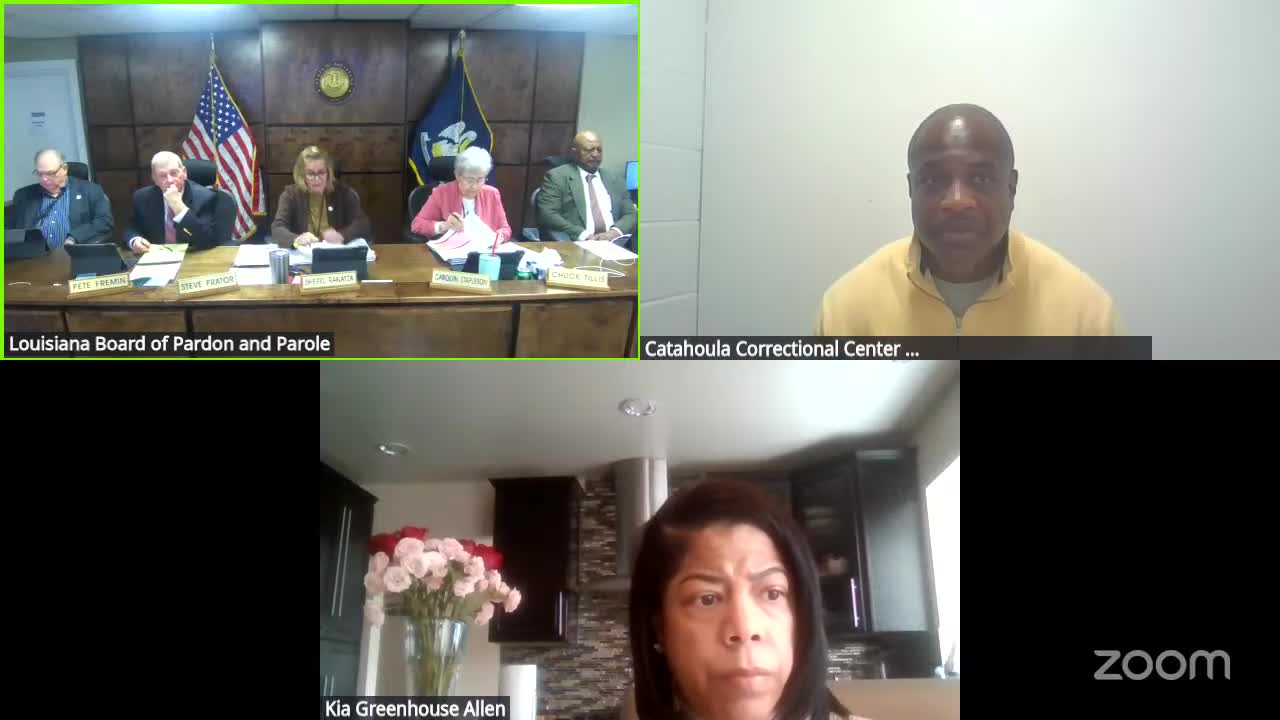
During the Catahoula Correctional Center remote hearing, Augustine acknowledged taking the life of a woman and told the panel he had taken classes and earned a GED while incarcerated. Tanya Stevenson, identified as the transition specialist at the facility, told the board he had served as a trustee and had no behavior problems at the facility.
Family members who appeared by Zoom and at the headquarters spoke in strong opposition. Sherae Lewis said Augustine “took her because of being selfish,” and Kia Greenhouse Allen described Sabitra Greenhouse as a mother whose life was taken in a sanctuary. Casey Greenhouse, who identified herself as the victim’s child, delivered an extended statement about the consequences: “I am here today because my father murdered my mother.” She told the board that she had received a letter from the applicant that she said contained no apology and said the loss shaped her entire life.
Board members acknowledged Augustine’s institutional programming but emphasized the legal and community context: a plea bargain, prosecutor and law‑enforcement opposition, and the depth of victim objection. A board member summarized their reasoning, noting the combination of the plea bargain and opposition from the DA and sheriff, and the panel voted to deny the commutation. Chair Cheryl Renaza announced the outcome: “Mister Augustine, you received 4 votes to deny your application today.”
What the board recorded: The board noted that Augustine received a 40‑year sentence in the 12th Judicial District for a manslaughter conviction, with a good‑time release date of Dec. 23, 2033. Board members said they were impressed with the applicant’s institutional record but that the combination of victim opposition, law enforcement input and the nature of the plea left them unwilling to reduce the sentence now.
Next steps: The applicant’s commutation was denied on the record; the applicant may reapply when eligible. The board’s transcript and vote will be included in the file forwarded to the governor and will be part of any future consideration.
View the Full Meeting & All Its Details
This article offers just a summary. Unlock complete video, transcripts, and insights as a Founder Member.
30-day money-back guarantee
Sponsors
Proudly supported by sponsors who keep Louisiana articles free in 2025

