County consultants report favorable PFAS risk results and successful installation of permeable reactive barrier at fire training site
November 19, 2025 | Barnstable County, Massachusetts
This article was created by AI summarizing key points discussed. AI makes mistakes, so for full details and context, please refer to the video of the full meeting. Please report any errors so we can fix them. Report an error »
John Pacman, principal hydrogeologist with GZA, said the team installed 16 additional multilevel monitoring wells and a broad sampling program that included more than 80 wells in May. That work clarified groundwater flow (about 1–1.5 feet per day in highly permeable Cape Cod sands) and defined a primary plume extending southeast toward the Mary Dunn supply wells. The team also identified a separate off‑site “mystery plume” whose source is not yet determined.
GZA and GHD described their ecological and human‑health evaluations. Bill, GHD’s ecological risk assessor, said the team collected fish, insect and benthic samples and used standard receptor models to compare exposure doses to accepted no‑effects thresholds. "Everything here is less than 1 under the no effects," he said, noting only two modest exceedances (benthic invertebrates in Flintrock Pond at 1.7 and a robin in site soils at 1.6) that the team characterized as minor and de‑minimis under their framework.
On human health, GZA reported a favorable initial screening from an in‑house public‑health scientist and credited earlier wellhead treatment for removing the primary drinking‑water exposure pathway. "When you eliminate that pathway, that cuts out a lot of risk to human health," Pacman said.
The consultants described possible contributors to the mystery plume, including industrial areas and the Barnstable wastewater treatment facility. They are gathering historical property records and additional sampling to strengthen a multiple‑lines‑of‑evidence approach to source identification and to frame where responsibility and further work should be pursued.
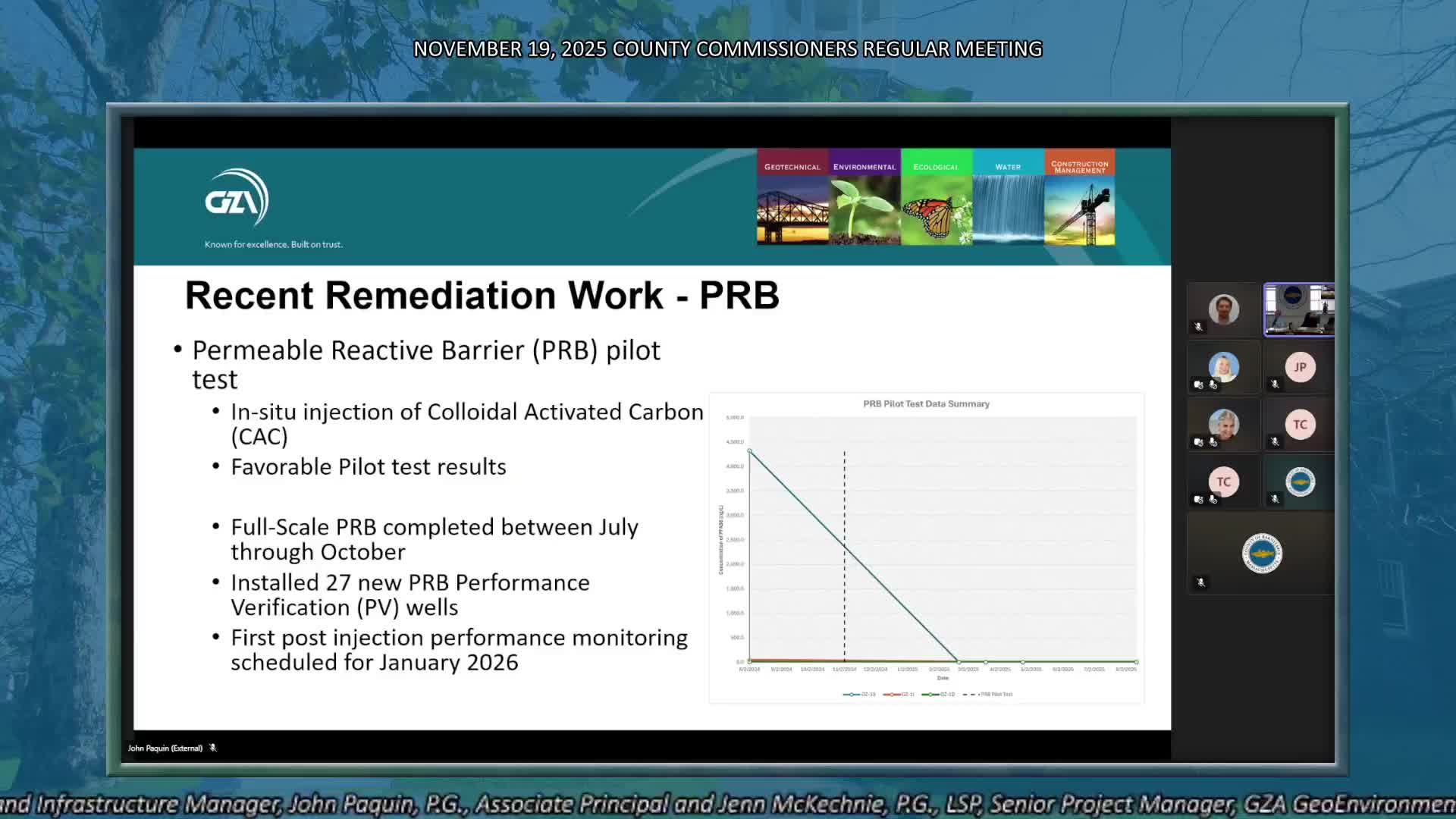
The meeting included a progress update on remediation: GZA said the permeable reactive barrier (PRB) was injected between July and October using material supplied by Regenesis (product name presented as PlumeSTOP). Pilot test monitoring showed rapid declines to very low or nondetectable PFAS concentrations after injection; the full‑scale PRB and 27 performance‑verification wells are installed. The team plans the first post‑injection monitoring in mid to late January.
Consultants described ancillary repairs and upgrades at the older pump‑and‑treat containment system — lines clogged with iron precipitate were jet‑cleaned and cleanouts added after vandalism and long‑term clogging. Pacman said the county may recommend terminating the pump‑and‑treat system if monitoring shows the PRB provides effective containment and treatment, reducing ongoing operating costs.
Next steps the team cited are completion of the Phase 2 comprehensive site assessment (ecological and human health components), performance monitoring of the PRB, and consultation with Massachusetts Department of Environmental Protection to clarify the disposal‑site boundary that will determine which off‑site investigations the county should pursue or hand over to state authorities. The consultants said the MCP (Massachusetts Contingency Plan) framework will guide remedial decisions and that continued public engagement and data sharing with the airport, the water district and Hyannis civic groups is ongoing.
Tom Kimberere, who said he has followed the work and coordinated with community members in Hyannis, thanked the team for transparency and thoroughness. The county said it will report monitoring results and DEP guidance to future meetings.
View the Full Meeting & All Its Details
This article offers just a summary. Unlock complete video, transcripts, and insights as a Founder Member.
30-day money-back guarantee
Sponsors
Proudly supported by sponsors who keep Massachusetts articles free in 2025

