Boynton Beach commission approves several charter and ordinance measures, then delays certification of some to review timing
November 19, 2025 | Boynton Beach, Palm Beach County, Florida
This article was created by AI summarizing key points discussed. AI makes mistakes, so for full details and context, please refer to the video of the full meeting. Please report any errors so we can fix them. Report an error »
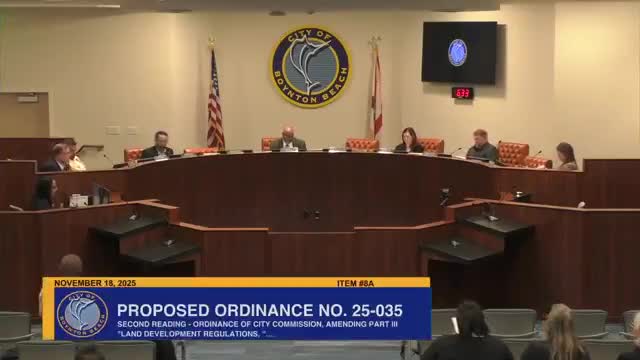
City Clerk May Lee read proposed ordinance 25‑035, an amendment to procedures for relief applications under the land‑development code, and staff reported “no changes” since first reading. Commissioners voted unanimously to adopt the ordinance on second reading. The commission likewise approved ordinance 25‑136, establishing procedures for public‑private partnerships, with staff saying the amendment updates city code to align with recent changes in Florida statute.
Clerk May Lee then read three charter amendments slated for submission to a March 2026 referendum: a proposed preamble to the charter (25‑037), an amendment to require continuous residence prior to filing for office (25‑038), and a cleanup replacing masculine‑only pronouns and updating notice/publication requirements (25‑041). On 8D, Commissioner Turpin proposed changing the residency requirement from one year to continuous two years; multiple public speakers and commissioners supported the longer period. Commissioners voted to amend 8D to require continuous two‑year residence prior to filing and approved the ordinance on second reading by roll call.
Afterward commissioners raised the fiscal and logistical cost of running citywide referendums and the recently extended certification deadline from Dec. 5 to Dec. 10. Several members questioned whether holding stand‑alone citywide referendums in March — which would require ballots and precinct locations citywide — was the best use of funds if races are uncontested. Following that discussion, the commission made and carried a motion to reconsider items 8C, 8D and 8E and then to instruct the clerk not to certify those ordinances until the commission provides further direction at its Dec. 2 meeting.
The commission characterized the action as procedural rather than substantive: the ordinances remain approved by vote, but certification and formal submission to the supervisor of elections will be delayed to allow the commission to evaluate timing, costs and whether a mail‑ballot option is preferable. Clerk May Lee said the changed deadline gives the commission time to decide and to consult the supervisor of elections about mail ballots and costs.
Next steps: staff will report back at the Dec. 2 meeting with options and cost estimates for certification and election method; until that direction is given, the clerk will hold certification for the three charter items.
View the Full Meeting & All Its Details
This article offers just a summary. Unlock complete video, transcripts, and insights as a Founder Member.
30-day money-back guarantee
Sponsors
Proudly supported by sponsors who keep Florida articles free in 2025

