Prescott staff outline draft long-term water management plan, target draft mid-2026
November 19, 2025 | Prescott City, Yavapai County, Arizona
This article was created by AI summarizing key points discussed. AI makes mistakes, so for full details and context, please refer to the video of the full meeting. Please report any errors so we can fix them. Report an error »
At a study session Mayor Goode and council members heard that consultants Herb Dischlop (consultant), Matrix New World and Corolla Engineering will run hydrology and infrastructure scenarios and that the city aims to have consultants contracted and a kickoff meeting in early 2026. "We need a plan," said Brian Reese, the city's water resource manager, summarizing the objective to address time horizons from tomorrow to 50 years.
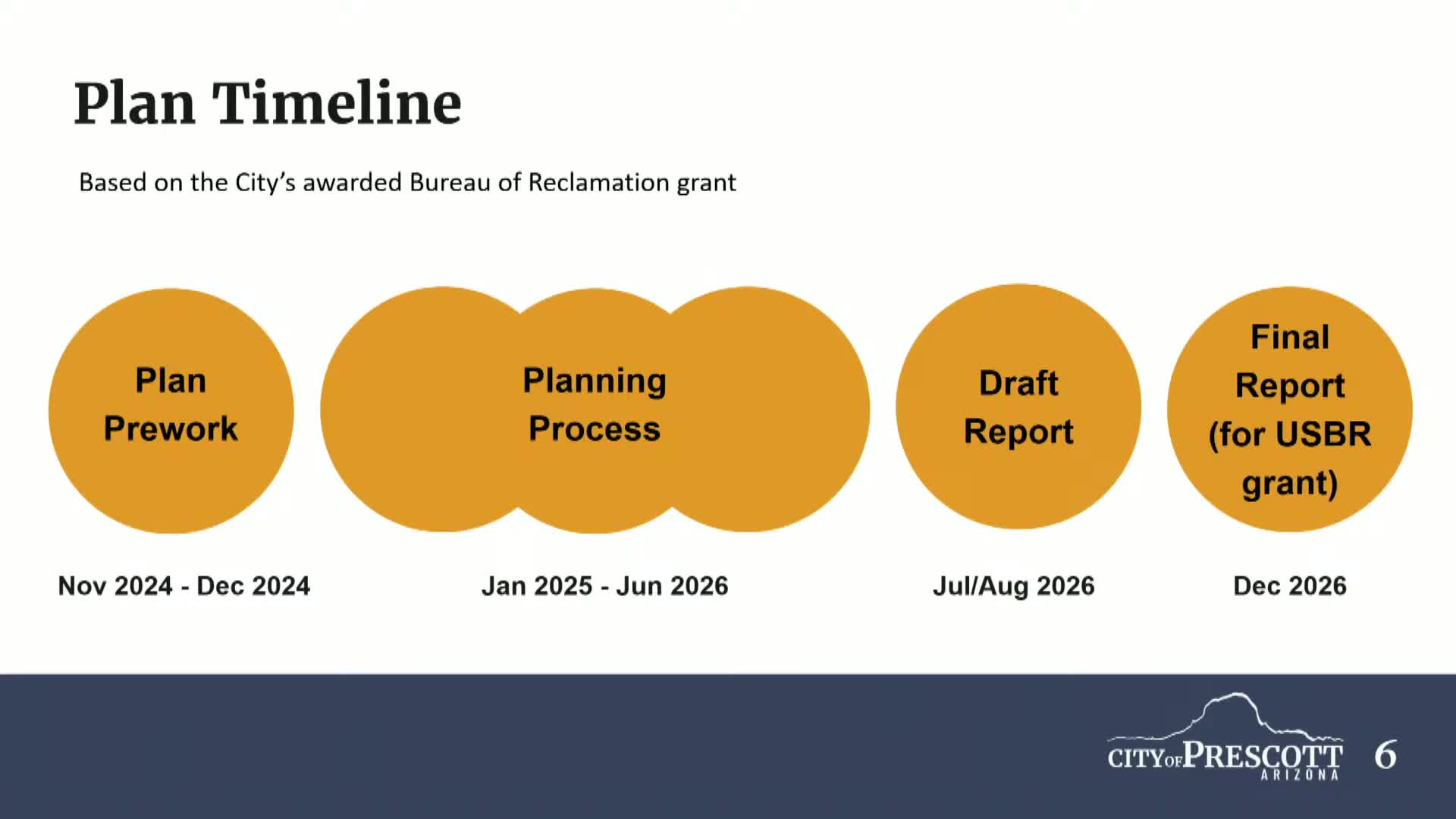
Why it matters: staff tied the planning timetable to an awarded Bureau of Reclamation grant that requires a final report by Dec. 2026; staff said a draft report is expected in July–August 2026. The plan will inform future council choices on growth, codes and water policy and will account for binding obligations such as intergovernmental agreements and the city's role in an Indian water‑rights settlement.
Key findings presented
- Baseline and service area: Staff used 2024 as the baseline year and reported 25,573 municipal accounts in 2024. Dischlop said account-based billing provides the most reliable basis for demand forecasting.
- Supply mix and regional role: Prescott relies on three supply types—groundwater, reclaimed (effluent) water and surface water from Granite Creek and local reservoirs. Staff reported the city delivered about 7,200–7,300 acre‑feet in 2024 and supplied roughly 38% of delivered water within the Prescott Active Management Area (AMA); Prescott accounted for about 26–27% of groundwater pumping in the AMA in 2024.
- Reclaimed water and storage accounting: Return flows (effluent) averaged about 68% of potable deliveries, staff said. The city recharges reclaimed water and must decide how much to count as annual storage versus bank as long‑term storage credits under existing requirements. "How you balance that out… is clearly a policy call," Dischlop said.
- Demand details: Single‑family accounts averaged about 0.163 acre‑feet in 2024 (≈53,000 gallons) while the median single‑family account was about 0.133 acre‑feet (≈43,000 gallons), reflecting skew from high‑use outliers. Multifamily averaged ~0.092 acre‑feet per unit; nonresidential customers accounted for roughly 34% of delivered volume.
- Nonpotable large users and infrastructure loss: Staff flagged several permanent large nonpotable users (golf courses and a sand‑and‑gravel operation) that materially affect the potable/nonpotable split. Systemwide loss and unaccounted‑for water totaled 8.9% in 2024 (below the 10% regulatory standard), a figure staff said can be reduced with infrastructure and metering improvements.
Policy and legal constraints
Consultants walked the council through the regulatory framework that constrains local options, including federal water‑quality laws such as the Safe Drinking Water Act and the Clean Water Act, state oversight by ADWR, and the Groundwater Management Act of 1980, which governs active management areas and pumping rules. Dischlop also noted the city is a party to a federal Indian water‑rights settlement that creates service obligations to the reservation.
Questions and next steps
Council members asked how the analysis would disaggregate commercial uses and whether policies should limit future high‑use irrigation accounts such as additional golf courses. Council members also pressed staff to include reservoir capacities (Goldwater, Watson and Willow Lakes) and siltation in scenarios; staff said Corolla's scope includes surface‑water interconnect and capacity analysis.
Staff said obligations mapping is ongoing: the city has catalogued hundreds of historical contract‑type documents (service agreements, will‑serve letters, easements and intergovernmental agreements) that create future demand and will be connected to the water‑resource model. Staff reiterated the planned schedule: contractors under contract and a kickoff in early 2026, scenario modeling and draft results mid‑2026, and a final report by Dec. 2026 to meet the grant condition.
The study session adjourned with the council scheduled to reconvene at 3:00 p.m. for its voting meeting.
Don't Miss a Word: See the Full Meeting!
Go beyond summaries. Unlock every video, transcript, and key insight with a Founder Membership.
30-day money-back guarantee
Sponsors
Proudly supported by sponsors who keep Arizona articles free in 2025

