Minneapolis committee receives 2026 legislative policy recommendations including funding asks, digital signage proposal and civil-rights expansion
November 19, 2025 | Minneapolis City, Hennepin County, Minnesota
This article was created by AI summarizing key points discussed. AI makes mistakes, so for full details and context, please refer to the video of the full meeting. Please report any errors so we can fix them. Report an error »
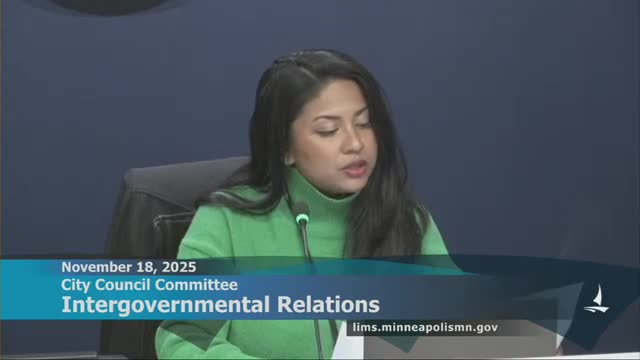
The briefing, prepared through the city’s Policy Liaison Team (PLT), identified 10 new or amended positions that staff said respond to operational needs raised by departments. "This responsibility is now ours," said Steve Fuser, senior government relations representative, referring to municipal responsibilities for candidate filing and campaign finance after a 2022 state law change shifted duties from Hennepin County to the City of Minneapolis.
Why it matters: The PLT recommendations will form part of the city’s legislative agenda for the 2026 session and include items with budgetary implications and requests for new state authority. The committee did not vote on any positions; staff said formal action will be taken early next year.
Key proposals summarized in the presentation:
- Elections and campaign finance: Staff proposed asking the state for clarifying statutory language governing municipal candidate filing and campaign finance reporting to fill gaps created when responsibilities moved to the city's Elections Office in 2022.
- Digital signage/entertainment-district revenue: CPED staff proposed authority to create an entertainment-district overlay that would allow digital outdoor advertising in specified districts and charge a fee, with revenues earmarked for public art or public-safety improvements. Staff noted that current state law prevents charging such a fee and that legislative authorization would be required.
- Energy-code enforcement funding: The health department’s sustainability team asked the state for $500,000 in ongoing funding to place building-science and new-technology experts in local jurisdictions to support enforcement of residential and commercial energy codes.
- Cannabis policy updates: CPED proposed four measures: restore local cannabis aid removed from the recent state budget, streamline local site approval and Building and Fire Code sign-offs, study impacts of license transfers, and allow employers more discretion for hiring in the cannabis industry to address employment restrictions tied to prior offenses.
- Data privacy for violence-prevention programs: Neighborhood Safety requested that the state consider carving certain Group Violence Intervention and youth‑program participant and volunteer data out of public Chapter 13 data so that those interacting with programs could be assured of privacy protections and potentially increase participation.
- Water affordability program: Public Works proposed supporting creation of a statewide low‑income water services affordability program funded through a statewide fee on service connections for drinking water and wastewater systems, with an opt-out provision for local governments that prefer to run local programs.
- Municipal State Aid (MSA) design flexibility: Staff asked the state to clarify support for allowing cities to use alternative design standards (for example, MnDOT or NACTO guidance), expand the MSA variance process, and add appeal procedures; MSA eligibility applies to cities above 5,000 population and is funded by the highway user tax distribution fund (gas tax) with a local 20% use limitation described in the presentation.
- Solid-waste proposals: Solid Waste and Recycling requested investments and workforce-development programs for reuse, recycling and deconstruction of construction and demolition (C&D) materials and supported a statewide food-disposal ban requiring large food generators to use organics recycling and divert edible food for consumption.
- Civil-rights expansion: The Civil Rights Department proposed amending the Minnesota Human Rights Act to add protections for justice-impacted status, housing status, and height and weight to align state law with a recent city ordinance.
Committee discussion highlighted local priorities and cross-cutting concerns. Council Member Wansley outlined three items she plans to champion in January — a nonfatal shooting task force modeled on Ramsey County’s program, a 20‑year extension of the University of Minnesota’s Good Neighbor Fund focused on food security, and a second phase of pedestrian lighting in Dinkytown. Chair Oreen Chowdhury and staff discussed how the city’s ongoing Biz Committee pause on off‑premises digital signs intersects with the legislative pursuit of a fee-based overlay district; CPED offered to provide additional briefings.
The clerk received and filed the PLT presentation; staff said the formal 2026 legislative positions document will be edited to incorporate the PLT items and returned to the committee for consideration early next year.
Quotes from the meeting:
"This responsibility is now ours," said Steve Fuser of the elections proposal, describing the 2022 shift of filing and campaign-finance duties from Hennepin County to the city. "We would be supporting the creation of this [water-affordability] program," Public Works staff said of the proposed statewide fee-funded assistance program.
Next steps: Staff will prepare an edited legislative positions document reflecting today’s PLT recommendations for committee review and formal action in the new year.
Don't Miss a Word: See the Full Meeting!
Go beyond summaries. Unlock every video, transcript, and key insight with a Founder Membership.
30-day money-back guarantee
Sponsors
Proudly supported by sponsors who keep Minnesota articles free in 2025

