Council asks NOAA Fisheries to review whiting EFP after tribal, angler and industry testimony
November 19, 2025 | Fishery Management Council, Pacific, Governor's Office - Boards & Commissions, Executive, Washington
This article was created by AI summarizing key points discussed. AI makes mistakes, so for full details and context, please refer to the video of the full meeting. Please report any errors so we can fix them. Report an error »
The motion — which a council member described as a request for NMFS to “consider the complete record” rather than an endorsement — passed after more than three hours of public comment and council discussion. The motion carried with a majority in favor; two council members registered “no” votes and one abstained.
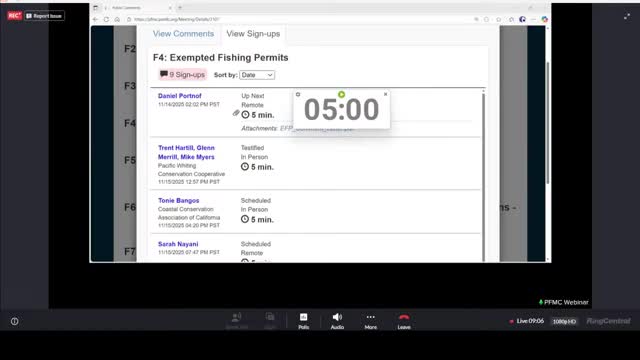
The meeting opened by returning to agenda item F4, where dozens of stakeholders had sought time to speak. Daniel Portnoff, a graduate student at Scripps Institution of Oceanography, urged caution and asked the council to defer endorsement because “California salmon fishery remains in crisis” and even a 500‑fish incidental cap could pose material risk to vulnerable Chinook runs.
Tribal representatives made similar pleas. Keith Parker, senior fisheries biologist for the Yurok Tribe, read a letter from the tribe’s chairman opposing an EFP and described the cultural and subsistence implications: “We don’t have 500 Klamath Chinook to sacrifice currently,” he said, noting tribal in‑river quotas remain very low after major dam removals and rebuilding efforts.
Recreational and coastal business speakers told the council the past three years of salmon closures have devastated guides, retailers and related services. Toni Bangos of the Coastal Conservation Association of California said the proposal risked undermining the state’s salmon rebuilding plan: “We cannot afford this test,” she said.
Industry and applicant witnesses described the EFP as precautionary and highly monitored. Sarah Niani of Arctic Storm Management Group, a co‑applicant, said the application includes “100% monitoring on catcher vessels, 200% observer coverage on motherships and catch processors,” and argued moving mothership processors south could reduce incidental salmon bycatch by allowing vessels to harvest cleaner aggregations. Heather Mann, executive director of the Midwater Trawlers Cooperative, told the council the application was unusually detailed and supported moving forward “as long as” the specified precautionary provisions remain in place.
Council members pressed both sides for data. Several asked applicants and agencies to clarify historical catch and incidental mortality south of 42° and to provide genetic or sampling results that would show which Chinook stocks are being intercepted. NOAA staff said the agency will need to weigh the council record alongside its own environmental and enforcement review and noted staff workload constraints following a recent furlough.
The council’s motion asked NOAA Fisheries to consider the EFP application and “the complete record,” including advisory‑body recommendations and public comment received at the meeting. A council member emphasized the vote was not an endorsement but a request that NMFS examine the application with full context and analysis.
What’s next: NOAA Fisheries (NMFS) will review the record, perform its statutory environmental and legal analysis under the Magnuson‑era regulations and publish its own findings and any Federal Register notices as appropriate. Council members and advocates said they expect additional technical briefings and that NMFS will report back to the council in coming months.
View the Full Meeting & All Its Details
This article offers just a summary. Unlock complete video, transcripts, and insights as a Founder Member.
30-day money-back guarantee
Sponsors
Proudly supported by sponsors who keep Washington articles free in 2025

