Committee advances bill to dedicate property for long‑term affordable rentals after debate over AMI caps
November 17, 2025 | Honolulu City, Honolulu County, Hawaii
This article was created by AI summarizing key points discussed. AI makes mistakes, so for full details and context, please refer to the video of the full meeting. Please report any errors so we can fix them. Report an error »
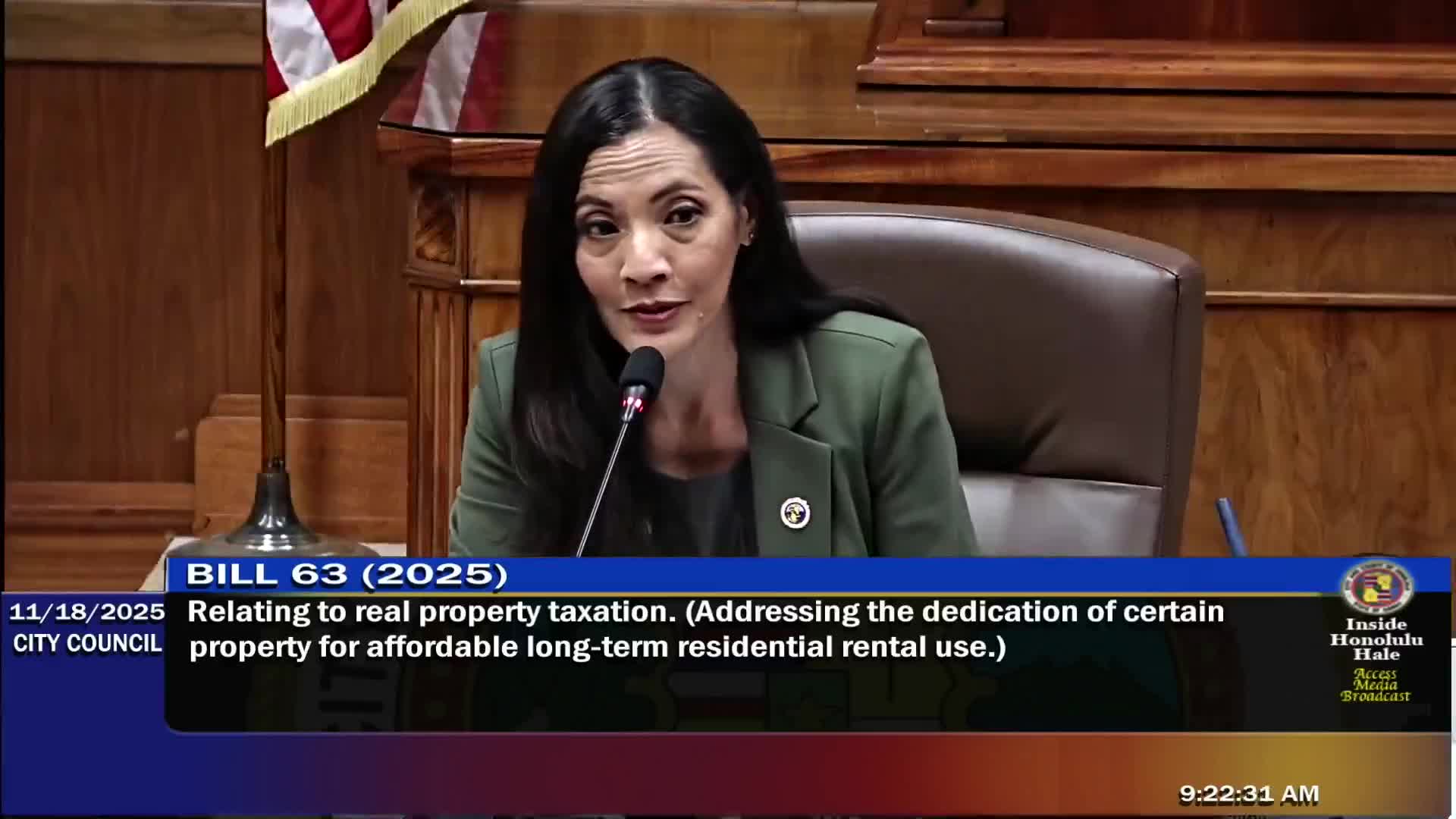
Director of Budget and Fiscal Services Andy (Kolano/Kawano in the transcript) told the committee the department "support[s] bill 63" and said staff had worked with Councilmember Kia Aina on the measure. Councilmember Aina pushed for raising the AMI cap from 80% — which she said had produced no takers — to a higher threshold to increase uptake by property owners. "I thought that by trying to increase the AMI, we might get some takers," Aina said.
The committee discussed concrete rent examples tied to AMI tiers. Councilmember Aina cited figures for a 100% AMI cap (a studio listed at $2,660 and a four‑bedroom up to $4,410) and contrasted them with figures for a 140% AMI cap (a studio at $3,724 and a four‑bedroom at $6,174), warning higher AMI may approach market rates. Director Kawano/ Kolano cautioned the fiscal impact was unknown: "Until we get this going, we don't really have any... we don't know the fiscal impact right now," he said, and added that raising AMI "will broaden the net of the homeowners that could possibly qualify the property as being for rental residential use," which could affect tax classifications and revenue.
To address concerns about implementation, Councilmember Aina proposed a verbal amendment to RO 8 §8‑7.6(l) to make director rulemaking permissive — changing 'shall' to 'may' for the adoption of implementing rules — and restated the CD1's intent to incentivize owners by allowing residential tax treatment for properties offered as affordable long‑term rentals using AMI‑based rent caps. The chair recommended that Bill 63 be amended to the posted CD1 and incorporate the additional amendments discussed, and the committee reported the bill out for a second reading and scheduling of a public hearing.
Committee members asked departments to evaluate the fiscal consequences of raising AMI and to report back. The committee did not record a roll‑call vote in the transcript; actions were taken by the chair's recommendation with no objections recorded.
Next steps: Bill 63 will return to the council calendar for a second reading and a public hearing; the Budget Department and Housing and Land Management are expected to prepare follow‑up fiscal analysis and implementation details before the hearing.
View the Full Meeting & All Its Details
This article offers just a summary. Unlock complete video, transcripts, and insights as a Founder Member.
30-day money-back guarantee
Sponsors
Proudly supported by sponsors who keep Hawaii articles free in 2025

