Garden City planning commission recommends denial of agricultural special‑use for two vacant lots
November 17, 2025 | Garden City, Wayne County, Michigan
This article was created by AI summarizing key points discussed. AI makes mistakes, so for full details and context, please refer to the video of the full meeting. Please report any errors so we can fix them. Report an error »
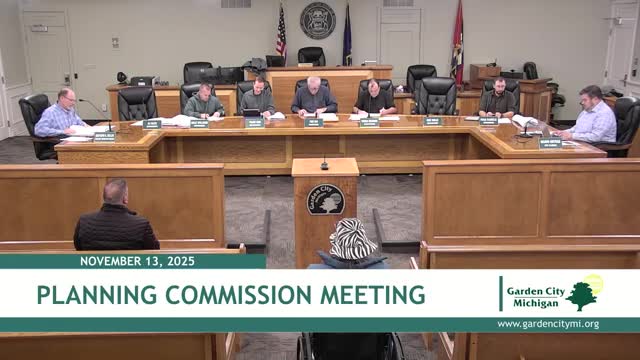
The commission voted to forward a denial recommendation to council, 3–2, after staff and commissioners said the proposed operation raised compatibility concerns with surrounding single‑family homes and because the city zoning code lacks specific standards for small commercial agricultural operations on lots without a principal residence.
Planning staff told commissioners the two lots total roughly 14,850 square feet and that the zoning ordinance lists gardening and agricultural production as a special land use in R‑1 but does not supply detailed operation standards or parking rules for such uses. Staff repeatedly identified "compatibility" with adjacent residences as the central approval criterion for a special land use.
The applicant told the commission he has farmed the lots for three years and described plantings of garlic, lilies, elderberries and clover. He said he had been inspected and that he is "GAMP compliant" under Michigan's Right to Farm Act, and that he does not intend to use manure or artificial pesticides. "I'm compliant with the state. That means I have a right to farm," he said during public comment.
Several commissioners said the jurisdiction of the Right to Farm Act differs from local land‑use approval and that the commission's responsibility is to determine whether the request meets local special‑use criteria. Commissioners repeatedly flagged three municipal citations previously issued at the property (excess refuse, high grass and a parking violation) as evidence of existing neighborhood friction.
Commissioners who opposed the recommendation said they value community gardens but worried the scale of a standalone agricultural operation on lots without a principal residence, the proximity of a neighboring house (about 60 feet to the north), the lack of screening, and the potential for odor or future expansion make the use incompatible in an R‑1 district. One commissioner summarized the concern: "I'm just not sure this is compatible with the neighbors being as close as they are."
Other commissioners suggested the commission could consider conditions if council chose to allow the use — such as prohibiting delivery of commercial manure and forbidding on‑site processing — but the majority concluded the application did not meet the special‑use standards for compatibility.
Because the commission recommended denial to the city council, commissioners also voted 5–0 to table separate site‑plan review pending council action and any required variances or ZBA interpretations (for example, whether an accessory structure could be allowed without a principal residence).
The commission's recommendation is advisory; the City Council will make the final decision if the applicant pursues the request to council or seeks a ZBA interpretation or variance.
Don't Miss a Word: See the Full Meeting!
Go beyond summaries. Unlock every video, transcript, and key insight with a Founder Membership.
30-day money-back guarantee
Sponsors
Proudly supported by sponsors who keep Michigan articles free in 2025

