Neighbors press planners to delay Blodgett/Corwell parking-ramp expansion as traffic, safety and light concerns mount
November 17, 2025 | East Grand Rapids, Kent County, Michigan
This article was created by AI summarizing key points discussed. AI makes mistakes, so for full details and context, please refer to the video of the full meeting. Please report any errors so we can fix them. Report an error »
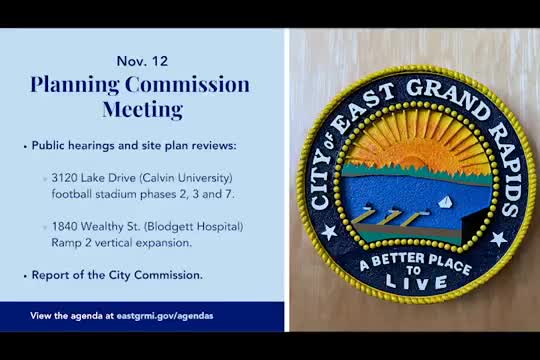
City staff summarized the request as a vertical expansion on the existing footprint that does not require variances under current code; staff recommended conditions if approved, including signal-timing optimization, light shields, landscaping and a six-month post-construction traffic verification paid for by the hospital if level-of-service worsens.
Hospital leaders said the expansion aims to address frequent shortages that impede patients and visitors. John Ashford, Corwell’s chief operating officer, said the emergency department alone will see roughly 45,000 patients this year and that prior manual counts showed many days with zero available spaces in the northern ramp; parking and access problems, he said, harm patient experience.
Neighbors disputed that the expansion was the right remedy. Dozens of residents described years of construction, traffic queuing on Plymouth Avenue, headlight glare into homes, light pollution, and safety concerns at the busy Plymouth & Lake intersection. Resident Robert Aspoff recounted being struck by a Corwell employee while walking in a marked crosswalk: "I was hit and seriously injured by a car driven by a Corwell employee… I suffered a concussion, broken back, vertebrae, and broken ribs," he said, urging the commission to delay action until corrective signal work is completed and verified.
Traffic consultant Kyle Ritzman presented modeling that forecasted most study intersections would remain at acceptable service after mitigation, but noted a southbound approach at Plymouth & Lake could operate at level-of-service F in the PM peak without mitigation. Ritzman and staff said signal-timing optimization and leading-pedestrian intervals or push-button LPIs could bring the approach to acceptable levels; staff recommended a post-construction verification six months after completion, with Corwell responsible for mitigation costs if the intersection performed worse than level D.
Commissioners raised several unresolved issues: whether the ramp should be considered a two-and-a-half or multi-story structure for zoning purposes, the visual impact of an added level visible to adjacent homes, headlight glare, LED color temperature, options for mechanical screening or vertical fins to soften precast facades, and whether a deed restriction could permanently limit future increases in height. Several commissioners said they were sympathetic to the hospital’s operational arguments but wanted additional assurances for neighbors.
Outcome: Commissioners did not vote and directed staff to work with Corwell to produce additional materials — photometric plans, pedestrian counts, acoustical measures as relevant, refinements to screening and material choices, documentation about crane/construction logistics, and legal counsel input on deed restrictions — and to return with revised materials. The matter remains active on a future agenda.
Next steps: Applicant to submit requested studies and designs; staff will circulate materials to commissioners and neighbors before the commission takes final action.
Don't Miss a Word: See the Full Meeting!
Go beyond summaries. Unlock every video, transcript, and key insight with a Founder Membership.
30-day money-back guarantee
Sponsors
Proudly supported by sponsors who keep Michigan articles free in 2025

