Parents and teachers urge Sylvania Schools board to reject proposed high‑school PE waiver
November 18, 2025 | Sylvania Schools, School Districts, Ohio
This article was created by AI summarizing key points discussed. AI makes mistakes, so for full details and context, please refer to the video of the full meeting. Please report any errors so we can fix them. Report an error »
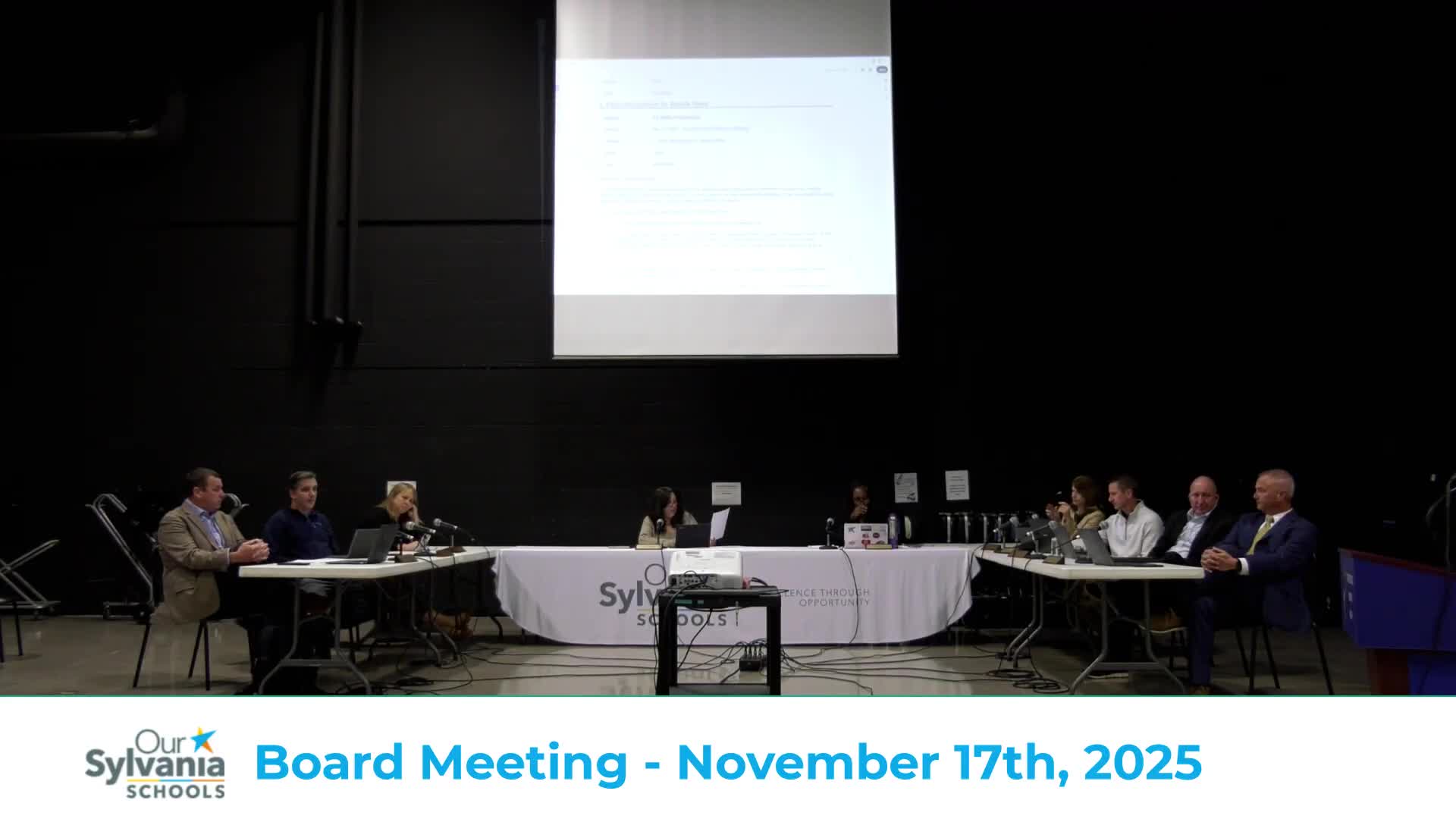
"I have been a PE teacher in Sylvania for 28 years," said Greg Burrows, who urged the board not to adopt the waiver and noted summer‑PE enrollment dropped from more than 250 students to about 80. "This decision will affect students' mental, physical, emotional, and social health." Other speakers — classroom teachers, intervention specialists and parents — said athletics and after‑school sports do not substitute for curriculum‑based PE, which they said teaches lifetime fitness, health literacy and social skills.
Kirsten Long, a fourth‑grade teacher, pointed to the district budget when arguing the change: "A savings of $70,000 for cutting a PE position in a budget over $100,000,000 is inconsequential," she said, calling teacher cuts the likely consequence of the waiver proposal. Zach Korolewski, a parent and former coach, cited an athletic‑association statistic he described as a "62 percent increase" in injury risk for single‑sport athletes to argue that team practices alone are not an adequate replacement for PE.
The board did not vote on the waiver or on related graduation‑policy language at the meeting; Dr. Motley presented policy 54‑60 (graduation requirements) for a first reading and said the district will review state guidance and how peer districts manage waivers. "We can certainly explore what some options would be for our students," Dr. Motley said, adding staff will provide data on how many students use flex scheduling, what they leave for, and building‑level controls.
Board members asked whether the district can require a specific reason for a waiver — for example, employment, College Credit Plus (CCP) courses or internships — and whether building‑level approvals and GPA thresholds are applied. Staff responded that some controls exist at the building level and that the district will compile updated counts and options for the board to consider before any second reading.
Speakers who addressed the board emphasized special‑education benefits and mental‑health supports delivered in PE classes, and several read statements from colleagues who work with students with disabilities. Tracy Donnelly read a statement from Kylie Jarrell, an intervention specialist, that said structured PE helps students with behavioral and emotional regulation and promotes inclusion.
What happens next: because policy 54‑60 was presented as a first reading, the board will consider a second reading and potential vote at a future meeting after staff returns with data, legal guidance and examples from other districts. The board did not take a formal vote on the PE waiver at this meeting.
Quotes in this article are taken from speakers during the Nov. 17, 2025 Sylvania Schools Board of Education meeting.
Don't Miss a Word: See the Full Meeting!
Go beyond summaries. Unlock every video, transcript, and key insight with a Founder Membership.
30-day money-back guarantee
Sponsors
Proudly supported by sponsors who keep Ohio articles free in 2025

