Trinity County board approves sweeping fee updates to recover department costs
November 18, 2025 | Trinity County, California
This article was created by AI summarizing key points discussed. AI makes mistakes, so for full details and context, please refer to the video of the full meeting. Please report any errors so we can fix them. Report an error »
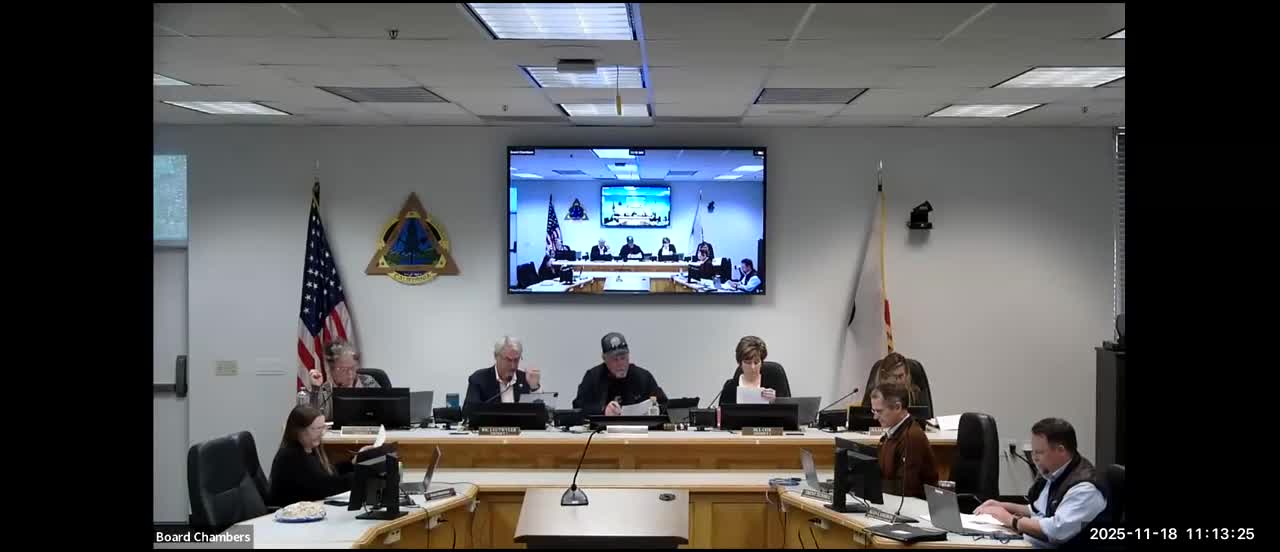
County Chief Administrative Officer Rick Tuthill and finance staff told the board the fee model uses a 2019 baseline for consistency across departments while the county establishes a rolling update cycle so no department falls more than two years behind. Susie, the county's fee-study lead, told the board that planning has been the largest ongoing general-fund draw and that the planning division's subsidy for fiscal year 2024-25 was $858,814.24.
"We are losing money on many of the services we provide," Susie said. "The intent is to calculate what it actually costs the county to provide a service and to charge up to that cost, not more." She explained the board may choose to charge less than full cost recovery in particular cases but said the county's discretionary revenue is limited and many departments have been subsidized for years.
Board members and members of the public pressed staff on sensitive areas, including cannabis program renewals. Several speakers and board members said renewal reviews typically require less staff time than new applications and urged staff to include a renewal-specific analysis as soon as data allow. Susie and planning staff said renewal-fee analysis was intended but the county currently lacks sufficient historical renewal data; staff pledged to bring a focused renewal study forward when it is available.
Supervisors discussed potential downstream effects: higher planning fees could create disincentives for small projects in a county with limited development activity, but staff and supervisors said the single largest benefit would be freeing general-fund dollars that could be redirected to priorities or targeted incentives. CAO Tuthill said the county will continue to bring one-off fee adjustments as needed and that deposit and hourly accounting practices will give applicants transparency on anticipated charges.
The board adopted the ordinance on a unanimous roll call and directed staff to proceed with the planned schedule of updates and to return promptly with any needed adjustments based on stakeholder feedback.
Outcome: Ordinance to update county fees introduced/waived and advanced for adoption; board authorized continuation of a rotating fee-update schedule and directed staff to analyze renewal fees (notably cannabis renewals) and return with any necessary one-off changes.
Next steps: Staff will implement the ordinance process, return for second reading per County ordinance timing, and continue targeted analyses for renewal fees and potential incentive/waiver mechanisms.
View the Full Meeting & All Its Details
This article offers just a summary. Unlock complete video, transcripts, and insights as a Founder Member.
30-day money-back guarantee
Sponsors
Proudly supported by sponsors who keep California articles free in 2025

