Connecticut advisory committee prioritizes three funding proposals to bolster primary care workforce
November 18, 2025 | Department of Public Health, Departments and Agencies, Organizations, Executive, Connecticut
This article was created by AI summarizing key points discussed. AI makes mistakes, so for full details and context, please refer to the video of the full meeting. Please report any errors so we can fix them. Report an error »
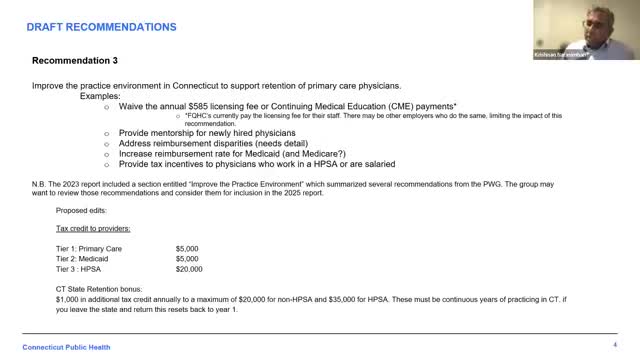
Chair Krishna said the committee will present the three high-priority items to the legislature and keep four other, lower-cost recommendations in the report body. "So our big asks, especially money wise, are number 1, pipeline program for scholarships. It's a $3,000,000 ask," Krishna said as members discussed funding scale and piloting options.
Margaret, who led the report drafting and presented the slides, framed the scholarship proposal on Rhode Island's model, which provides roughly $70,000 per academic year and awarded five scholarships in that state. Committee members debated eligibility rules — whether scholarships should be restricted to Connecticut residents who train entirely in-state, or open to trainees who train elsewhere but commit to practice in Connecticut. Margaret said an exit survey and service obligations could be used to track and enforce commitments.
On tax incentives, the committee recommended a tiered personal income tax credit targeted at physicians who serve Medicaid patients or work in HPSAs. Examples discussed included initial credits of $5,000 and $20,000 for different tiers, plus incremental retention bonuses (for example, $1,000 per year up to a cap) to reward continuous practice in Connecticut. Members repeatedly noted the legislative charge to this committee specifically references physicians, which affects whether advanced practice providers would be eligible.
The third major proposal is a primary-care grant to expand patient access and panel size, modeled on Rhode Island's program. Committee members highlighted accountability mechanisms in the Rhode Island design, including target-based disbursement and paybacks if access-expansion targets are not met. Margaret reported Rhode Island appropriated about $6,695,000 for its program and suggested Connecticut could pilot at smaller funding levels.
Members and staff discussed funding math and program scale: whether to pilot five scholarships or target larger cohorts (some members noted 20 per year would substantially increase costs and require multi-year funding commitments). Several members urged seeking an appropriation large enough to launch a credible pilot and to include administrative funding for program oversight.
The committee agreed to prioritize the three proposals in the report and circulate the draft recommendations to members for individual edits (FOIA rules prevent group email deliberations). Staff will refine wording, estimate fiscal notes where possible, and return the report for final review at the December meeting.
Don't Miss a Word: See the Full Meeting!
Go beyond summaries. Unlock every video, transcript, and key insight with a Founder Membership.
30-day money-back guarantee
Sponsors
Proudly supported by sponsors who keep Connecticut articles free in 2025

