Lafayette planning commission approves three hillside homes on Cambridge Drive despite neighbor concerns about turnarounds and drainage
November 18, 2025 | Lafayette, Contra Costa County, California
This article was created by AI summarizing key points discussed. AI makes mistakes, so for full details and context, please refer to the video of the full meeting. Please report any errors so we can fix them. Report an error »
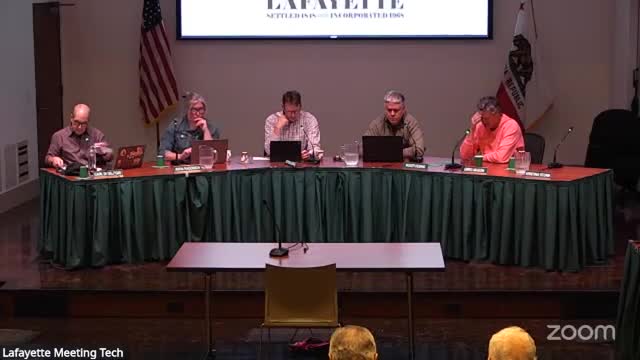
Staff project planners Nicole Zittel and Madison Church told the commission the three applications cover 1233, 1231 and 1227 Cambridge Drive, parcels ranging roughly 1.5 to 2.4 acres and located off Happy Valley Road. The Phase 1 review is limited to siting and massing; later Phase 2 review by the design review commission will address architectural details, landscaping and final grading and drainage plans.
Madison Church described the westernmost lot, 1233 Cambridge, as a proposed two‑story home of about 4,300 square feet with an 830‑square‑foot attached garage and a maximum height of 22 feet 5 inches; staff reported removal of 14 protected trees at that site. The middle lot, 1231, was described by Zittel as a similar two‑story home of just over 4,000 square feet with a maximum height near 26 feet and removal of roughly 16 trees. The eastern lot, 1227, was described as similar in massing, about 26 feet 6 inches in height at its tallest, with two protected trees proposed for removal.
Bill Wood of William Wood Architects, representing the applicant, said the designs tuck the houses into the hillside to minimize visual prominence and that the team coordinated early with the fire district. "I always tell clients you can fix the wood, but it's hard to fix the foundation," Wood said, describing a focus on drainage and soil stability in hillside designs.
Neighbors supported strong engineering review but raised practical safety concerns. Neighbor Chuck Greenberg, who lives below Lot 5, said the Lot 5 turnaround did not appear adequate and warned that trucks or vehicles forced to back down the private portion of Cambridge Drive would create a hazard at the cul‑de‑sac, which serves as a morning and afternoon pickup/drop‑off for Happy Valley Elementary.
Staff said all three projects were referred to outside agencies; the fire district accepted an alternate materials and methods approach that allows omitting a full turnaround in exchange for fire‑mitigation measures. Staff incorporated those mitigation measures into the conditions of approval and agreed to add an oversight condition (alternate materials/methods) that staff had inadvertently left out of Lot 5's conditions.
Commissioners pressed for Phase 2 review to address grading details, drainage, and roadway repair or maintenance agreements. The applicant said standard practice includes video documentation of private roads before and after construction and roadway maintenance agreements on private lanes where appropriate.
Commissioner DiGiorgio moved to adopt the staff recommendation to find each project exempt from the California Environmental Quality Act and approve the projects subject to conditions. The commission approved three separate resolutions — PC Resolution 2025‑17, PC Resolution 2025‑18 (with the added AMM condition), and PC Resolution 2025‑19 — by unanimous 5‑0 votes. Each approval carries a 14‑day appeal period.
What happens next: the Phase 2 review at the design review commission will consider detailed grading and drainage plans, building materials and final landscaping; the city engineer and public works will revisit drainage and street impacts at that time.
View the Full Meeting & All Its Details
This article offers just a summary. Unlock complete video, transcripts, and insights as a Founder Member.
30-day money-back guarantee
Sponsors
Proudly supported by sponsors who keep California articles free in 2025

