Utility staff and 1 Energy Renewables outline four solar projects on utility land
November 18, 2025 | Marshfield, Wood County, Wisconsin
This article was created by AI summarizing key points discussed. AI makes mistakes, so for full details and context, please refer to the video of the full meeting. Please report any errors so we can fix them. Report an error »
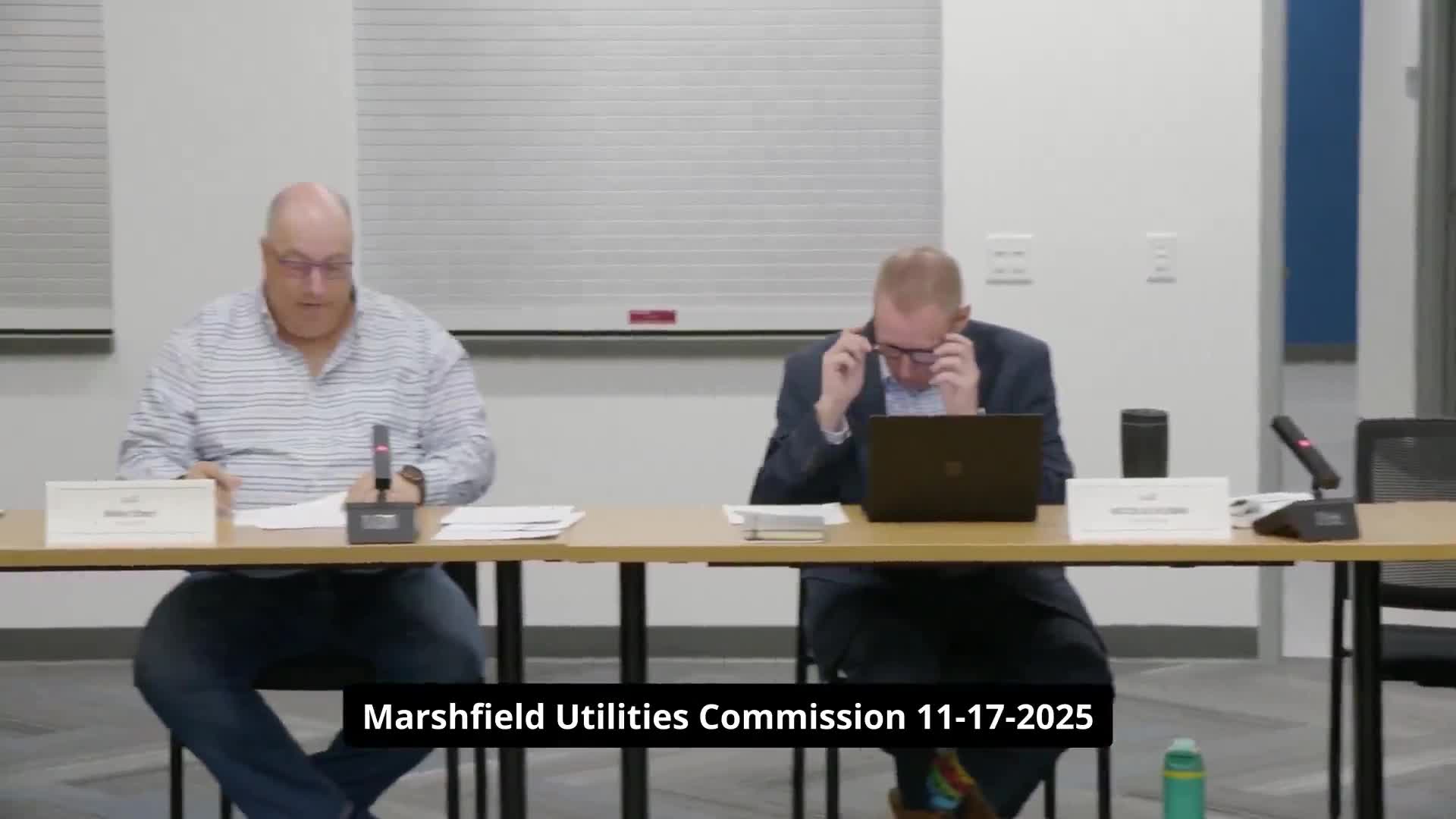
Stanley Mednick, a development representative for 1 Energy Renewables, described the company as a public‑benefit corporation and said the firm focuses on distribution‑connected projects. He said the projects were selected because they are on utility‑owned land and have favorable interconnection points. "These projects are being pursued because they're economical, and they provide us a local supply, and they provide a hedge against our future wholesale cost," staff said when introducing the presentation.
Project 1 ("Marshfield 1") would sit adjacent to a substation with the fenced array using "around 13 acres of a 20‑acre parcel," with access from the nearby roundabout and inverters and transformers placed centrally. Project 2, at McMillan and Galvin, is a 5‑megawatt proposal on roughly 25 acres of a 32‑acre parcel; the presenter estimated it would produce about 10,000,000 kilowatt‑hours per year (roughly equivalent to 1,250 homes). Project 3, south of the quarry, was described as approximately 4 MW using about 19 acres and producing an energy equivalent near 1,000 homes; Project 4 is another 5‑megawatt site (about 26 acres) sited to preserve nearby wellheads and test wells with buffer zones and an access arrangement inside the project fence.
Staff emphasized all four sites are utility‑owned and that two lie in Marathon County and two in Wood County, so each will follow the respective county permitting processes. Staff also told the commission that three of the sites (Projects 2, 3 and 4) lie within wellhead protection areas, which restrict certain land uses and require coordination with the DNR; staff said the company is using level‑1 wetland delineations and design modifications to avoid sensitive areas.
Commissioners asked whether Project 1 would affect a nearby sledding hill; staff and the presenter said the project layout avoids the recreational space and does not 'dip into' the hill. Questions from commissioners also covered neighboring landowners, tree‑screening and whether property taxes could increase; the presenter said the lease commits the developer to pay for any tax increases seen by the property owner and that because the owner is Marshfield a tax windfall for private landowners is not expected.
On engineering details, the presenter said the arrays will use steel piles (not concrete slabs) and skid‑mounted transformers; the firm prefers many smaller 200‑kW inverters rather than a few very large units to improve redundancy and reduce single‑point failures. Fencing proposed is woven agricultural wire about 8 feet tall and generally avoids chain‑link/barbed wire aesthetics. The presenter said the lease includes a decommissioning commitment to remove steel and installed components if a project is nonoperational for a year and restore the land for the owner.
Stanley Mednick also described vegetation plans that favor pollinator habitat (native seed mixes and staged establishment) as the default and said some sites use seasonal sheep grazing for vegetation maintenance where appropriate. He offered to share the full PDF presentation and follow up on remaining technical questions.
Next steps: staff will continue project design refinements, pursue county permitting where needed and return to the commission with updates and any lease or interconnection agreements requiring formal approval.
View the Full Meeting & All Its Details
This article offers just a summary. Unlock complete video, transcripts, and insights as a Founder Member.
30-day money-back guarantee
Sponsors
Proudly supported by sponsors who keep Wisconsin articles free in 2025

