Augusta commissioners weigh cuts, excise tax and a possible millage to close a $19–21 million shortfall
November 18, 2025 | Augusta City, Richmond County, Georgia
This article was created by AI summarizing key points discussed. AI makes mistakes, so for full details and context, please refer to the video of the full meeting. Please report any errors so we can fix them. Report an error »
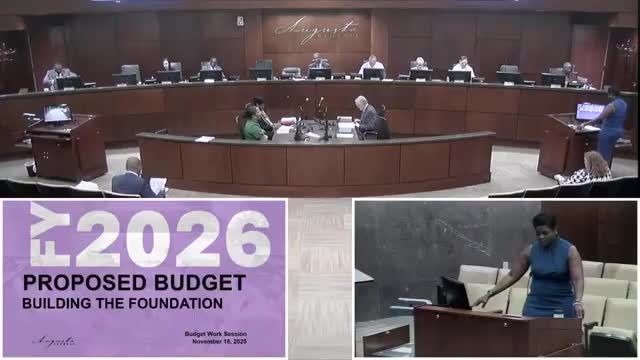
Administrator Allen told commissioners the original FY2026 starting point showed a substantial gap: "We started out out of balance in the general fund by 11,600,000.0 and by 9,500,000.0 in law enforcement," she said, and reminded the body that previous proposals and midcycle reductions had altered the numbers but left a sizable remainder to close. Finance staff reiterated the administration’s current estimate that, after the reductions already agreed, about $19,300,000 remained to be identified to produce a balanced budget.
The meeting centered on three families of options. The administration’s first scenario would adopt a 1.69‑mill increase to the county maintenance and operations (M&O) rate and accept previously proposed cuts to departments and discretionary funding. A second approach would levy a smaller millage increase restricted to law‑enforcement needs, paired with deeper cuts elsewhere. The third would avoid any millage increase but require steep across‑the‑board reductions to departments and non‑governmental partners — a step administrators warned could eliminate a large share of field positions and reduce core services.
Administrator Allen emphasized the tradeoffs: eliminating the proposed cost‑of‑living adjustment (COLA) for staff would free roughly $3 million; proposed transit reductions to preserve Saturday service amount to about $593,003.50; and the administration’s lapsed‑salary estimate — funds set aside to account for turn‑over vacancies — is about $6,500,000 for the general fund. Finance also told commissioners that fully excluding elected officials and judges from cuts would increase the burden on other departments.
As an alternative to tax increases or deep cuts, staff raised a state‑enabled energy excise tax that would apply the normal sales‑tax rate to certain manufacturing energy currently exempt at the state level. "Mr. Schreier is estimating that this could yield about $22,000,000 for Augusta in 2026," Administrator Allen said; commissioners asked for outreach to local manufacturers and the Chamber of Commerce before pursuing that option, noting it could have competitive implications.
Commissioners framed the choices in different ways. Commissioner Brandon Garrett criticized what he described as long‑running budgeting practices that had hidden structural problems and advocated for deeper programmatic review. Commissioner Jordan Johnson urged the commission to seek new revenue sources beyond property taxes, citing short‑term revenue options such as licensing and permitting. Several commissioners said they were unwilling to raise taxes without clear cuts, while others warned that workforce reductions would harm service delivery.
No final vote to adopt a millage was reached. Instead, the commission directed staff to model combinations of cuts and revenue options — including a targeted one‑mill increase for law enforcement paired with additional reductions — and to return with a more detailed set of numbers. The body recessed the meeting to resume budget consideration at 10:00 a.m. next Tuesday.
Why it matters: The commission must by statute and local ordinance present a balanced FY2026 budget. The decisions will affect tax bills, employee pay and staffing levels, transit service, and funding for nongovernmental programs citywide. The commission instructed staff to produce detailed scenarios so elected members can weigh fiscal, service and equity impacts before a final vote.
What’s next: The commission reconvenes at 10:00 a.m. Tuesday, Nov. 25, to continue consideration of the FY2026 budget and vote on final adoption or further revisions.
View the Full Meeting & All Its Details
This article offers just a summary. Unlock complete video, transcripts, and insights as a Founder Member.
30-day money-back guarantee
Sponsors
Proudly supported by sponsors who keep Georgia articles free in 2025

