Bay City Commission rejects Flock license-plate reader contract after ACLU and months of public debate
November 17, 2025 | Bay City, Bay County, Michigan
This article was created by AI summarizing key points discussed. AI makes mistakes, so for full details and context, please refer to the video of the full meeting. Please report any errors so we can fix them. Report an error »
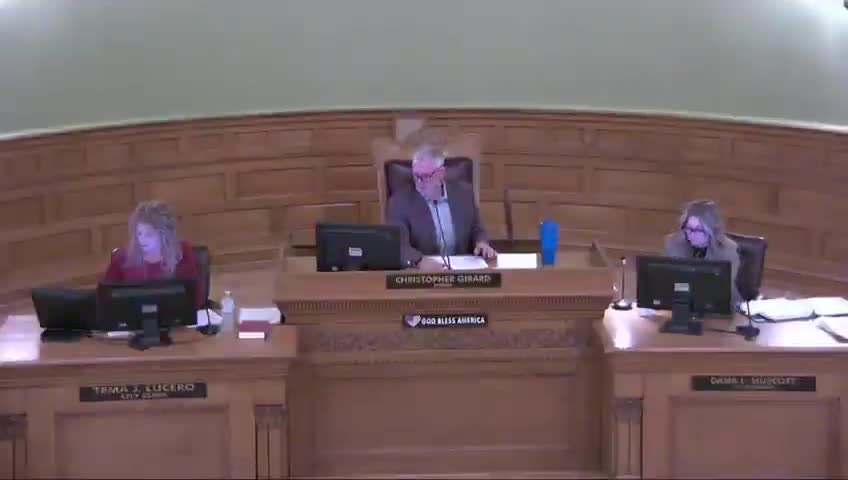
The most immediate decision at the meeting was the commission’s failure to approve the contract, which the city manager had recommended at $45,150 for fiscal 2026 and $39,000 for fiscal 2027. The motion to adopt the contract passed only two votes (Commissioners Morris and Zanotti) and failed on a 2–6 roll call. Several commissioners cited a lack of community buy-in, legal and privacy concerns, and unresolved questions about data sharing and vendor obligations.
The ACLU’s Gabriel Dresner, appearing by Zoom, opened the evening’s policy discussion by warning that ALPRs “are a little-noticed surveillance technology that’s designed to track the movements of passing drivers,” and urged the commission to adopt a robust local policy if the city proceeds with procurement. Dresner emphasized that, without state law, local policy must set limits on retention, access and sharing. “If LPR systems are procured, policy must be adopted to ensure proper protections,” he said.
Flock representatives, including Mike Lampman, presented the vendor’s view that the systems can be configured to protect privacy while aiding investigations. Lampman told commissioners that “Flock does not sell data. Period” and that Bay City would “own 100% of the data” and could restrict sharing. He also described technical controls the company offers, such as a 30‑day retention window, audit trails, standardized search reasons, and filters to block searches related to immigration or reproductive‑health matters.
Commissioners pressed both presenters and staff on legal risks and contract language. Questions focused on whether a subpoena or warrant could compel data disclosure, how sharing agreements with other agencies would work, whether multifactor authentication is required by default, and whether Flock or municipal employees would administer access and audits. One 30‑second detail raised at the meeting: the contract includes a replacement fee for damaged cameras (about $800) and staff said a portion of the cost would come from a federal JAG grant ($88,500) with the remainder from the city’s security camera fund.
Public comment was extensive and heavily opposed to the contract. Residents challenged vendor claims, cited national litigation and local examples, and argued the city should not build a searchable history of residents’ movements. “I think it’s BS to claim there’s no identifying info being collected,” said Paul Kleinhill, who questioned the vendor’s assertion that plate data are not personally identifying. Chadwick Twillman, a local candidate for state Senate, urged commissioners to “Vote no on the Flock agreement,” calling the contract “turning Bay City into a node” in a wider surveillance network.
Supporters of the technology, including the police director, said ALPRs help recover stolen vehicles and can provide actionable leads in late‑night shootings when descriptions are vague. The public safety director told the commission that his priority is public safety and that, in his view, the tool has provided important investigative support in other jurisdictions.
After the roll call defeat, Commissioner DeWitt introduced a resolution that would formally reject the Flock contract and would create a process to reallocate the security camera fund toward other allowable public-safety and fire department equipment; commissioners agreed to refer that proposal to staff and asked for a budget amendment and more detailed financial and legal analysis to be returned at a later meeting.
Votes at a glance
- Agreement with Flock Group Inc. (automated license-plate readers), recommended: approve; motion failed on roll call, 2 yes (Morris, Zanotti), 6 no (Romberg, Charlebois, Kubit, Coakley, Tenney, DeWitt). (Item read and discussed; final motion failed.)
- Creation of Obsolete Property Rehabilitation District at 906 7th Street: adopted on roll call.
- 12‑year obsolete property rehabilitation exemption certificate for 906 7th Street ($105,682): adopted on roll call.
- Ordinance amendment deleting a city services fee (trash bags): adopted on roll call.
Why it matters
The meeting crystallized a broader local debate about whether cities should contract with private vendors for surveillance services and how to balance investigatory benefits against long‑term privacy risks. The decision leaves the city without the proposed ALPR deployment for now, while staff will return with a budget amendment and further legal analysis on the resolution introduced by Commissioner DeWitt.
What’s next
Commissioners referred DeWitt’s resolution to staff for preparation of a formal budget amendment and supporting analysis; staff indicated it will bring budgetary line‑item details and legal clarifications back to the commission at a subsequent meeting (DeWitt requested the amendment be ready for the Dec. 1 meeting). The commission did not adopt any local ordinance or binding policy changes on ALPR use during this session.
Reporting note: Quotes in this story are recorded verbatim from the Nov. 17 meeting transcript and are attributed to speakers as they appeared in the record.
View the Full Meeting & All Its Details
This article offers just a summary. Unlock complete video, transcripts, and insights as a Founder Member.
30-day money-back guarantee
Sponsors
Proudly supported by sponsors who keep Michigan articles free in 2025

