Santa Fe County frames water policy around growth and housing needs as SGMP revision begins
November 17, 2025 | Santa Fe County, New Mexico
This article was created by AI summarizing key points discussed. AI makes mistakes, so for full details and context, please refer to the video of the full meeting. Please report any errors so we can fix them. Report an error »
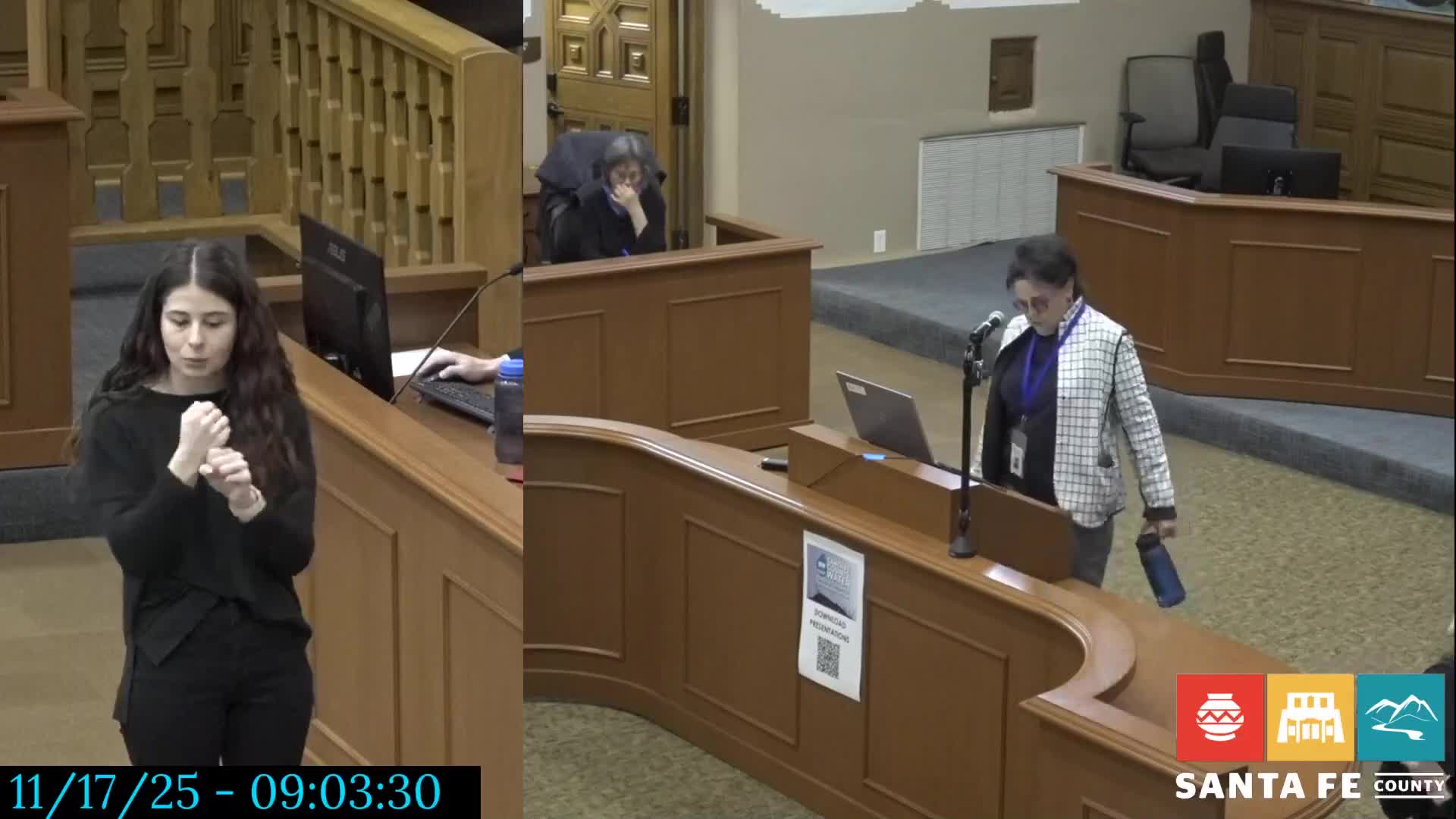
Alexander Ladd, growth management staff, told the commission that recent perceptions of rapid growth are misleading: the county’s growth rate was about 0.12% last year and the county has grown 8.18% since 2010. He said the central policy question is not simply whether there is water but “how do we ensure that we manage our water so that everyone who wants to live here can live here.” Ladd cited the county’s affordable housing plan, which estimates roughly 17,000 additional housing units are needed between 2022 and 2025 to address inadequate housing and cost burden.
Herbert Foster, a planning team leader, described the Sustainable Growth Management Plan (SGMP) as the county’s comprehensive plan with a roughly 20‑year horizon. Foster said the SGMP identifies three Sustainable Development Areas (SDA 1–3) and will include a preferred land‑use plan, updated water, sewer and stormwater policies, and a public participation plan. He said the county will use the SGMP revision to align regulations and development outcomes so the county “gets what it wants” from code changes.
Staff explained how water supply is verified during development review: projects connecting to a public water system must do so; if a public system is not available, applicants must demonstrate a self‑supplied source via a well permit from the Office of the State Engineer or a ‘ready, willing and able’ letter from a mutual domestic system. County staff emphasized that infrastructure — line extensions and built capacity — must be considered early: without the infrastructure in place, development applications are incomplete. Growth management also said covenants recorded with permits limit domestic well use to roughly a quarter acre‑foot per residence per year.
Commissioners and members of the public pressed staff on how long entitlement commitments last and whether older commitments that are not built should be revisited. Staff said most entitlements tied to public hearings generally expire after two years with a possible one‑year extension and that recent ready, willing and able letters are usually tied to entitlements; if entitlements lapse, the obligation to serve typically goes away.
The SGMP revision process will include an initial public‑participation plan expected to be brought to the commission in the next several months, followed by broader community outreach and subsequent code amendments to implement the plan’s vision.
The commission heard multiple requests to make the SGMP and code changes attentive to workforce housing rather than second homes, and to clarify how accessory dwelling units and townhomes should be counted and incentivized. Staff said revisions to Chapter 13 of the Santa Fe County Sustainable Land Development Code (the inclusionary‑zoning chapter) are already in progress and will be coordinated with community input and future code redlines.
The meeting closed with commissioners thanking staff and the public. Commissioner Green moved to adjourn; Commissioner Ka'kari Stone seconded the motion (motion made and seconded; vote not captured in the provided transcript).
View the Full Meeting & All Its Details
This article offers just a summary. Unlock complete video, transcripts, and insights as a Founder Member.
30-day money-back guarantee
Sponsors
Proudly supported by sponsors who keep New Mexico articles free in 2025

