Security Council speaker urges urgent action to stop food being used as a weapon in conflict
November 18, 2025 | United Nations, Federal
This article was created by AI summarizing key points discussed. AI makes mistakes, so for full details and context, please refer to the video of the full meeting. Please report any errors so we can fix them. Report an error »
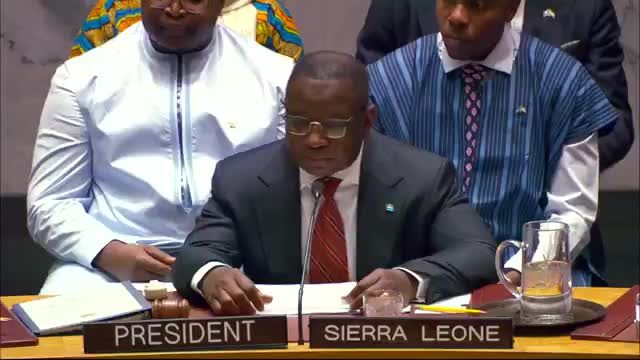
A delegate addressing the United Nations Security Council warned that armed conflict is driving a global food crisis and urged immediate action to protect food systems, bolster resilience and pursue political solutions to prevent starvation being used as a weapon.
The speaker, identified in the debate only as Speaker 1 and who said he had served as Nigeria’s minister of environment, told the council that “war destroys more than infrastructure” and described how fighting can obliterate farms, markets, transport routes and storage facilities that communities rely on.
He framed the conflict–food nexus as an existential threat to international peace and security, citing UN figures that “295,000,000 people faced acute hunger” last year — 14,000,000 more than the year before — and saying the number experiencing catastrophic hunger has “more than doubled to 1,900,000.” The speaker warned that when food systems are attacked, “food itself has become a weapon through deliberate starvation tactics.”
The delegate listed regional examples including Sudan (where he said violence is perpetuating famine across Darfur and Khordafan), Gaza (where famine was confirmed in August), and severe situations in Haiti, Yemen, the Sahel and the Democratic Republic of the Congo, and argued that borders offer no protection from spillover effects when markets and trade are disrupted.
He contrasted global military spending and humanitarian needs, saying total military expenditure over the past decade was about $21,900,000,000,000 while ending hunger by 2030 would cost roughly $93,000,000,000 a year, and called for enforcement of existing Security Council resolutions that condemn the use of starvation as a method of warfare (the speaker cited the council’s 2018 and 2021 resolutions on the issue).
The speaker set out four specific priorities for action. First, he called for unimpeded humanitarian access, durable ceasefires and strict observance of international humanitarian law so relief can reach civilians and food systems (farms, markets, transport and storage) can be protected as civilian infrastructure. Second, he urged a shift from short-term relief to long-term transformation of food systems — strengthening local markets, storage and processing, connecting food systems to health and social protection, and increasing women’s and youth’s ownership and decision-making.
Third, the delegate said climate action and adaptation finance are essential: early warning systems must reach everyone and communities need access to drought‑resistant seeds and water management systems so they can absorb shocks rather than collapse. Fourth, he said humanitarian aid saves lives but cannot end wars — only political solutions can do that — and called for prevention, early investment and the humanitarian–development–peace Nexus approach to tackle root causes.
Quoting an East African proverb, he concluded: “When elephants fight, it is the grass that suffers,” and urged the council to choose policies that prevent food from being weaponized and that make food systems engines of peace and resilience rather than casualties of conflict. He then thanked the deputy secretary-general for her briefing. No vote or formal Council action followed during this statement.
The speaker, identified in the debate only as Speaker 1 and who said he had served as Nigeria’s minister of environment, told the council that “war destroys more than infrastructure” and described how fighting can obliterate farms, markets, transport routes and storage facilities that communities rely on.
He framed the conflict–food nexus as an existential threat to international peace and security, citing UN figures that “295,000,000 people faced acute hunger” last year — 14,000,000 more than the year before — and saying the number experiencing catastrophic hunger has “more than doubled to 1,900,000.” The speaker warned that when food systems are attacked, “food itself has become a weapon through deliberate starvation tactics.”
The delegate listed regional examples including Sudan (where he said violence is perpetuating famine across Darfur and Khordafan), Gaza (where famine was confirmed in August), and severe situations in Haiti, Yemen, the Sahel and the Democratic Republic of the Congo, and argued that borders offer no protection from spillover effects when markets and trade are disrupted.
He contrasted global military spending and humanitarian needs, saying total military expenditure over the past decade was about $21,900,000,000,000 while ending hunger by 2030 would cost roughly $93,000,000,000 a year, and called for enforcement of existing Security Council resolutions that condemn the use of starvation as a method of warfare (the speaker cited the council’s 2018 and 2021 resolutions on the issue).
The speaker set out four specific priorities for action. First, he called for unimpeded humanitarian access, durable ceasefires and strict observance of international humanitarian law so relief can reach civilians and food systems (farms, markets, transport and storage) can be protected as civilian infrastructure. Second, he urged a shift from short-term relief to long-term transformation of food systems — strengthening local markets, storage and processing, connecting food systems to health and social protection, and increasing women’s and youth’s ownership and decision-making.
Third, the delegate said climate action and adaptation finance are essential: early warning systems must reach everyone and communities need access to drought‑resistant seeds and water management systems so they can absorb shocks rather than collapse. Fourth, he said humanitarian aid saves lives but cannot end wars — only political solutions can do that — and called for prevention, early investment and the humanitarian–development–peace Nexus approach to tackle root causes.
Quoting an East African proverb, he concluded: “When elephants fight, it is the grass that suffers,” and urged the council to choose policies that prevent food from being weaponized and that make food systems engines of peace and resilience rather than casualties of conflict. He then thanked the deputy secretary-general for her briefing. No vote or formal Council action followed during this statement.
Don't Miss a Word: See the Full Meeting!
Go beyond summaries. Unlock every video, transcript, and key insight with a Founder Membership.
✓
Get instant access to full meeting videos
✓
Search and clip any phrase from complete transcripts
✓
Receive AI-powered summaries & custom alerts
✓
Enjoy lifetime, unrestricted access to government data
30-day money-back guarantee
