Orinda panel outlines fuel‑breaks, evacuation modeling and $400,000 in mitigation incentives at wildfire education night
November 17, 2025 | Orinda City, Contra Costa County, California
This article was created by AI summarizing key points discussed. AI makes mistakes, so for full details and context, please refer to the video of the full meeting. Please report any errors so we can fix them. Report an error »
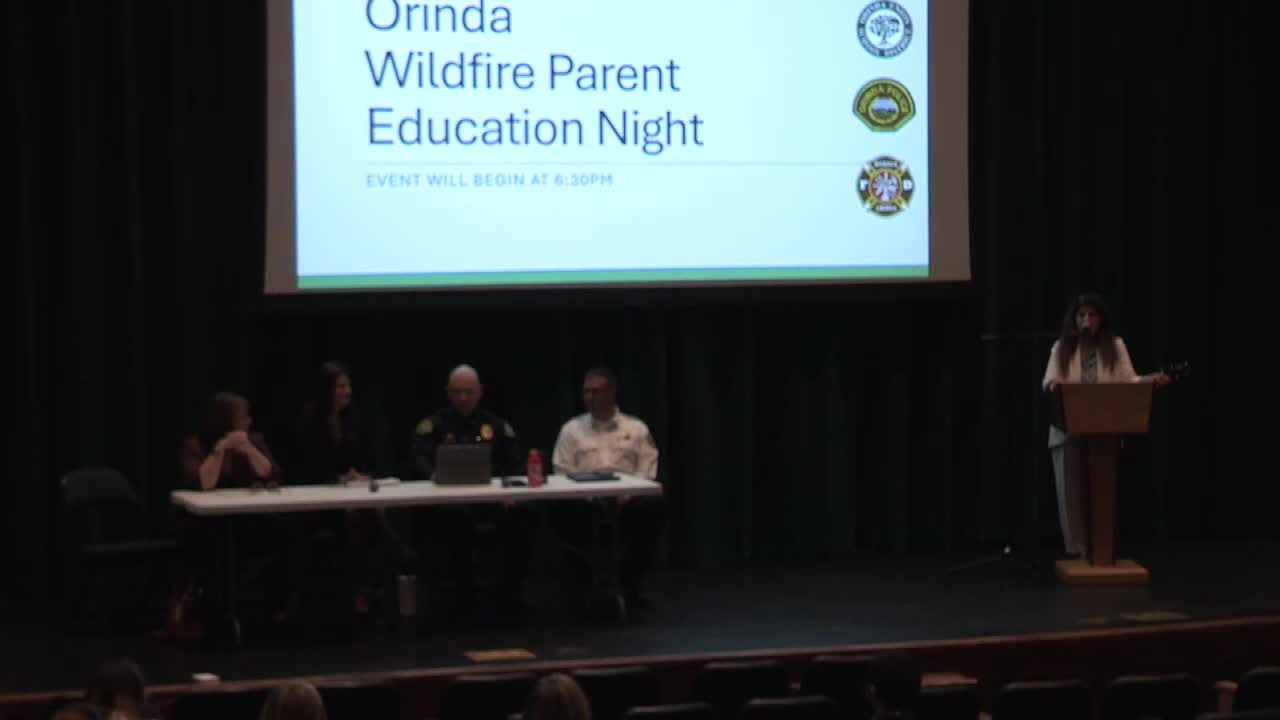
The event, the second in a series of Orinda wildfire community education nights, featured Moraga‑Orinda Fire District (MOFD) Chief Jeff Isaacs, Deputy Chief Lucas Lambert, Police Chief Anthony Rossi, Orinda Union School District Superintendent Aida Lehi and City Manager Linda Smith. "We can't guarantee anything," Mayor Kani said, urging residents to treat mitigation as a shared responsibility.
Why it matters: Officials said Orinda has been heavily affected by insurer nonrenewals and that sustained mitigation work — from defensible space to home‑hardening — reduces the chance of home‑to‑home ember ignition and can preserve evacuation routes. "Fire does not discriminate," Deputy Chief Lucas Lambert said when showing photos from the January Palisades fire; he used the case as an example of how ember attack and wind can cause rapid home‑to‑home spread.
Most important details: Jeff Isaacs described MOFD’s current priorities: maintenance of the North Orinda shaded fuel break and the Tunnel East Bay Hills fuel break, targeted defensible‑space inspections along evacuation routes, a home‑hardening program that distributes gutter guards and ember‑resistant vent mesh, and a year‑round chipping program residents can request. "We completed our prioritized evacuation‑route inspections," Isaacs said, explaining how cleared vegetation reduces ember and flame exposure along roads.
Police Chief Anthony Rossi detailed unified command operations and evacuations: law enforcement issues evacuation orders and Orinda — a contract city for the Contra Costa County Sheriff’s Office — can receive surge deputy support. Rossi urged residents to sign up for the Community Warning System (CWS). "CWS is our number one tool," he said, adding that Nixle, public‑address speakers on vehicles and door‑to‑door checks are other layers of public warning and response.
School safety and reunification: Superintendent Aida Lehi said the district — which she said serves about 2,700 students and roughly 370 staff — has revised annual safety plans, used Measures E and I bond funds for facility upgrades (windows, roofs, HVAC) and runs monthly evacuation drills. "Our first plan is reunification with parents," Lehi said; if parents cannot reach sites the district would use school buses and designated reunification locations such as the high‑school parking lot.
City programs and tools: City Manager Linda Smith described an incentive program that can pay residents up to $1,000 for mitigation work and said the city has budgeted about $400,000 in that fund. Smith announced a one‑stop information site, orindaready.com, and a new evacuation‑modeling tool (LADrus) that city staff expect to make public in the next few months to help residents visualize evacuation times and routes under different scenarios. Longer‑lead projects include feasibility work for an auxiliary lane on Moraga Way and synchronized smart signals to improve outbound flow during evacuations.
Q&A highlights: On where students should go if a fire threatens schools, Lehi reiterated that parents should pick up students for campus reunification but said buses and alternate reunification sites would be used if parents cannot reach campuses. When cell and internet service are limited, officials recommended battery‑ or crank‑powered radios, AM radio updates, satellite‑capable phones, and that police use public‑address speakers or door‑to‑door checks. On detection, panelists described statewide camera networks and AI analytics monitored by dispatch to identify rapidly building columns and augment resources.
What officials asked residents to do: create and maintain defensible space around homes, harden structures where possible, join Firewise neighborhoods, sign up for CWS, keep a "go bag," and use the city’s chipper and incentive programs. Mayor Kani said the panel’s recording will be shared with parents and the community.
Next steps: LADrus evacuation modeling will be made public in the coming months, the city continues to pursue funding and feasibility work for infrastructure improvements, and officials said regional coordination with East Bay MUD, East Bay Regional Parks, PG&E and Caltrans is expanding to align fuel mitigation and data sharing.
Sources: Direct quotes and program details come from remarks by Mayor Lethe Kemal Kani, MOFD Chief Jeff Isaacs, Deputy Chief Lucas Lambert, Police Chief Anthony Rossi, Superintendent Aida Lehi and City Manager Linda Smith during the Orinda wildfire community education night (Nov. 1, 2025).
Don't Miss a Word: See the Full Meeting!
Go beyond summaries. Unlock every video, transcript, and key insight with a Founder Membership.
30-day money-back guarantee
Sponsors
Proudly supported by sponsors who keep California articles free in 2025

