Seattle council approves SDCI fee update after hours of debate over small-project burden
November 17, 2025 | Seattle, King County, Washington
This article was created by AI summarizing key points discussed. AI makes mistakes, so for full details and context, please refer to the video of the full meeting. Please report any errors so we can fix them. Report an error »
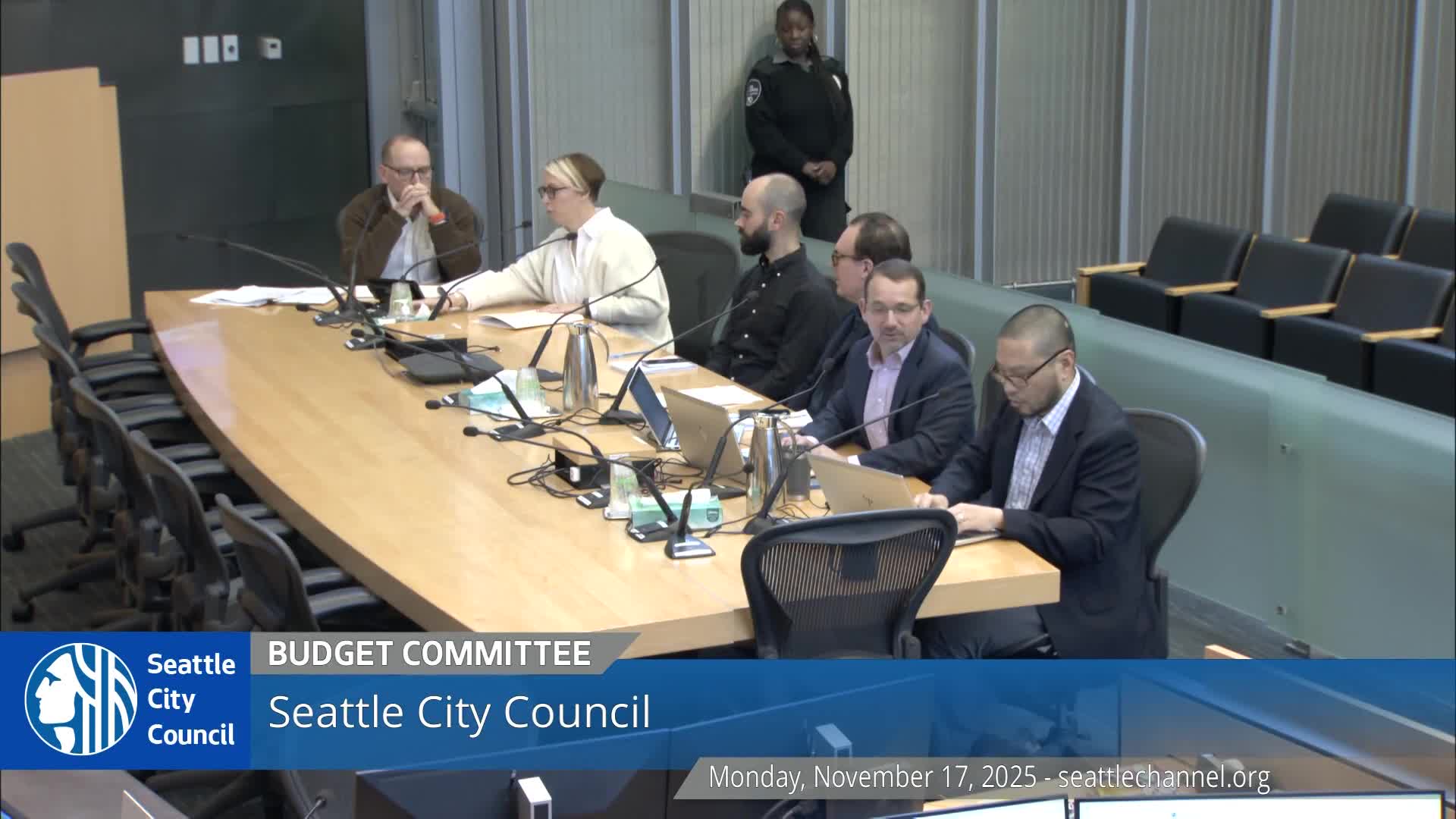
The ordinance would update fee schedules to reflect both an inflationary adjustment and a partial ‘‘catch-up’’ to address a longer-term shortfall in permit-fee revenue. SDCI leaders told the committee that while construction volumes have risen modestly, total project valuation has fallen, shifting the department’s project mix toward many smaller, lower-value jobs and away from the high-value projects that historically subsidized regulatory services.
“Over the past decade we had a lot of larger, high-value projects that brought in much more revenue,” SDCI acting director Brooke Bellman said. “Now the mix has shifted to smaller projects. To stabilize the fund we need revenue — we proposed starting with an 18% increase in 2026 and are continuing to evaluate needs for future years.”
SDCI staff said the 18% increase was the first step in a plan that modeled options including a larger 35% increase if economic conditions do not recover. Finance director Shane Mookov said the 18% adjustment was projected to generate about $8–9 million in additional revenue in 2026 and help preserve the department’s core staffing reserve. Without fee increases, SDCI projection models showed core reserves drawn down and service levels at risk.
Several council members pushed back, arguing the increase shifts disproportionate cost onto smaller projects and homeowners. Council member Teresa Rivera questioned impacts on constituents who remodel or add accessory dwelling units, asking whether smaller homeowners would “bear the burden” of higher fees when large developments are not being built. Council president Nelson argued the policy point more directly: “This feels like a policy discussion… maybe SDCI can be used as leverage to see system improvements,” she said, urging improvements to customer service and process efficiency before accepting a large fee increase.
The committee recorded a divided roll call on the motion. The clerk recorded: Hollingsworth Aye; Juarez Aye; Nelson No; Rink Yes; Rivera No; Sacca Aye; Solomon No; Strauss Yes — yielding 5 in favor and 3 opposed. The committee’s vote forwards the ordinance to the Nov. 21 full council meeting for final action.
A majority of members supporting the measure cited the statutory requirement that fee-funded programs recover a reasonable share of service cost and warned that not acting would require layoffs or steeper cuts to permit-processing capacity. Opponents urged that the council consider either a targeted general‑fund subsidy or more aggressive process reforms to reduce city costs before raising fees that could increase housing and remodeling costs for residents.
SDCI also committed to quarterly reporting next year on the health of the construction and inspections fund so the council can reassess midyear. The committee’s action does not itself change staffing; it recommends the fee ordinance that will be considered by full council on Nov. 21.
The meeting is scheduled to resume Thursday for two technical items; the fee ordinance moves forward to the full council with the committee recommendation.
View the Full Meeting & All Its Details
This article offers just a summary. Unlock complete video, transcripts, and insights as a Founder Member.
30-day money-back guarantee
Sponsors
Proudly supported by sponsors who keep Washington articles free in 2025

