Groundwater Authority approves $5 million earmark submission and a $20,000 lobbying contract cap increase
November 15, 2025 | Ridgecrest, Kern County, California
This article was created by AI summarizing key points discussed. AI makes mistakes, so for full details and context, please refer to the video of the full meeting. Please report any errors so we can fix them. Report an error »
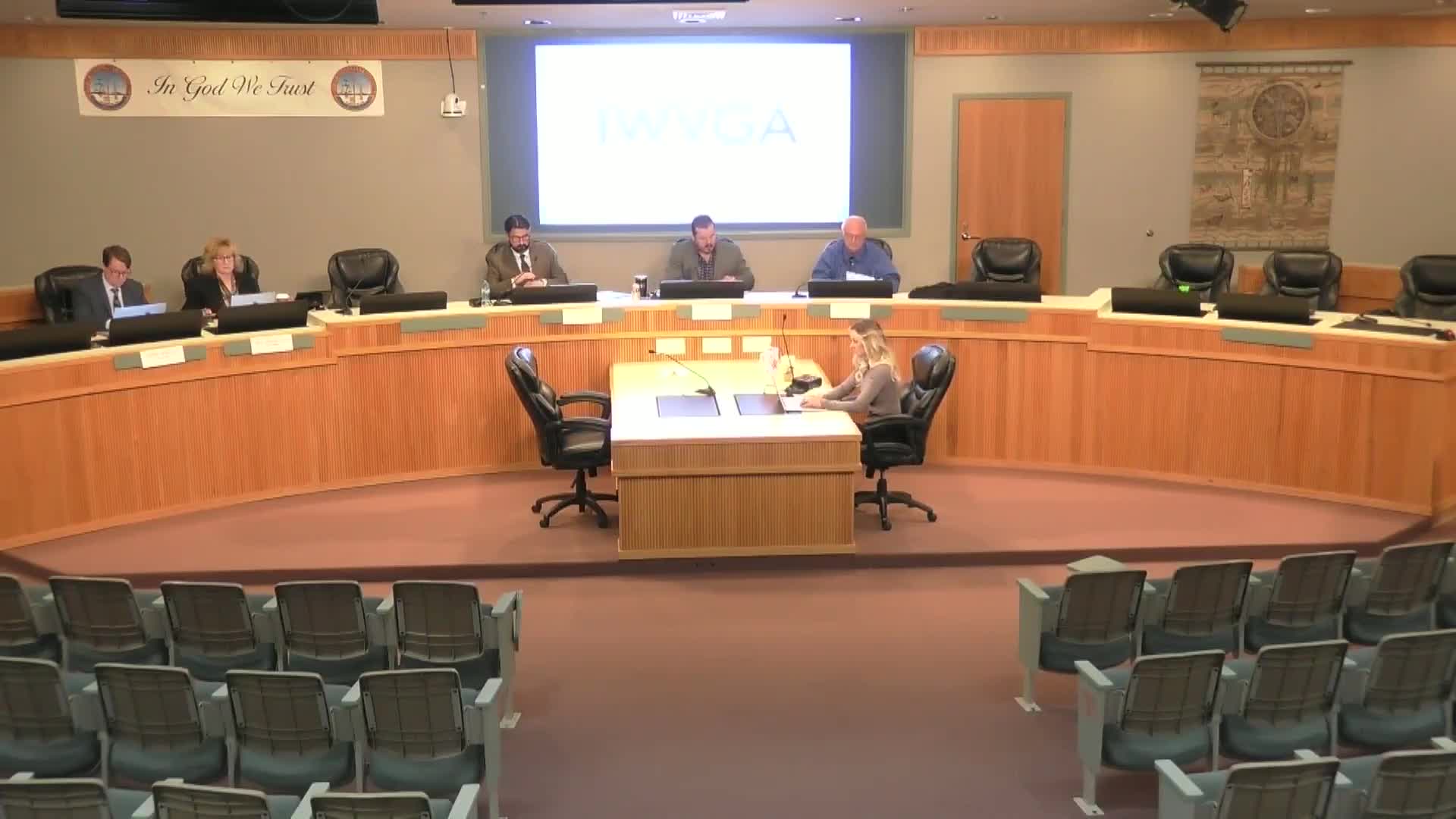
Michael McKinney of Capital Corp told the board the additional $20,000 is a contingency to cover ongoing legislative work and "does not mean that we would use this entire amount." Staff said the increase — raising the not‑to‑exceed total from about $222,000 to roughly $242,000 for the year — could be accommodated in current‑year funds.
On the pipeline earmark, Capital Corp presented a plan to request a $5,000,000 earmark in FY27 as a project initiation appropriation under the Energy and Water Development Act; that would be the first $5 million against a $50 million total authorization. McKinney said the Army Corps would have discretionary authority over how the funds are used and that the $5 million would need to be spent in FY27 to allow the Corps to begin project work.
Directors pressed staff about the authority’s role as a non‑federal sponsor and how the required non‑federal match (approximately $12.5 million per $50 million tranche) could be funded. McKinney and staff said options include state earmarks, Proposition funding, or local agency contributions, but that no board‑approved plan for matching funds exists yet. Staff said the board previously accepted the non‑federal sponsor role in a letter of intent earlier in the year.
The board approved both items: the contract cap increase (motion carried with one abstention by Director Saint Amond) and the submission of the FY27 $5 million packet (motion carried; Director Saint Amond voted no on the earmark vote). The vote to submit the earmark packet occurred after detailed discussion on sponsor obligations and funding options.
Next steps include submitting the earmark packet at the appropriate congressional request window and staff continuing work to identify potential non‑federal funding sources.
View the Full Meeting & All Its Details
This article offers just a summary. Unlock complete video, transcripts, and insights as a Founder Member.
30-day money-back guarantee
Sponsors
Proudly supported by sponsors who keep California articles free in 2025

