Committee clarifies homeschool access to school activities amid questions about ESA funding and 'cocurricular' language
November 15, 2025 | Education, Joint & Standing, Committees, Legislative, Wyoming
This article was created by AI summarizing key points discussed. AI makes mistakes, so for full details and context, please refer to the video of the full meeting. Please report any errors so we can fix them. Report an error »
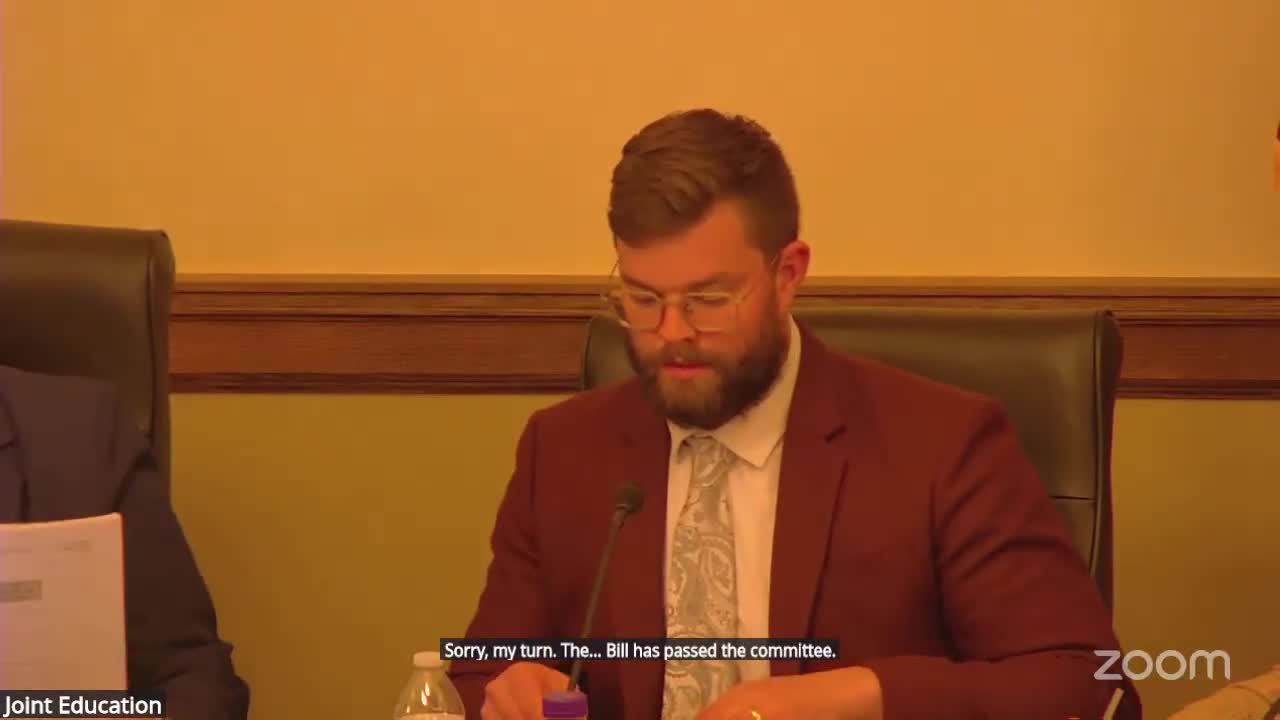
The Joint Education Committee on Nov. 15 advanced 26LSO197, a bill intended to clarify that students who are not enrolled in a resident school district — including homeschool and private‑school students — may participate in cocurricular and extracurricular activities offered by that district in grades 6–12.
Ashley Phillips of the Legislative Services Office summarized the draft, saying it "requires school districts to allow children in grades 6 through 12 not enrolled in the district to participate in cocurricular and extracurricular activities…" and that the provision is effective for the 2026‑27 school year with an act effective date of July 1, 2026. LSO later noted the draft initially included explicit "cocurricular" language from the Wyoming High School Activities Association handbook, which prompted a sustained policy discussion.
Committee members and witnesses focused on a specific tension with the state's Education Savings Account (ESA) program. Tanya Heitrich (LSO) and staff explained that parental ESA agreements typically require a student not be enrolled in public school and that if an ESA student were to take curricular classes provided by a district the ESA vendor/service‑provider framework and parental agreement requirements could create a conflict. That tension led some members to propose narrowing or striking the explicit "cocurricular and extracurricular" wording to default to existing statutory practice; the committee ultimately struck the explicit phrase and adopted language limiting the provision to students "not enrolled in the district."
Members also discussed funding and operational implications. LSO finance analyst Matthew Wilmarth reported participation counts tracked by the Wyoming High School Activities Association of roughly 380 high‑school non‑enrolled participants and 394 middle‑school participants in 2024‑25, and noted that non‑enrolled students do not generate average daily membership (ADM) funding for the district. Committee members debated partial ADM, vendor/provider approaches for ESA students, and whether districts would face unfunded costs when providing cocurricular or curricular services.
Public testimony from district officials, superintendents and parents described real examples where interpretation of the ESA law led districts to block homeschoolers from activities mid‑season, producing community disruption and a request for statutory clarity. Representative Lolli and others said the bill aims to restore long‑standing practice for non‑ESA homeschool families while the committee considered potential carve‑outs or clarifications for ESA participants.
After adopting a technical amendment deleting the phrase "as a full‑time student" and then striking the specific "cocurricular and extracurricular" wording to rely on existing statutory interpretation, the committee recorded a roll call and advanced the bill by majority vote.
Ashley Phillips of the Legislative Services Office summarized the draft, saying it "requires school districts to allow children in grades 6 through 12 not enrolled in the district to participate in cocurricular and extracurricular activities…" and that the provision is effective for the 2026‑27 school year with an act effective date of July 1, 2026. LSO later noted the draft initially included explicit "cocurricular" language from the Wyoming High School Activities Association handbook, which prompted a sustained policy discussion.
Committee members and witnesses focused on a specific tension with the state's Education Savings Account (ESA) program. Tanya Heitrich (LSO) and staff explained that parental ESA agreements typically require a student not be enrolled in public school and that if an ESA student were to take curricular classes provided by a district the ESA vendor/service‑provider framework and parental agreement requirements could create a conflict. That tension led some members to propose narrowing or striking the explicit "cocurricular and extracurricular" wording to default to existing statutory practice; the committee ultimately struck the explicit phrase and adopted language limiting the provision to students "not enrolled in the district."
Members also discussed funding and operational implications. LSO finance analyst Matthew Wilmarth reported participation counts tracked by the Wyoming High School Activities Association of roughly 380 high‑school non‑enrolled participants and 394 middle‑school participants in 2024‑25, and noted that non‑enrolled students do not generate average daily membership (ADM) funding for the district. Committee members debated partial ADM, vendor/provider approaches for ESA students, and whether districts would face unfunded costs when providing cocurricular or curricular services.
Public testimony from district officials, superintendents and parents described real examples where interpretation of the ESA law led districts to block homeschoolers from activities mid‑season, producing community disruption and a request for statutory clarity. Representative Lolli and others said the bill aims to restore long‑standing practice for non‑ESA homeschool families while the committee considered potential carve‑outs or clarifications for ESA participants.
After adopting a technical amendment deleting the phrase "as a full‑time student" and then striking the specific "cocurricular and extracurricular" wording to rely on existing statutory interpretation, the committee recorded a roll call and advanced the bill by majority vote.
View the Full Meeting & All Its Details
This article offers just a summary. Unlock complete video, transcripts, and insights as a Founder Member.
✓
Watch full, unedited meeting videos
✓
Search every word spoken in unlimited transcripts
✓
AI summaries & real-time alerts (all government levels)
✓
Permanent access to expanding government content
30-day money-back guarantee
