Access committee backs staff work on city framework for mobility devices used by people with disabilities
November 15, 2025 | Santa Barbara City, Santa Barbara County, California
This article was created by AI summarizing key points discussed. AI makes mistakes, so for full details and context, please refer to the video of the full meeting. Please report any errors so we can fix them. Report an error »
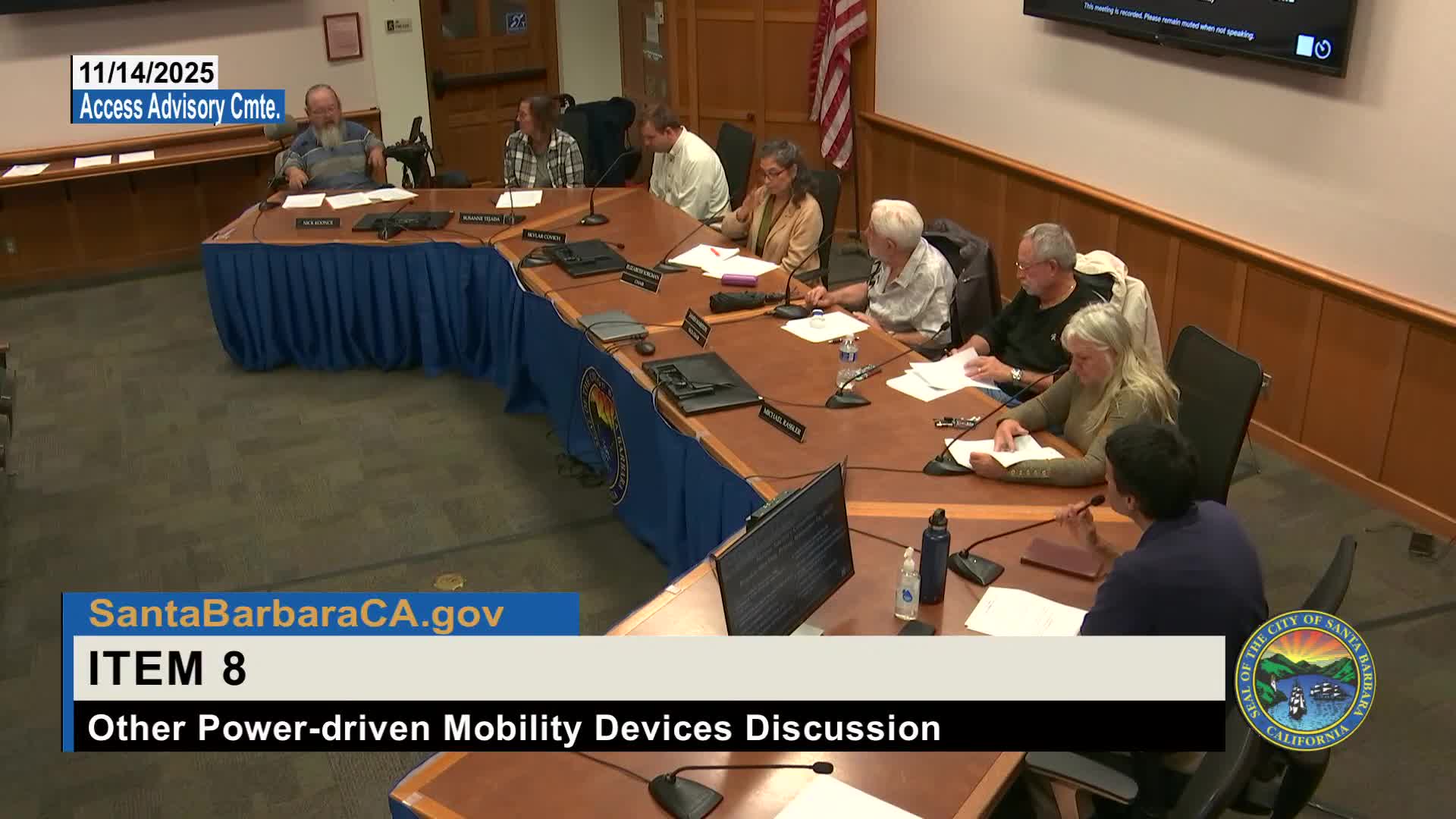
Koons framed the proposal with federal ADA principles: "Under federal ADA regulations, OPDMDs are powered mobility devices used by people with mobility disabilities that fall outside of the traditional wheelchair definition," and said a policy would protect access for residents with mobility disabilities while giving staff clear operational guidance.
The draft proposes a five‑factor style assessment to determine when restrictions are justified — considering device size/weight/speed, pedestrian volumes, facility characteristics, legitimate safety needs, and environmental/resource impacts — and suggests operational steps such as stakeholder outreach, input from the city attorney, and limited verification options that do not require medical documentation (for example, a placard, state ID, or verbal attestation described as "credible assurance").
Committee members raised privacy concerns about verification methods and discussed examples where visible and nonvisible disabilities require different approaches. Members suggested providing an optional identification card or sticker as an educational tool and recommended the city coordinate with police, parks, recreation and waterfront staff and external stakeholders (beach and private‑park operators) before adopting enforceable rules.
The committee voted unanimously to direct staff to continue stakeholder outreach, consult departmental partners and the city attorney, and return with feedback and recommended next steps.
Why it matters: the policy effort is intended to reduce enforcement confusion, protect access for people who need nontraditional mobility devices, and limit inappropriate restrictions on legitimate assistive devices while balancing public safety considerations.
Next steps: staff will share the draft broadly with internal departments and external stakeholders, bring back departmental feedback and legal guidance, and return to the committee with a recommended draft ordinance or policy language for council consideration.
Don't Miss a Word: See the Full Meeting!
Go beyond summaries. Unlock every video, transcript, and key insight with a Founder Membership.
30-day money-back guarantee
Sponsors
Proudly supported by sponsors who keep California articles free in 2025

