Council restricts city support for some "safe supply" items after heated debate
November 15, 2025 | Seattle, King County, Washington
This article was created by AI summarizing key points discussed. AI makes mistakes, so for full details and context, please refer to the video of the full meeting. Please report any errors so we can fix them. Report an error »
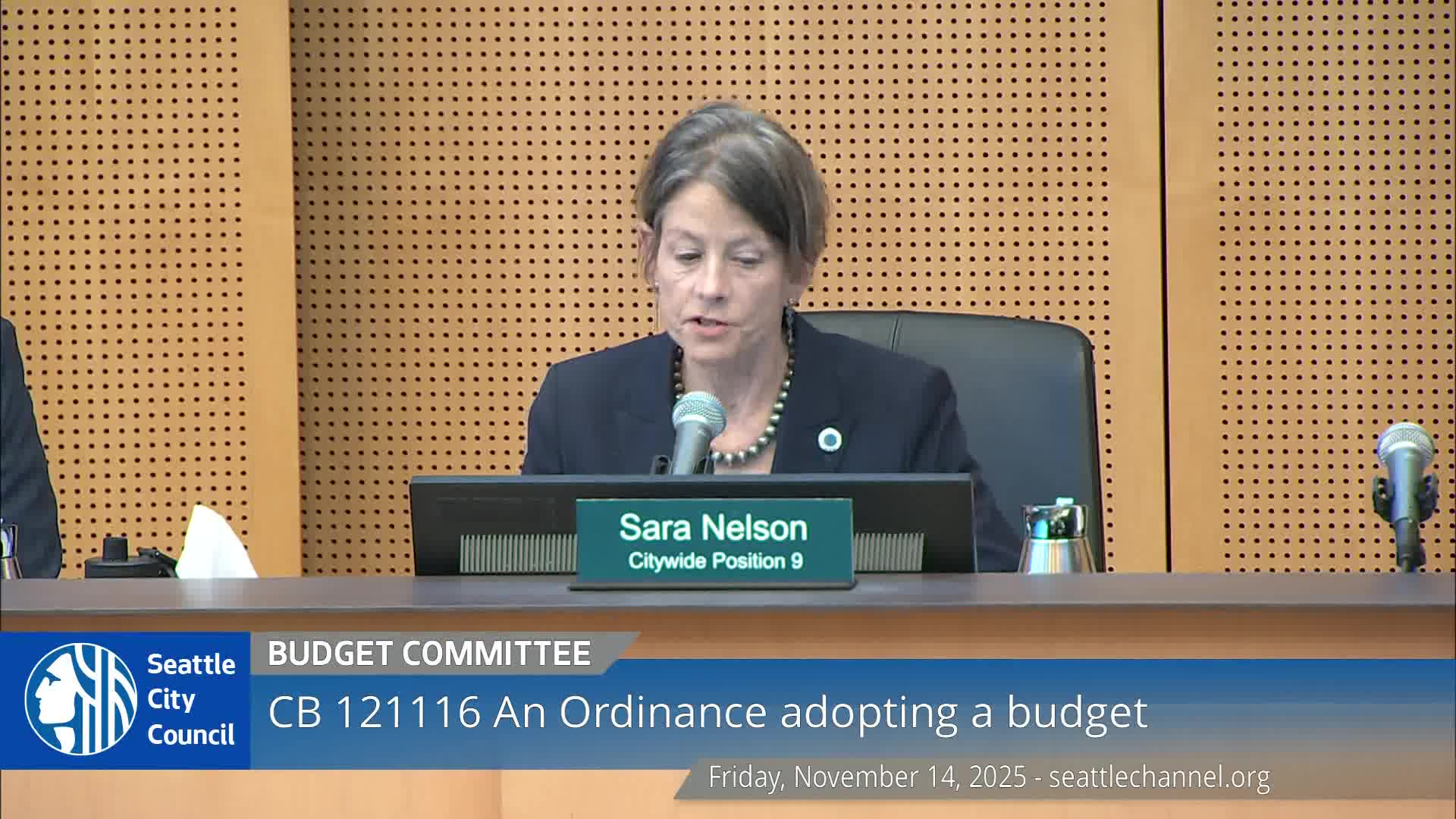
Council President Lorena Nelson, sponsor of HSD 57a1, said she supports needle-exchange programs because they reduce disease transmission but opposed distributing items "such as pipes and foil, that are used to consume deadly drugs like meth and fentanyl." Nelson cited local overdose figures to make the public-safety case: "There were 570 overdose deaths in Seattle last year and 1,047 in King County," she said.
Supporters of harm-reduction approaches have argued distribution of certain supplies can build rapport with people who use drugs and link them to treatment. Councilmember Hollingsworth said she was not an expert and chose to abstain but urged stronger coordination with King County public-health services to ensure rapid treatment access.
What the council did: The clerk called the roll on HSD 57a1. The vote recorded five yes (Kettle, Nelson, Rivera, Saka, Solomon), three no (Juarez, Rink, Chair Strauss) and one abstention (Hollingsworth). The amendment passed and the city budgeting instructions now limit the city's ability to fund distribution of certain consumption supplies while continuing support for needle-exchange programs.
Why it matters: The amendment touches on the city's overdose-prevention strategy, opioid-settlement spending, and how local public-health efforts balance immediate overdose risk against long-term treatment engagement. Councilmembers asked public-health agencies for data on whether distribution of specific supplies leads to higher treatment uptake; sponsors and skeptics both said evidence and reporting on outcomes are limited.
Next steps: The proviso will be attached to council bill 121116. Councilmembers who raised concerns asked central staff and public-health partners for additional reporting so future budget decisions can be better informed by outcomes data.
Vote details: HSD 57a1 passed 5-3 with one abstention. The clerk recorded the roll-call vote.
Don't Miss a Word: See the Full Meeting!
Go beyond summaries. Unlock every video, transcript, and key insight with a Founder Membership.
30-day money-back guarantee
Sponsors
Proudly supported by sponsors who keep Washington articles free in 2025

