Grand Rapids mobility workshop outlines 20‑year blueprint, pushes short-term pilots and equity data collection
November 14, 2025 | Grand Rapids City, Kent County, Michigan
This article was created by AI summarizing key points discussed. AI makes mistakes, so for full details and context, please refer to the video of the full meeting. Please report any errors so we can fix them. Report an error »
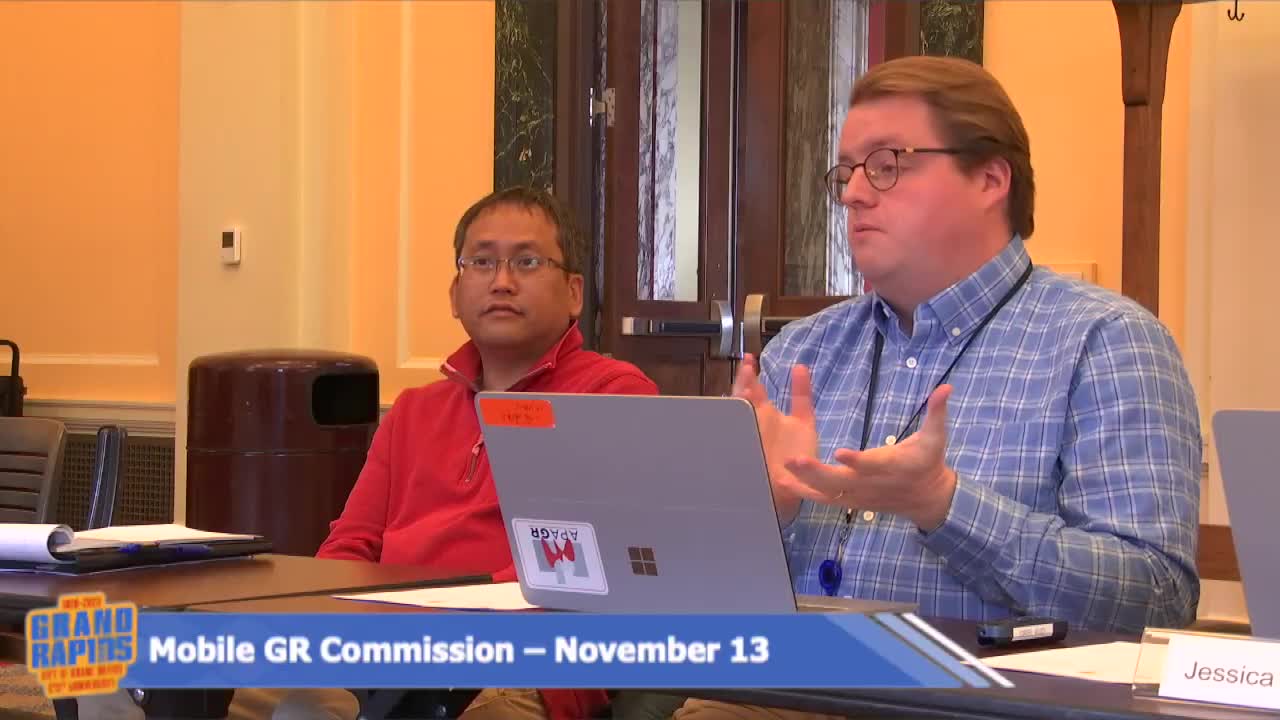
The city attorney’s office, represented in the meeting by Michael, reminded commissioners that the body’s role is advisory. "Your actions are nonbinding, but they are important," Michael said, urging commissioners to submit questions to the city attorney’s office for clarification of scope.
A planning consultant (Speaker 8) explained the plan’s structure and timeline: "A long range plan is typically a 20 year planning horizon," the consultant said, adding that an "implementable" mobility plan should produce a capital project list and a realistic capital-investment program (a 10‑year investment view with a 5‑year capital plan and a three‑year refresh). The consultant said consultant procurement could take six‑to‑eight weeks and that plan development typically requires about 18 months plus roughly six months for adoption and external review.
Commissioners repeatedly pushed for the blueprint to do two things: (1) create a clear, data‑driven prioritization method for capital projects and (2) identify short-term, lower‑cost pilot projects to demonstrate viability. "We recommend x, we want y," one long-serving participant (Speaker 5) said, urging the commission to produce explicit recommendations that staff could brief to the city commission.
The workshop probed trade-offs between long-term planning and immediate action. Several commissioners and participants favored "quick-build" pilots — reversible, lower‑cost installations such as temporary protected bike lanes, Jersey‑barrier treatments, rumble strips, or pop‑up bus lanes — as a way to test designs, build public confidence and gather usage data. One participant described quick builds as a way to "prove viability" by letting residents experience a change before permanent construction.
Policy and equity were central themes. Commissioners asked the blueprint to include explicit equity lenses (income, ability, aging populations) and better data collection (bike counts, demographic mode‑use data). "When you design for those most in need, quite often so many more of us benefit from that," one commissioner (Speaker 10) said, invoking ADA‑level accessibility as a baseline. Another commissioner argued that combining housing and transportation costs would provide a more accurate affordability measure: "If I can eliminate a car in my life, I've eliminated $10,000 a year in cost," Speaker 5 said.
Technical and legal constraints came up as well. Speakers noted that some enforcement and automated technologies are limited by state law, meaning the city may need to pair local pilots with advocacy for state‑level changes before full deployment. Participants also suggested pursuing federal and state grant opportunities and identified an immediate need to define prioritization criteria so any additional funding is targeted.
Several concrete near‑term recommendations emerged from the discussion: include temporary or pilot projects in the capital pipeline, create a prioritization rubric to guide engineering and capital decisions, pilot a connected corridor or loop (rather than isolated segments) to produce measurable results, and invest in communications and wayfinding so residents know what has changed and how to use new facilities.
The workshop closed with staff committing to compile feedback and return to the commission in a subsequent meeting with short‑term recommendations and a path for procuring consultants and scoring projects. There were no public comments at the session.
What happens next: staff will summarize the workshop feedback, scope consultant work, and propose near‑term pilot candidates and a prioritization method for the commission and city commission to consider.
Don't Miss a Word: See the Full Meeting!
Go beyond summaries. Unlock every video, transcript, and key insight with a Founder Membership.
30-day money-back guarantee
Sponsors
Proudly supported by sponsors who keep Michigan articles free in 2025

