PPS says its K–5 curriculum aligns with science of reading; staff outline dyslexia screening and teacher training progress
November 14, 2025 | Portland SD 1J, School Districts, Oregon
This article was created by AI summarizing key points discussed. AI makes mistakes, so for full details and context, please refer to the video of the full meeting. Please report any errors so we can fix them. Report an error »
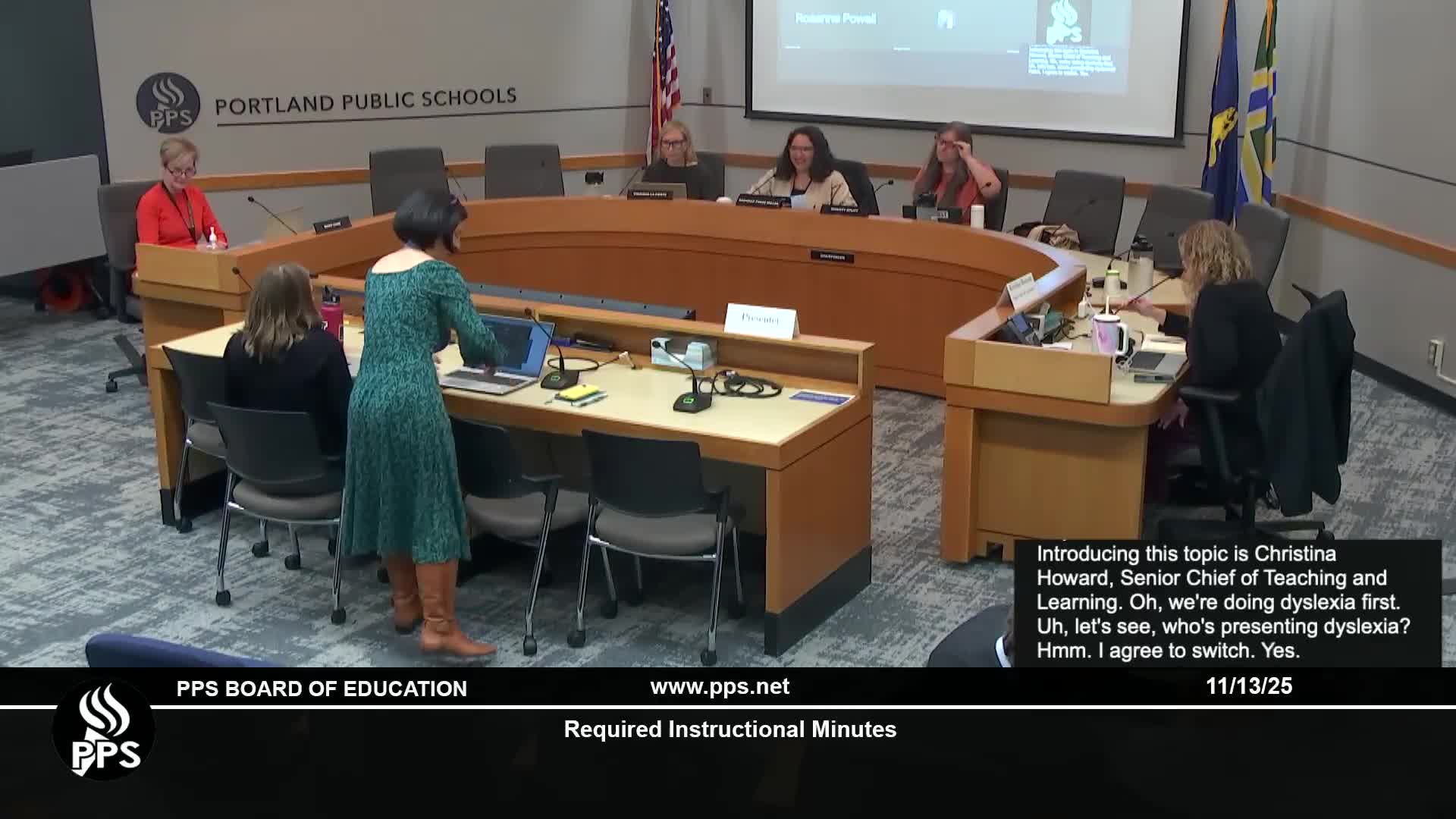
Emily Glasgow, senior director for PreK–5 academics, said PPS has “come to a place where we absolutely do” align core K–5 instructional materials with the science of reading and uses Scarborough’s Rope as a framework for explicit instruction in phonemic awareness, phonics and other foundational skills.
Elizabeth Martin, assistant director for academic intervention, walked the committee through the state requirements and PPS practice. She said kindergarten students and district newcomers in grade 1 are screened using MAP Reading Fluency; as students progress into connected text, staff use adaptive oral reading to capture oral reading fluency and comprehension. “One thing to note about that flag though is that it's not identifying dyslexia, but it could be identifying a potential reading difficulty,” Martin said.
How screening and supports work
Martin said MAP Reading Fluency flags students who fall at or below the 10th percentile nationally, but PPS additionally monitors students below the 40th percentile to provide earlier intervention. For students flagged in the lowest tiers, PPS deploys academic interventionists who deliver intensive, often daily, small‑group or one‑on‑one instruction for 30–45 minutes per session.
On teacher training, Martin said the district has more than 350 educators who have completed ODE‑listed dyslexia training and that PPS has trained two teachers per K–5 or K–8 building in earlier state‑funded reimbursement phases. “It has to be from the Oregon Department of Education list as well, and it covers 3 key areas,” she said, listing recognition of dyslexia, foundational best practices for teaching reading, and intensifying instruction for severe needs.
Supports beyond elementary
Board members asked how the district supports older students whose dyslexia or reading difficulty was not identified earlier. Martin described middle‑school intervention classes that teach decoding adapted for older students and provide vocabulary and connected‑text work; high school accommodations such as audio versions of texts and intervention courses are also available.
Staff said training once funded by the state became a locally budgeted responsibility after reimbursement ended, and that PPS continues to pay teachers for training time (substitutes or extended hours) and uses a mix of trainings including LETRS and online programs such as Reading Expert Training from Ashlock Consulting.
What remains to be detailed
Board members asked for clarity on how dyslexia content is incorporated into broader science‑of‑reading professional development and whether the district can consolidate training lists. Staff said some dyslexia content is not fully covered by science‑of‑reading modules and that annual presentations (for Dyslexia Awareness Month) and additional training help fill gaps. Data collection, screening cadence and the MTSS monitoring process were described as current practices with room for iterative improvement.
Don't Miss a Word: See the Full Meeting!
Go beyond summaries. Unlock every video, transcript, and key insight with a Founder Membership.
30-day money-back guarantee
Sponsors
Proudly supported by sponsors who keep Oregon articles free in 2025

