Chautauqua County Audit & Control Committee approves 18 resolutions including Bridge NY design, public‑health budget moves and JCC–YMCA design funding
November 14, 2025 | Chautauqua County, New York
This article was created by AI summarizing key points discussed. AI makes mistakes, so for full details and context, please refer to the video of the full meeting. Please report any errors so we can fix them. Report an error »
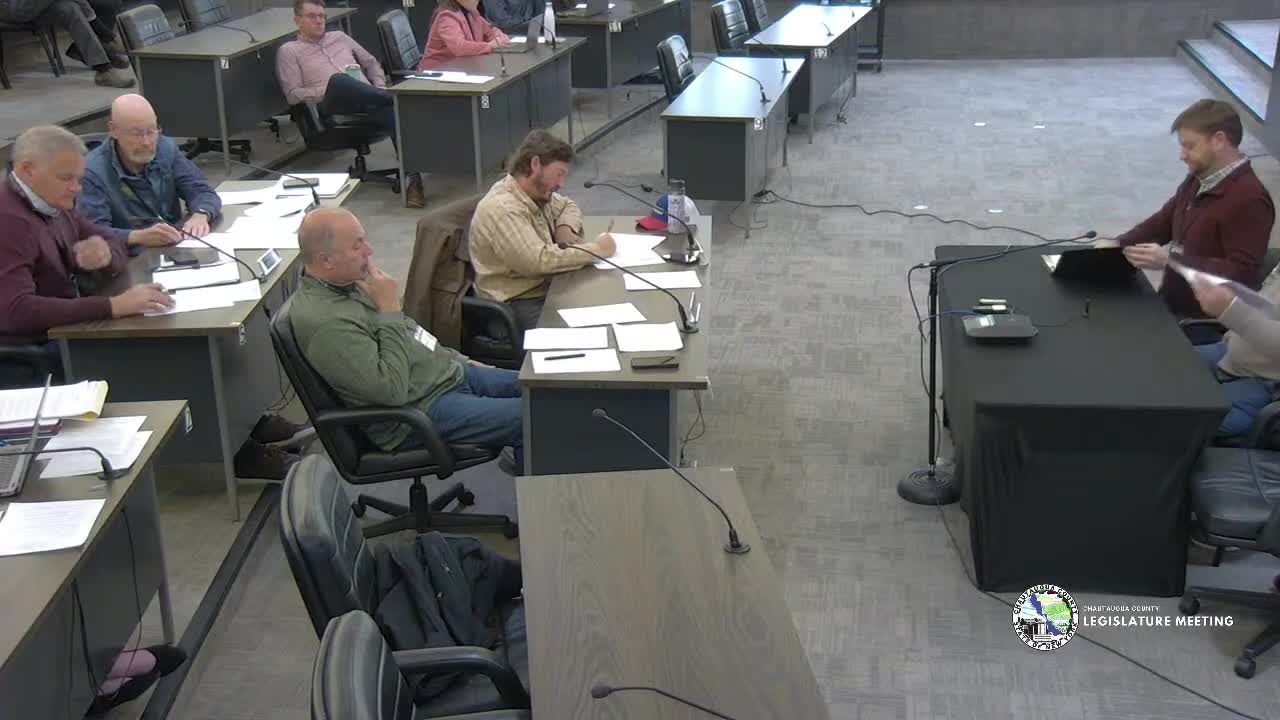
Among the highest‑profile items, county public‑facilities staff received authorization to enter the engineering phase of a Bridge NY project (PIN 576530) to replace the superstructure on County Bridge 920. Drew Rogers, deputy director of public facilities, said the design phase is budgeted at $350,000 and is part of an overall project estimated around $2.5 million; the program is about 95 percent federally funded with a five percent local match. Rogers said the design work will include environmental studies and preliminary and final engineering, and that any costs beyond the awarded $2.5 million would require a later funding decision by the county.
The committee also approved a public‑health budget amendment to shift $540,000 in appropriations within the 2025 public‑health budget to cover program overruns. Mike Falk, the county’s chief medical officer, told the committee that rising demand for medication‑assisted treatment (MAT) in the county jail has driven much of the increase and that the county currently has about "65 individuals on medication assisted treatment." Falk said many county patients are receiving long‑acting injectable medications that can cost roughly $1,500 per person per month; officials said they plan operational changes and to use $750,000 in opioid‑settlement funds in 2026 to offset some costs as they explore safer, lower‑cost oral options and better post‑release follow‑up.
In public‑safety funding, the sheriff’s office presented and the committee approved acceptance of a New York State Office of Homeland Security Next‑Generation 911 grant of $1,515,197. The sheriff’s office representative said the funds will prepare county dispatch for the state’s migration to the Vesta call‑handling system and pay for updated call recording servers and related infrastructure; the entire amount will be added to the 2025 budget and encumbered in 2025.
On settlement and liability, Kristen Wright of the county law department summarized a recommendation to settle a sensitive, older claim that dates to the 1970s. Wright said the county is not admitting liability but, after depositions and a credibility and litigation‑cost assessment, recommends settling for the amount stated in the resolution. The committee voted to approve the settlement.
County leaders also approved county participation in design funding for a joint Jamestown Community College–YMCA wellness complex. Representatives from JCC and the YMCA described a multi‑phase, roughly $45 million project; officials said SUNY has funded part of the design and asked the county to contribute its share of the design appropriation (about $195,000 of an estimated $1.56 million total design cost) so the design can proceed on a phased basis.
Other approved actions included: an amended resolution to transfer a tax‑foreclosed parcel in conformance with county policy (requiring the receiving municipality to pay unpaid back taxes rather than receive the parcel for $1); a budget correction moving interest expense into the proper account after issuance of bonds; annual mortgage‑tax distributions to municipalities; a lease with the City of Jamestown to collocate mental‑health, homeless and mobile‑crisis teams in city office space; a small award to the Office for Aging; EMS and sheriff’s‑office budget amendments; and several intermunicipal contracts for enhanced police protection and court security services beginning in 2026.
A handful of members raised operational questions but there were no recorded roll‑call tallies in the transcript; votes were taken by voice and the chair stated each resolution was carried. Staff repeatedly noted that some figures — for example, total unpaid taxes on a specific foreclosed parcel and exact future settlement amounts or future opioid settlement flows — would be determined by the appropriate offices or are subject to change.
After the votes the chair invited members to remain for an external presentation that was scheduled at the airport. The committee then adjourned.
Sources: meeting transcript of the Chautauqua County Audit & Control Committee Nov. 13 meeting; statements by county staff and outside presenters recorded in the public transcript.
View the Full Meeting & All Its Details
This article offers just a summary. Unlock complete video, transcripts, and insights as a Founder Member.
30-day money-back guarantee
Sponsors
Proudly supported by sponsors who keep New York articles free in 2025

