Mobile County opens 2026 HUD action-plan public hearing; CDBG applications to be posted Nov. 25
November 14, 2025 | Mobile County, Alabama
This article was created by AI summarizing key points discussed. AI makes mistakes, so for full details and context, please refer to the video of the full meeting. Please report any errors so we can fix them. Report an error »
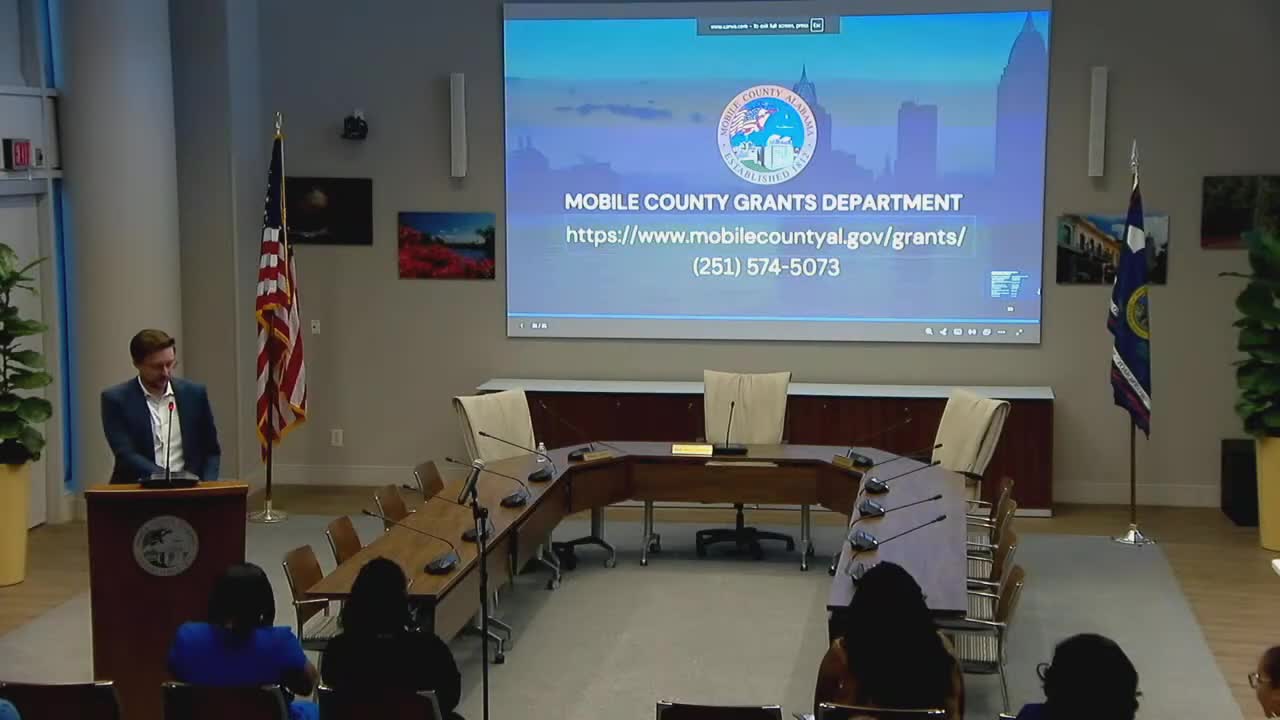
"This is the county's 2026 annual action plan public hearing," said Gordon Bauer, director of grants for Mobile County, introducing the application workshop and the roles county staff will play in assisting applicants. Bauer said the county estimates "just under $1.6 million" in CDBG funding and about "$575,000" in HOME funding for the coming program year; he reiterated that Mobile County does not regularly qualify for Emergency Solutions Grants (ESG) under HUD's formula and does not expect ESG this year.
Why this matters: CDBG and HOME dollars finance a range of local programs, from nonprofit public services to affordable-housing development and capital projects such as roads and senior centers. The county uses the annual action plan to identify local needs, propose activities, and estimate the number of residents who will benefit.
Bauer reviewed program rules and caps applicants should expect in the posted materials. For CDBG he said the county will follow the standard caps: up to 20% for administration, 15% for public services and the remainder for capital improvements, and that at least 70% of CDBG-funded activities must serve low- and moderate-income (LM) residents. Based on the county's estimate of roughly $1.6 million in CDBG funds, 15% for public services would equal about $240,000 in the coming program year.
On HOME funding, Bauer said the county sets 10% for administration and 15% for CHDOs (community housing development organizations), with the remainder used for housing activities. He cited recent projects funded with HOME or CDBG, including Cleveland House (a disability services center in Saraland), East Elm Street road work in Prichard, and three affordable housing developments—Legacy Trail, Azalea Landing and Camellia Square—each described as 56-unit projects with rent caps for 20-plus years.
Bauer said the county has expanded its down-payment assistance program: "We've increased it to 25,000," an amount the county reports helped 14 households buy homes over the past year. He also described a separate HDPA program financed with one-time Hurricane Sally and Zeta disaster funds (2020) that provides up to $50,000 toward home purchase for residents who lived in Mobile County at the time of those storms; homes financed through that program must be in the county, not within the City of Mobile.
On application mechanics, Bauer said: CDBG applications will be posted online Nov. 25; applications will be due in January; county staff will conduct an internal review and scoring process across roughly two months; and the county plans a second public hearing in early March to present proposed uses. The meeting transcript contained inconsistent wording about the exact sequence of the public comment window and Commission adoption (speakers referenced April and May in quick succession); Bauer told attendees that formal dates and the public comment period will be posted with the application materials.
Bauer and staff answered attendee questions about eligibility and reimbursement. He said nonprofit vehicle purchases to transport eligible county beneficiaries can qualify as public service expenses if the vehicle is for organizational client transport (not for an individual's personal use), and that most program reimbursements operate on a draw basis (applicants submit monthly draw requests or expense tracking for reimbursement). He also listed application certification requirements that will appear in the posted materials, including recent audits, conflict-of-interest and anti-lobbying certifications, and proof of 501(c)(3) status for nonprofit applicants.
Bauer cautioned that ESG allocations are formula-driven and unpredictable: the county has qualified twice in the past 10 years and the county typically learns whether it will receive ESG by spring, though timing has varied. He also clarified that projects may combine multiple funding sources but cannot charge the same cost to two different grants.
Next steps: the county will post application packets Nov. 25, accept CDBG applications with a January deadline, complete an internal review over about two months, hold a second public hearing in early March, publish a public comment period and then seek Commission consideration and submission to HUD; final, exact dates will appear in the posted application materials. County staff provided contact information and offered to assist applicants.
The public hearing concluded with staff announcing door-prize drawings for sign-in participants and closing remarks.
View the Full Meeting & All Its Details
This article offers just a summary. Unlock complete video, transcripts, and insights as a Founder Member.
30-day money-back guarantee
Sponsors
Proudly supported by sponsors who keep Alabama articles free in 2025

