Anne Arundel parents, students and researchers urge board to drop plan to split Nantucket community
November 14, 2025 | Anne Arundel County Public Schools, School Boards, Maryland
This article was created by AI summarizing key points discussed. AI makes mistakes, so for full details and context, please refer to the video of the full meeting. Please report any errors so we can fix them. Report an error »
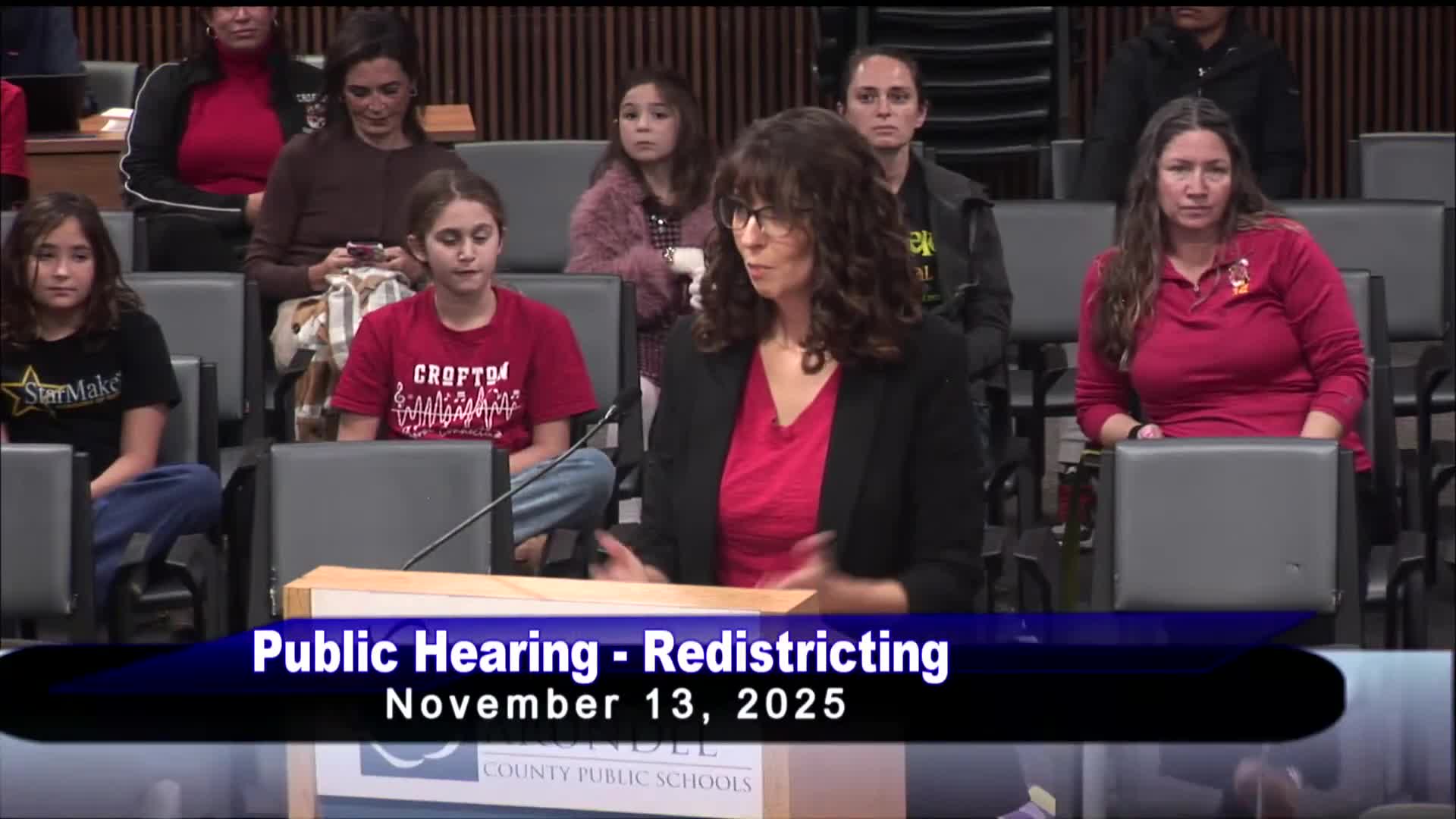
Parents and students delivered emotional accounts of disrupted friendships, lost extracurricular participation and added travel across hazardous routes. "The fastest way to build trust is to show a willingness to make new choices when better information becomes available," Rebecca James said, urging the board to reconsider in light of newly surfaced evidence. Fifth grader Connor said plainly, "Split articulation gives us no community." Several speakers asked the board to allow legacy options for rising fifth and eighth graders and for juniors and seniors to finish at their current high school if moves are unavoidable.
A recurring factual dispute centered on how state capital funding is calculated. Citizens who researched the issue reported email and phone verification from the Interagency Commission on School Construction (IAC) and cited COMAR and IAC guidance, arguing that available seats at adjacent schools (underutilization) — not an overcapacity condition at Crofton High — determine eligibility for some funding. "No negative impact on any other school's funding," Jessica Weider told the board, summarizing her group's exchange with the IAC. Community presenters estimated the state's additional funding gain tied to the proposed changes at about $1.5 million; because the county would be responsible for a roughly 50% match, speakers said the county contribution would approach $1.5 million as well.
Speakers, including parents and researchers, pressed district staff statements they described as inconsistent. Students and parents quoted differing explanations given at prior meetings by AACPS staffers about whether moving students would be required to unlock funding for Arundel Middle or other projects. "We've attempted to corroborate that statement, and tonight we've showed that it is false," Crofton sophomore Ryan Caminiti said in reference to staff remarks. Other commenters, however, voiced support for the board's revised recommendation (BR-3), saying the board's process involved data on bus routes, safety and minimizing disruption and asked the board to finalize a plan to provide certainty to families.
Public-safety concerns were raised repeatedly. Multiple speakers cited Route 3 and Ritchie Highway congestion and said proposed reassignments would force students into dangerous crossings and less-safe bus routings. Dr. Clark Petrie, an active-duty Navy commander, urged the board to avoid late-stage map changes that would introduce hazardous left-turn commutes for families.
Researchers and advocates highlighted peer-reviewed and meta-analytic studies showing mobility can depress test-score gains and increase risks of grade retention. Several called for narrowly tailored protections — for example, allowing juniors to finish at their current high school if reassigned — as a mitigation if the board proceeds.
Board staff opened the hearing by saying the board is scheduled to vote on adoption later this month and that the adopted plan would take effect in the 2026-2027 school year. The board announced a second public hearing on Phase 2 redistricting set for Monday, Nov. 17 at 6 p.m. before taking further action.
What happens next: the board has signaled it will vote later this month; community members asked trustees to remove the split-articulation amendment and to restore legacy options for specific grade cohorts while the district clarifies how state funding rules apply.
Don't Miss a Word: See the Full Meeting!
Go beyond summaries. Unlock every video, transcript, and key insight with a Founder Membership.
30-day money-back guarantee
Sponsors
Proudly supported by sponsors who keep Maryland articles free in 2025

