HWMA considers 3% or 5% 457 match but defers decision to January
November 14, 2025 | Humboldt County, California
This article was created by AI summarizing key points discussed. AI makes mistakes, so for full details and context, please refer to the video of the full meeting. Please report any errors so we can fix them. Report an error »
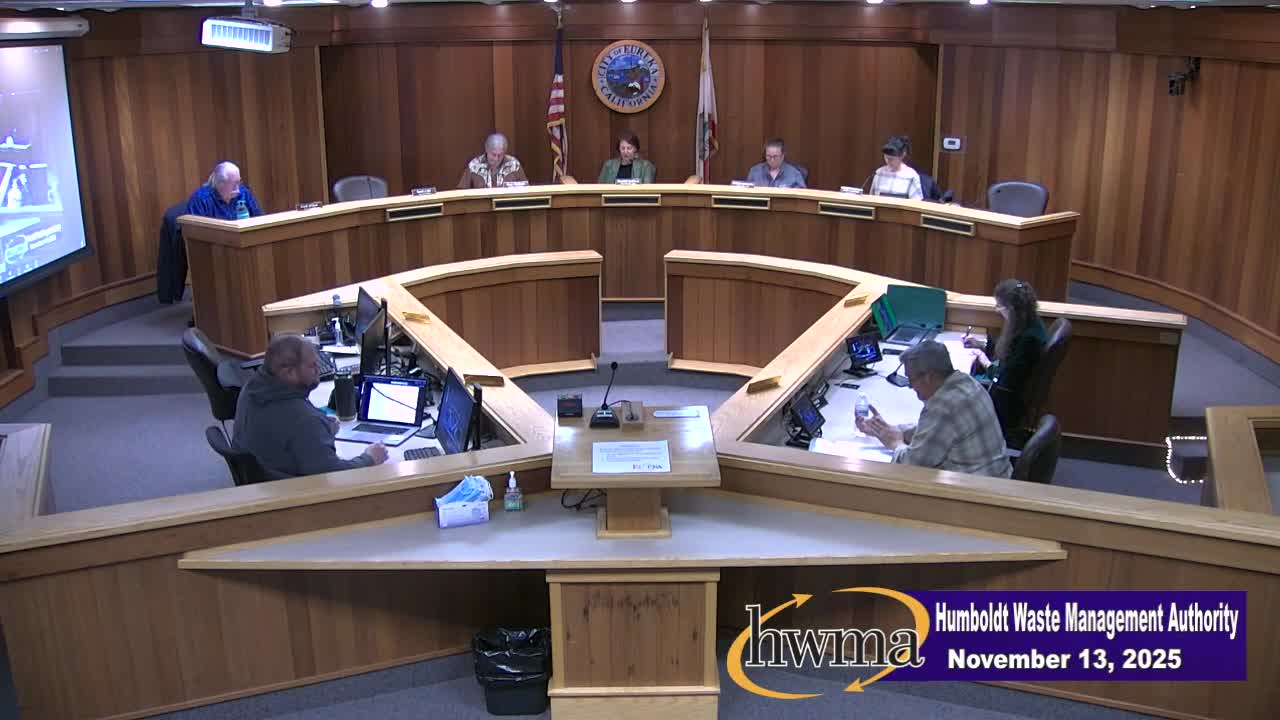
Staff reminded the board that HWMA employees participate in CalPERS (with classic and PEPRA classifications) and that the 457 plans are voluntary supplemental retirement accounts. Staff presented participation data showing 30 filled FTE positions out of 35 authorized, with 11 employees currently participating in available 457 plans (about 37%). The internal staff poll identified two employees who would participate regardless of a match and four additional staff who would join only if an employer match were offered.
Staff proposed two illustrative match levels: a 3% employer match and a 5% employer match. Using a $50,000 salary as an example, staff said a 3% match would equal $1,500 annually for that employee and a 5% match would equal $2,500. Staff presented modeled cost scenarios that assumed full participation and noted the absolute “maximum impact” under some scenarios (a figure cited by staff as about $62,000 for a modeled 3% full‑participation case). Staff warned that because the authority budgets to collect costs through the tip fee, any ongoing match would ultimately be reflected in tipping fees unless alternative reserves were used.
Directors expressed competing priorities. Director Castellano said she could not responsibly ask ratepayers to absorb another increase so soon after recent rate hikes. Other directors argued a modest match could reduce turnover and long‑term training and onboarding costs, and one director proposed a two‑step approach of starting with a 3% match and monitoring enrollment. Several directors favored pausing until the board receives the organics feasibility update and draft budget language in January. Chair and staff confirmed that, if the board decides to move forward, staff will return with draft policy language no later than the January meeting.
Because the board did not approve a match at this meeting, there is no immediate change to employee benefits. The board left open the option to pilot a match using the board’s $150,000 employee benefit and rate stabilization reserve if members choose that path in the future.
Don't Miss a Word: See the Full Meeting!
Go beyond summaries. Unlock every video, transcript, and key insight with a Founder Membership.
30-day money-back guarantee
Sponsors
Proudly supported by sponsors who keep California articles free in 2025

